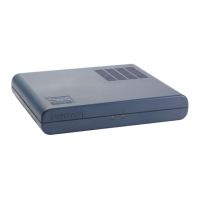
Watson SHDSL Router
Operating Manual
Watson-SHDSL-Router-Manual.doc
Version 1.0-03
802.1p Priority
The matching of packets by rules is connection-based, known as Stateful Packet Inspection (SPI),
using the same connection-tracking mechanism used by the firewall. Once a packet matches a rule,
all subsequent packets with the same attributes receive the same QoS parameters, both inbound
and outbound.
3.4.2 Traffic Shaping
Traffic Shaping is the solution for managing and avoiding congestion where a high speed LAN
meets limited broadband bandwidth. A traffic shaper is essentially a regulated queue that accepts
uneven and/or bursty flows of packets and transmits them in a steady, predictable stream so that
the network is not overwhelmed with traffic.
While Traffic Priority allows basic prioritization of packets, Traffic Shaping provides more sophisti-
cated definitions. Such are:
Bandwidth limit for each interface
Bandwidth limit for classes of rules
Prioritization policy
TCP serialization
3.4.3 Traffic Shaping
The bandwidth of an interface can be divided in order to reserve constant portions of bandwidth to
predefined traffic types. Such a portion is known as a Traffic Class. When not used by its prede-
fined traffic type, or owner (for example VoIP), the bandwidth will be available to all other traffic.
However when needed, the entire class is reserved solely for its owner. Moreover, you can limit the
maximum bandwidth that a class can use even if the entire bandwidth is available.
3.4.4 Differentiated Services Code Point (DSCP)
Differentiated Services (DiffServ) is a Class of Service (CoS) model that enhances best-effort Inter-
net services by differentiating traffic by users, service requirements and other criteria. Packets are
specifically marked, allowing network nodes to provide different levels of service, as appropriate for
voice calls, video playback or other delay-sensitive applications, via priority queuing or bandwidth
allocation, or by choosing dedicated routes for specific traffic flows.
DiffServ defines a field in IP packet headers referred to as DSCP. Hosts or routers passing traffic to
a DiffServ-enabled network will typically mark each transmitted packet with an appropriate DSCP.
The DSCP markings are used by DiffServ network routers to appropriately classify packets and to
apply particular queue handling or scheduling behavior.
Watson SHDSL router provides a configurable table of predefined DSCP values, which are mapped
to 802.1p priority marking method.
3.4.5 IEEE 802.1p priority
The IEEE 802.1p priority marking method is a standard for prioritizing network traffic at the data
link/Mac sub-layer. 802.1p traffic is simply classified and sent to the destination, with no bandwidth
reservations established.
The 802.1p header includes a 3-bit prioritization field, which allows packets to be grouped into eight
levels of priority. Watson SHDSL router maps these eight levels to three main priorities: high, me-
3-8 Revision: 2007-05-24


 To Next Page