EasyManua.ls Logo

Sealey FJ48 - User Manual

Sealey FJ48
2 pages
Print Icon
To Next Page IconTo Next Page
Loading...
1.1. GENERAL SAFETY
3 Visually and operationally inspect Jack before each use, ensure it is sound. Take action for immediate repair or replacement of
damaged parts. Use genuine parts only. The use of improper parts may be dangerous and will invalidate the warranty.
p WARNING! If any part of Jack fails to work properly, discontinue and have repaired. Never attempt to repair Jack while Jack is under load.
p WARNING! Ensure Jack to supported on suitable base so it will not slip or shift during operations and load is properly supported at lift
point to prevent shifting. If required, use appropriately rated clivis pins, chains, bolts, ropes etc, through beam holes to assist operation.
3 Place complete lifting beak of jack under object to be lifted. You can pull lifting beak up to the point of lift (or strain) without pumping handle.
3 Always lock and/or stabilise load to be lifted. The Jack will not act as a load stabiliser.
3 Always keep firm grip on pumping handle and support beam.
3 All persons shall be clear of load being raised, lowered or pulled. Never work under a raised load unless using additional supports
and insert 1/2 bolt (not included) through hole in steel beam immediately below lifting mechanism, (to act as a safety pin).
p WARNING! if you exceed rated capacity at the height of one foot, the shear pin will break and the handle will drop.
3 Jack must have a 50kg load or more to activate the lowering step by step, otherwise lifting beak will drop.
3 Ensure there are no persons or obstructions beneath a load before lowering.
s DANGER! DO NOT use additional devices on handle to provide extra leverage. Use hand power only.
7 DO NOT operate the jack if damaged.
7 DO NOT exceed the rated capacity of the jack.
p WARNING! DO NOT place an excessive strain on load, equipment or supports when using jack for pulling or tensioning.
7 DO NOT push lifted load off Jack.
s DANGER! DO NOT use the jack for purpose other than for which it is designed.
3 Put handle in upright position before tripping the reversing latch to lower load.
3 KEEP JACK CLEAN AND OILED. Front and back of rail must be kept rust free. Store in a safe, dry childproof area.
1.2. WHEN USED TO JACK A VEHICLE
O IMPORTANT: Apply appropriate safety features as mentioned in 1.1. above with the following additions or exceptions:
3 Place wedges under wheels of vehicle.
3 Ensure the vehicle handbrake is engaged, engine is switched off and transmission is in gear (or PARK if automatic).
3 Ensure minimum distance of 0.5m between vehicle and static objects such as doors, walls, etc.,
to allow for vehicle tilting.
3 Ensure there are no passengers in the vehicle.
3 Only place jack under those lifting points recommended by vehicle manufacturer (see vehicle hand book).
3 Check the lifting point is stable and correctly positioned on the lifting beak.
p DANGER: Use the jack for lifting only, NOT for supporting the lifted load.
3 Use suitable capacity axle stands under the vehicle before proceeding with any task.
3 Ensure there are no persons or obstructions beneath the vehicle before lowering.
7 DO NOT jack vehicle if there is a risk of spillage of fuel, battery acid, or other dangerous substances.
7 DO NOT work under the vehicle until axle stands have been correctly positioned.
7 DO NOT allow the vehicle to move while supported by the jack, or use the jack to move the vehicle.
INSTRUCTIONS FOR:
FARM JACK
MODEL:
FJ48
Your new Jack is produced and manufactured to a high standard of dependability and will, if used according to these instructions and properly
maintained, give you years of trouble free performance.
IMPORTANT: READ THESE INSTRUCTIONS CAREFULLY. NOTE THE SAFE OPERATIONAL REQUIREMENTS, WARNINGS AND CAUTIONS. USE
THIS JACK CORRECTLY AND WITH CARE FOR THE PURPOSE FOR WHICH IT IS INTENDED. FAILURE TO DO SO MAY CAUSE DAMAGE OR
PERSONAL INJURY AND WILL INVALIDATE THE WARRANTY. RETAIN THESE INSTRUCTIONS FOR FUTURE USE.
1. SAFETY PRECAUTIONS
FJ48 - 0016 - (1) - 150600
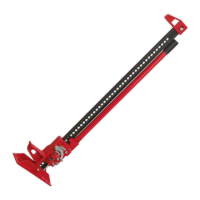
Heavy-duty lever-ratchet operated jack with 48" beam. Reversible
ratchet mechanism enables jack to be used for lifting or lowering.
Versatile and lightweight unit suitable for pulling tree-stumps and
tensioning fences as well as a positioning aid for heavy machinery.
Many units sold to 4WD owners
2. INTRODUCTION & SPECIFICATIONS
Specifications
Max Load . . . . . . . . . . . . . . . . . . . . . . . . . . . . .1000kg
Min height . . . . . . . . . . . . . . . . . . . . . . . . . . . .150mm
Max. height . . . . . . . . . . . . . . . . . . . . . . . . . .1200mm
Min lowering load . . . . . . . . . . . . . . . . . . . . . . . . .50kg
Weight . . . . . . . . . . . . . . . . . . . . . . . . . . . . . . . 13.6kg
Sole UK Distributor
Sealey Group,
Bury St. Edmunds, Suffolk.
01284 757500
E-mail: sales@sealey.co.uk
01284 703534

Question and Answer IconNeed help?

Do you have a question about the Sealey FJ48 and is the answer not in the manual?

Summary

Safety Precautions

General Safety Guidelines

Essential safety practices for operating the jack, covering inspection, load handling, and personal protection.

Vehicle Jacking Safety

Specific safety measures and requirements when using the jack to lift vehicles.

Product Introduction and Specifications

Technical Specifications

Detailed technical data for the FJ48 Farm Jack, including load capacity, height limits, and weight.

Operating Instructions

General Lifting Procedures

Step-by-step guide for jack operation, including lifting, lowering, and safety pin usage.

Parts List and Identification

Component Parts List

An itemized list of all replaceable parts for the FJ48 Farm Jack with their respective part numbers.

Compliance Information

Declaration of Conformity

Official statement confirming the product's compliance with relevant EEC standards and directives.

Summary

Safety Precautions

General Safety Guidelines

Essential safety practices for operating the jack, covering inspection, load handling, and personal protection.

Vehicle Jacking Safety

Specific safety measures and requirements when using the jack to lift vehicles.

Product Introduction and Specifications

Technical Specifications

Detailed technical data for the FJ48 Farm Jack, including load capacity, height limits, and weight.

Operating Instructions

General Lifting Procedures

Step-by-step guide for jack operation, including lifting, lowering, and safety pin usage.

Parts List and Identification

Component Parts List

An itemized list of all replaceable parts for the FJ48 Farm Jack with their respective part numbers.

Compliance Information

Declaration of Conformity

Official statement confirming the product's compliance with relevant EEC standards and directives.

Overview

The device described in the manual is a Sealey FJ48 Farm Jack, a heavy-duty lever-ratchet operated jack.

Function Description:

The Farm Jack FJ48 is designed for lifting and lowering operations, as well as for pulling and tensioning tasks. Its primary function is to provide mechanical advantage for raising heavy objects, such as vehicles, or for applying tension, for example, in pulling tree stumps or tensioning fences. It can also serve as a positioning aid for heavy machinery. The jack operates using a reversible ratchet mechanism, allowing it to be used for both lifting and lowering. The lifting beak, which engages with the object to be lifted, can be pulled up to the point of lift (or strain) without needing to pump the handle. Lowering requires a minimum load of 50kg to activate the step-by-step lowering mechanism; otherwise, the lifting beak will drop.

Important Technical Specifications:

  • Model: FJ48
  • Max Load: 1000kg
  • Min Height: 150mm
  • Max Height: 1200mm
  • Min Lowering Load: 50kg
  • Weight: 13.6kg
  • Beam Length: 48 inches (implied by "48" in model name and description)

Usage Features:

  • Lever-Ratchet Operation: The jack uses a handle and a ratchet mechanism for lifting and lowering. Pumping the handle downward (or forward for horizontal use) raises the load, while pushing the direction latch down and pumping the handle upward (or backward) lowers it.
  • Reversible Ratchet Mechanism: This feature enables the jack to be used for both lifting and lowering, making it versatile.
  • Versatile Applications: Beyond standard lifting, it's suitable for pulling tree stumps, tensioning fences, and positioning heavy machinery. It's also popular among 4WD owners.
  • Safety Pin Feature: For added safety when a load is raised, a 1/2" steel bolt (not supplied) can be inserted through a hole in the steel beam immediately below the lifting mechanism to act as a safety pin.
  • Direction Latch: A latch (fig 1.C) controls the direction of operation. Pulling it up engages the lifting mechanism, and pushing it down engages the lowering mechanism.
  • Load Engagement: The complete lifting beak (A) must be placed under the object to be lifted.
  • Handle Position: The handle should be held in an upright position (or parallel to the beam) and the clip (fig 1.G) engaged when the load is at the desired height or strain.
  • Minimum Lowering Load: A minimum load of 50kg is required to activate the step-by-step lowering mechanism. Without this load, the lifting beak will drop.

Maintenance Features:

  • Regular Inspection: Before each use, the jack must be visually and operationally inspected to ensure it is sound. Any damaged parts should be repaired or replaced immediately with genuine parts.
  • Lubrication: The jack should be kept clean and well lubricated.
  • Rust Prevention: The front and back of the rail must be kept rust-free.
  • Storage: Store the jack in a safe, dry, childproof area when not in use.
  • Repair: If any part of the jack fails to work properly, discontinue use and have it repaired. Never attempt to repair the jack while it is under load.

Safety Precautions (Integrated into Usage and Maintenance):

  • Always ensure the jack is supported on a stable base to prevent slipping or shifting.
  • The load must be properly supported at the lift point to prevent shifting.
  • Use appropriately rated clevis pins, chains, bolts, ropes, etc., through beam holes to assist operation if required.
  • Always lock and/or stabilize the load to be lifted; the jack does not act as a load stabilizer.
  • Maintain a firm grip on the pumping handle and support beam.
  • Ensure all persons are clear of the load during raising, lowering, or pulling.
  • Never work under a raised load without additional supports (e.g., axle stands and the 1/2" safety pin).
  • Do not exceed the rated capacity of the jack.
  • Do not use additional devices on the handle for extra leverage; use hand power only.
  • Do not operate the jack if damaged.
  • Do not place excessive strain on load, equipment, or supports when pulling or tensioning.
  • Do not push a lifted load off the jack.
  • Do not use the jack for purposes other than its design.
  • When jacking a vehicle, place wedges under wheels, engage the handbrake, switch off the engine, and put the transmission in gear (or "PARK").
  • Maintain a minimum distance of 0.5m between the vehicle and static objects.
  • Ensure no passengers are in the vehicle.
  • Only place the jack under vehicle manufacturer-recommended lifting points.
  • Check the lifting point is stable and correctly positioned on the lifting beak.
  • The jack is for lifting only, NOT for supporting the lifted load. Use suitable capacity axle stands under the vehicle before proceeding with any task.
  • Ensure no persons or obstructions are beneath the vehicle before lowering.
  • Do not jack a vehicle if there is a risk of spillage of fuel, battery acid, or other dangerous substances.
  • Do not work under the vehicle until axle stands have been correctly positioned.
  • Do not allow the vehicle to move while supported by the jack, or use the jack to move the vehicle.
  • Be aware that exceeding the rated capacity at one foot height will break the shear pin and cause the handle to drop.

Sealey FJ48 Specifications

General IconGeneral
BrandSealey
ModelFJ48
CategoryJacks
LanguageEnglish

Related product manuals