14 Safe driving
Correct adjustment of rear seat head restraints
Properly adjusted head restraints are an important part of
the passenger protection and can reduce the risk of injuries
in most accident situations
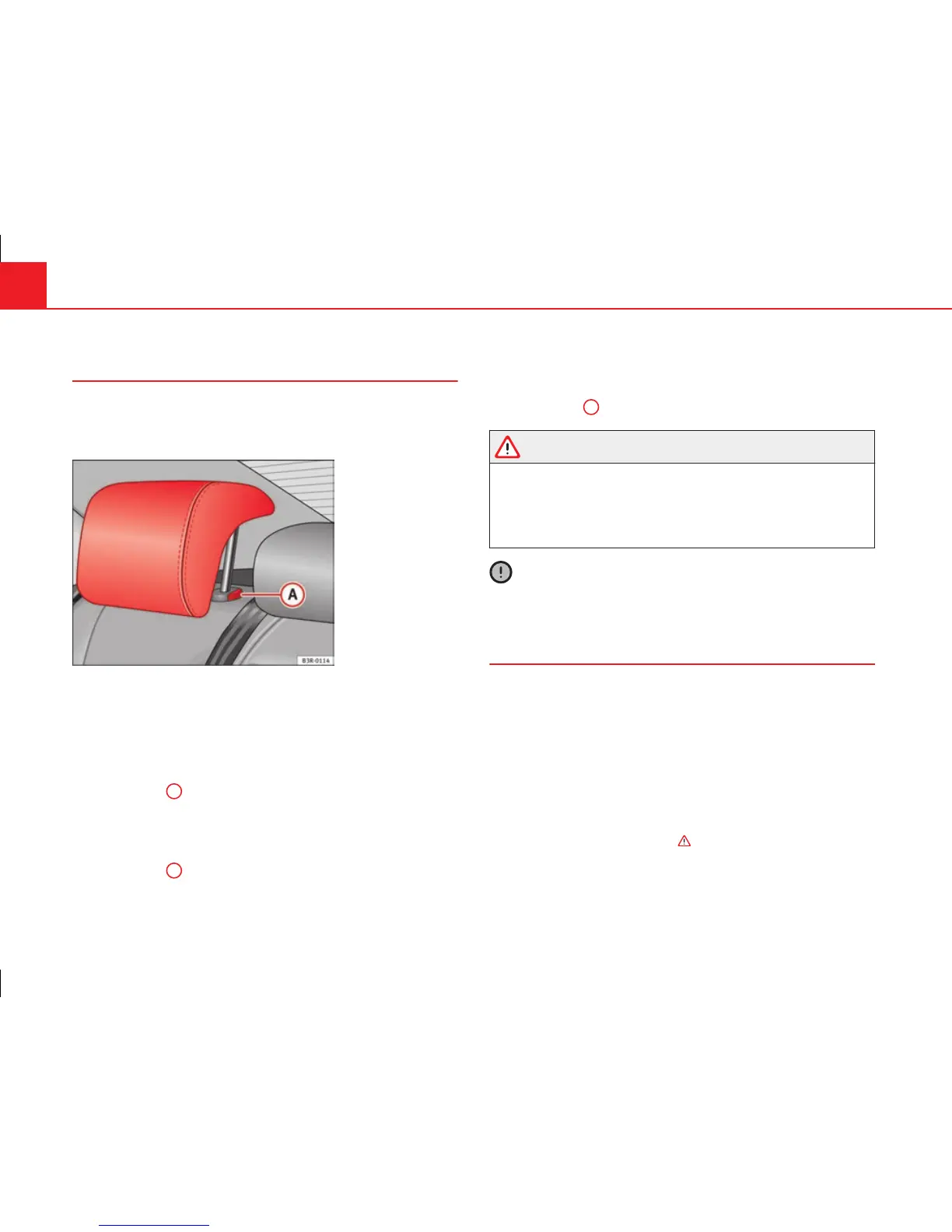
Fig. 5 Outer rear seats:
Head restraints
Raising the head restraint
– Take hold of the sides of the head restraint with both hands.
– Pull the head restraint up as far as it will go.
Lowering the head restraint
– Press button
A
⇒ fig. 5 and lower the head restraint.
Removing the head restraint
– Pull the head restraint up as far as it will go.
– Press button
A
⇒ fig. 5 and pull out the head restraint.
Fitting the head restraint
– Insert the head restraint in its guides until it clicks into place.
Press button
A
and lower the head restraint.
WARNING
● Under no circumstances should the rear passengers travel while the
head restraints are in the non-use position.
● Do not swap the centre rear head restraint with either of the outer
seat rear head restraints.
● Risk of injury in case of an accident!
CAUTION
Note the instructions on the adjustment of the head restraints ⇒ page 13.
Examples of incorrect sitting positions
An incorrect sitting position can lead to severe injuries to oc-
cupants.
Seat belts can provide optimal protection only when the belt webs
are properly positioned. Incorrect sitting positions substantially re-
duce the protective function of seat belts and increase the risk of
injury due to incorrect seat belt position. As the driver, you are re-
sponsible for all vehicle occupants, especially children.
– Never allow anyone to assume an incorrect sitting position in
the vehicle while travelling ⇒
.



 To Next Page