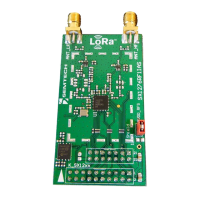
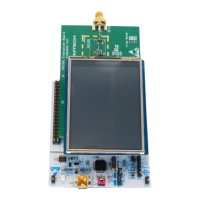
The Semtech SX1280/SX1281 Development Kit is a comprehensive tool designed for evaluating and developing applications with Semtech's long-range, low-power 2.4 GHz transceivers. This user guide outlines the kit's functionalities, technical specifications, and operational procedures, making it accessible for both initial setup and advanced testing.
Function Description:
The core function of the SX1280/SX1281 Development Kit is to facilitate the testing and development of wireless communication solutions using the SX1280 and SX1281 transceivers. It supports various modulation schemes, including LoRa, FLRC, GFSK, and a dedicated Ranging Modem, enabling a wide range of applications from basic data transmission to precise distance measurement. The kit is designed to perform bidirectional and unidirectional radio tests, allowing users to assess link quality, packet error rates, and ranging capabilities. Its integrated touch screen interface simplifies navigation and configuration, providing a user-friendly experience for setting up and running tests. The kit also offers access to basic operating modes for consumption testing and verification of datasheet specifications, eliminating the need for custom firmware development for these tasks.
Important Technical Specifications:
The SX1280/SX1281 transceivers operate in the 2.4 GHz band, offering long-range and low-power communication. Key configurable parameters include:
- Frequency (Freq): Adjustable from 1 Hz to 10 MHz steps, with preset frequencies available (e.g., 2402 MHz, 2450 MHz, 2480 MHz).
- Transmission Power (Tx Pow): Configurable in 1 dBm steps, ranging from -18 dBm to +13 dBm.
- Modulation Schemes:
- LoRa Modulation:
- Spreading Factor (SF): Selectable between SF5 and SF10.
- Bandwidth (BW): Options include 400 kHz, 800 kHz, or 1.6 MHz.
- Coding Rate (CR): Supports CR 4/5, 4/6, 4/7, 4/8, and CRLI 4/5, 4/6, 4/7.
- Payload Size: Adjustable from 12 to 248 bytes.
- FLRC Modulation:
- Data Rate and Bandwidth (BW): Various combinations available (e.g., 260 kbps/BW 300 kHz).
- Coding Rate (CR): Options include 1, 1/2, or 3/4.
- Bandwidth-Time Bit Period Product (BT): Selectable as 1, 0.5, or OFF.
- Payload Size: Adjustable from 12 to 120 bytes.
- GFSK Modulation:
- Data Rate and Bandwidth (BW): Various combinations available (e.g., 125 kbps/BW 300 kHz).
- Modulation Index (Mod. i): Adjustable between 0.35 and 4.
- Bandwidth-Time Bit Period Product (BT): Selectable as 1, 0.5, or OFF.
- Payload Size: Adjustable from 12 to 248 bytes.
- Ranging Modem: Utilizes specific LoRa parameters for distance measurement, with a "BEST SET" option for optimal ranging performance.
- Spreading Factor (SF): Selectable between SF5 and SF10.
- Bandwidth (BW): Options include 400 kHz, 800 kHz, or 1.6 MHz.
- Coding Rate (CR): Supports CR 4/5, 4/6, 4/7, 4/8, and CRLI 4/5, 4/6, 4/7.
- Power Amplifier (PA Mode): Configurable as either DCDC or LDO, impacting power consumption and efficiency.
- Packet Limit: Allows setting the number of packets for tests to Infinite, 100, 200, 500, or 1000.
- Antenna Selection: Supports ANT1 or ANT2, with independent capacitive proximity sensors for detecting nearby objects.
Usage Features:
The development kit is designed for ease of use, featuring a touch screen interface for intuitive navigation and configuration.
- Assembly: The kit consists of three main parts: a screen, a radio board, and a microcontroller MBED board, which must be correctly assembled before use.
- Power-On and Connection: Simply connect the mini-USB/USB cable to the kit and a PC to power it on and establish a connection. The PC recognizes the kit as an extra device.
- Firmware Management: Users can check the current firmware version via the Utilities menu and upload new firmware by dragging and dropping a .bin file onto the kit when connected to a PC. The kit may require screen calibration upon initialization after firmware upload.
- Navigation Conventions:
- Green: Indicates menus, functions, and configurable settings.
- White: Denotes data that cannot be modified.
- Yellow: Represents result data from tests.
- Demo Modes:
- Ping Pong Demo: Performs a bidirectional range test between two kits, displaying Packet Error Rate (PER), Packet Success Rate (PSR), Received Signal Strength Indication (RSSI), and Signal to Noise Ratio (SNR) for both Master-to-Slave and Slave-to-Master exchanges. Users can configure one unit as Master and the other as Slave.
- PER Demo: Conducts a unidirectional packet error rate test, with one kit acting as a transmitter (Master) and the other as a receiver (Slave). The Slave displays the aggregate PER, Rx OK (packets completely received), Rx KO (packets not completely received), PSR, RSSI, and SNR.
- Ranging Demo: Performs a distance measurement test between user-defined Master and Slave units. The Master displays the calculated range, which can be refreshed during the test. Ranging-specific radio settings can be configured, including a "BEST SET" option for optimal performance.
- Radio Test Modes: Provides access to preset test modes for evaluating radio consumption in different states (Sleep Mode, Standby RC Mode, Standby XOSC Mode) and for testing continuous wave (CW) transmission or continuous modulation. These modes are useful for verifying datasheet specifications and modem performance without custom firmware.
- Radio Settings: Allows detailed configuration of modulation parameters (LoRa, FLRC, GFSK, Ranging Modem), frequency, and transmission power. Each modulation type has its own set of configurable parameters.
- Ranging Settings: Accessible from the Radio Settings menu, this allows configuration of specific parameters for the Ranging Demo, such as request count, Z score, address, and antenna.
- LED Indicators: LEDs on each unit indicate data reception and transmission during tests.
Maintenance Features:
The kit includes features to help maintain its functionality and ensure optimal performance.
- Firmware Updates: The ability to check the firmware version and easily upload new firmware from the Semtech website ensures that the kit can always run the latest software, incorporating bug fixes and new features.
- Factory Reset: The "Fact. Reset" option in the Utilities menu allows users to restore the SX1280 Development Kit to its original factory settings, which can be useful for troubleshooting or starting fresh with configurations.
- System Information: The Utilities section provides important system information, including:
- Firmware Version: To verify the installed software.
- GPS Status: Displays the number of GPS satellites seen and the resulting position (if available), or "Satellites searching" if no satellites are detected.
- Proximity Sensor Output: Shows raw sensor data from independent capacitive proximity sensors on each antenna, indicating the detection of nearby objects. This can be useful for diagnosing antenna-related issues or environmental interference.
The Semtech SX1280/SX1281 Development Kit is a robust and versatile platform, providing developers with the necessary tools to explore and implement advanced 2.4 GHz wireless communication solutions.

 Need help?
 General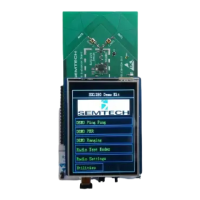

 To Next Page