
 To Next Page


C
Christina HowardSep 23, 2025
What to do if Shure BLX2 Microphone system sound level varies when switching sources?
- BbspenceSep 23, 2025
Adjust transmitter gain as necessary.

What to do if Shure BLX2 Microphone system sound level varies when switching sources?
Adjust transmitter gain as necessary.
Why does my Shure Microphone system have audio dropouts?
Audio dropouts or artifacts in your Shure Microphone system can occur if the receiver ready LED is flickering or off. Make sure the receiver and transmitter are positioned within the specified system parameters. The system should be set up within the recommended range and the receiver should be kept away from metallic surfaces. For optimal sound, the transmitter must be used in line of sight from the receiver.
How to fix a Shure BLX2 when the transmitter LED is flashing red?
If the transmitter indicator LED is flashing red on your Shure Microphone system, try these steps: Replace the transmitter batteries. Change the receiver and transmitter to a different group and/or channel. Identify and shut down or remove any nearby sources of RF interference. Replace the transmitter batteries again if necessary.
How to eliminate distortion in my Shure BLX2 Microphone system?
To eliminate distortion in your Shure Microphone system, reduce the transmitter gain.
What to do if Shure BLX2 sound levels vary between sources?
If you experience sound level variations when switching to different sources with your Shure Microphone system, adjust the transmitter gain as necessary.
What to do if Shure BLX2 Microphone system has distortion?
If your Shure Microphone system experiences audio distortion, and the audio LED on the receiver indicates overload (red), you should reduce the transmitter gain.
What to do if Shure Microphone system has sound level variations?
If you notice sound level variations when switching to different sources on your Shure Microphone system, adjust the transmitter gain as necessary.
How to troubleshoot no sound on Shure BLX2?
If your Shure Microphone system produces no sound or only a faint sound, first, check all sound system connections and adjust the gain. Ensure the receiver is properly connected to the mixer or amplifier. If the receiver's ready LED is off, turn on the transmitter, verify the batteries are correctly installed, set up the transmitter, and insert fresh batteries. If the receiver's LED screen is off, ensure the DC adapter is securely plugged into the electrical outlet and that the receiver is powered on. Finally, if the transmitter indicator LED is flashing red, replace the transmitter batteries.
What to do if my Shure Microphone system has audio artifacts or dropouts?
If you are experiencing audio artifacts or dropouts with your Shure Microphone system, try the following: If the ready LED is flickering or off, change the receiver and transmitter to a different group and/or channel. Identify and remove any nearby sources of RF interference. Replace the transmitter batteries. Ensure the receiver and transmitter are within system parameters. Set up the system within the recommended range and keep the receiver away from metallic surfaces. Ensure the transmitter is in the line of sight from the receiver.
How to fix sound level variations in Shure BLX2?
To address sound level variations in your Shure Microphone system, adjust the transmitter gain as necessary.
Lists the various components that make up the Shure BLX wireless system.
Provides initial setup steps to get the wireless system operational quickly.
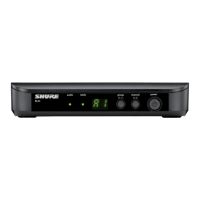
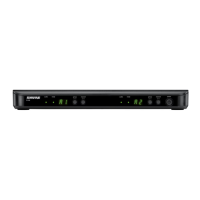
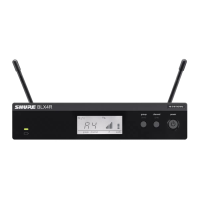
Overview of the front panel controls and indicators for BLX4 and BLX88 receivers.
Details the rear panel connections and ports for BLX4 and BLX88 receivers.
Information and indicators specific to the BLX1 bodypack transmitter.
Information and indicators specific to the BLX2 handheld transmitter.
Explains the meaning of LED status lights on the transmitters.
Step-by-step guide for setting up a single wireless system.
Instructions for manually setting the transmitter's group and channel to match the receiver.
Guide for setting up multiple wireless systems simultaneously to avoid interference.
Steps to manually change the receiver's group and channel settings.
How to lock and unlock the controls on the transmitter and receiver.
Tips and techniques for achieving optimal audio performance with the wireless system.
Guidance on optimal microphone positioning for clear audio capture and to avoid plosives.
Instructions for positioning headworn microphones correctly for consistent sound.
Information on battery life, replacement, and indicators for the BLX2 handheld transmitter.
Instructions on how to clip and wear the BLX1 bodypack transmitter for optimal performance.
Procedures for powering down the BLX2, BLX4/88, and BLX1 transmitters.
Guide on how to attach and remove identification caps on the BLX2.
Provides technical specifications for the overall Shure BLX wireless system.
Lists detailed technical specifications for the BLX1 bodypack transmitter.
Lists detailed technical specifications for the BLX4 and BLX88 receivers.
Details regarding licensing requirements for operating wireless microphone equipment.
FCC compliance information and user guidelines for device operation.
Warnings and compliance information specific to wireless device usage in Canada.
Specific warnings and conditions for wireless device operation in Australia.
Tables detailing frequency bands and their corresponding transmitter output power levels.
 General
| Battery Life | Up to 14 hours |
|---|---|
| Battery Type | 2 AA batteries |
| Modulation | FM |
| Transmitter Type | Handheld |
| Compatibility | BLX Series |
| Frequency Response | 50 Hz to 15 kHz |
| Operating Range | 300 ft (91 m) typical |
| Microphone Capsule | SM58 |
| RF Output Power | 10mW |
| Dynamic Range | 100 dB |