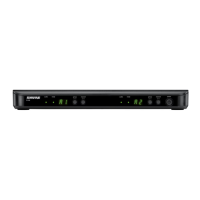
How to fix sound level variations on Shure BLX88 Microphone system?
- KKara Daniel MDSep 23, 2025
If you notice sound level variations when switching between different sources on your Shure Microphone system, adjust the transmitter gain as necessary.
How to fix sound level variations on Shure BLX88 Microphone system?
If you notice sound level variations when switching between different sources on your Shure Microphone system, adjust the transmitter gain as necessary.
How to fix distortion in Shure BLX88 Microphone system?
If the audio LED on the receiver of your Shure Microphone system indicates an overload (red), reduce the transmitter gain. See Adjusting Gain.
What to do if Shure Microphone system has no sound?
If your Shure Microphone system produces no sound or a faint sound, verify all sound system connections and adjust the gain as needed. Also, ensure that the receiver is properly connected to the mixer or amplifier.
Why is the receiver ready LED off on my Shure BLX88 Microphone system?
If the receiver ready LED is off on your Shure Microphone system, ensure the transmitter is turned on and the batteries are correctly installed. You may need to perform the transmitter setup. If not, insert fresh batteries.
What to do if Shure Microphone system sound level varies when switching sources?
Adjust transmitter gain as necessary.
Why is the transmitter indicator LED flashing red on my Shure Microphone system?
If the transmitter indicator LED on your Shure Microphone system is flashing red, replace the transmitter batteries.
What to do if the receiver LED screen is off on my Shure BLX88 Microphone system?
If the receiver LED screen is off on your Shure Microphone system, make sure the DC adapter is securely plugged into the electrical outlet and that the receiver is powered on.
How to troubleshoot Shure BLX88 Microphone system with no sound or faint sound?
If your Shure Microphone system has no sound or faint sound, check these potential solutions: 1. Verify all sound system connections and adjust the gain as needed. 2. Ensure the receiver is properly connected to the mixer or amplifier. 3. Turn on the transmitter and make sure the batteries are installed correctly. 4. Perform the transmitter setup. 5. Insert fresh batteries into the transmitter. 6. Ensure the DC adapter is securely plugged into the electrical outlet and that the receiver is powered on.
Why does my Shure BLX88 have audio artifacts or dropouts?
Audio artifacts or dropouts in your Shure Microphone system can occur if the ready LED is flickering or off. To resolve this: 1. Change the receiver and transmitter to a different group and/or channel. 2. Identify and remove nearby sources of RF interference. 3. Replace the transmitter batteries. 4. Ensure the receiver and transmitter are within system parameters. 5. Set up the system within the recommended range and keep the receiver away from metallic surfaces. 6. Ensure the transmitter is used in line of sight from the receiver for optimal sound.
What to do if Shure BLX88 sound levels vary between sources?
If you experience sound level variations when switching to different sources with your Shure Microphone system, adjust the transmitter gain as necessary.
Covers essential safety precautions for operating the BLX wireless system.
Steps for connecting receiver to power and performing a group scan.
Guide for installing batteries, setting transmitter, and adjusting gain.
Step-by-step guide for setting up a single wireless system.
Instructions for manually setting the transmitter group.
Instructions for manually setting the transmitter channel.
Guidelines for setting up multiple wireless systems simultaneously.
Procedure for manually changing the receiver's group setting.
Procedure for manually setting the receiver's channel.
How to lock and unlock the transmitter controls.
Suggestions for optimizing wireless system performance and reducing interference.
How to adjust transmitter gain using the receiver's audio LED indicator.
Information on expected battery life and how to replace batteries.
Solutions for issues related to no sound or faint sound.
Steps to resolve audio artifacts and signal dropouts.
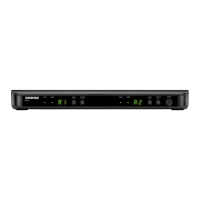
| Type | Dual Channel Receiver |
|---|---|
| Number of Channels | 2 |
| Power Source | External power supply |
| Number of Frequencies | Up to 12 compatible systems per frequency band (region dependent) |
| RF Output Power | 10 mW (typical) |
| Power Supply | Included |
| Compatibility | BLX Series |
| Audio Output | XLR and 1/4" output connectors |
| Power Requirements | 12-18V DC, 250 mA |
| Weight | 429 g |
| Operating Range | Up to 300 ft (100 m) |
| Receiver Type | Diversity |
| Receiver Outputs | XLR and 1/4" |
| Audio Frequency Response | 50 Hz to 15 kHz |
| Dynamic Range | 100 dB |
| Total Harmonic Distortion | < 0.5% |
| Battery Life | Up to 14 hours (with 2 AA batteries) |
| Dimensions | 40 mm H x 388 mm W x 116 mm D (1.6 in x 15.3 in x 4.6 in) |