
 Need help?
Do you have a question about the Siemens Connect Box and is the answer not in the manual?
Details on connecting, monitoring, and controlling building equipment via plug & play.
Information on required software licenses for Connect Box activation, duration, and capacity.
List of optional hardware components not included with the Connect Box.
Explanation of LED indicators, their colors, activities, and functions for device status.
Crucial safety warnings and national regulations for installation and operation.
Instructions for mounting the Connect Box, including location considerations and interfaces.
Procedures for the proper disposal of the Connect Box as electronic waste.
Details on the required input and output specifications for the power supply.
Summary of the different communication interfaces supported by the device.
Specifications for the 2G/3G/4G cellular communication module.
Details on the KNX interface type, cabling, and internal bus power.
Information on the USB interface, including data rate and protective switch.
Specifications for the LoRaWAN interface, including supported standards and frequencies.
Details on screw terminal types, wire specifications, stripping length, and torque.
List of communication protocols and drivers supported by the Connect Box.
Information on ambient conditions, protection, product standards, and regulatory approvals.
FCC compliance, warnings, and cellular RF module specifications and precautions.
FCC/IC compliance, warnings, and antenna gain limits for LoRaWAN.
Details on cellular and LoRaWAN antenna types, impedance, and gain.
Information on housing color, dimensions, weight, and product warranty.
Diagram and description of all connection terminals on the device.
Detailed physical dimensions of the Connect Box in mm and inches.
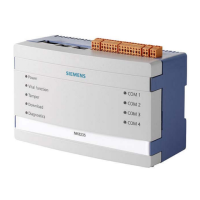
The Siemens Connect Box is a versatile and open IoT solution designed to simplify the connection and monitoring of small and medium-sized buildings. It acts as a central hub, integrating various building equipment and systems into a unified platform, thereby reducing the effort, investment, and complexity typically associated with device integration and retrofitting additional functionalities for building optimization.
The Connect Box serves as a powerful IoT device, combining the essential functionalities of a gateway, a PLC (Programmable Logic Controller), a modem, and an edge device. Its primary function is to connect equipment from buildings via a plug-and-play mechanism. This includes a wide range of devices such as IoT sensors, meters, heating systems, air conditioning units, air handling systems, and existing building management systems (BMS).
A key feature is its role as a smart converter, unifying various field communication protocols, both standard and proprietary, wired and radio, onto a single device. This broad compatibility allows for seamless integration of diverse equipment. The device collects data from these connected systems and can also issue controls to manage the equipment.
The Connect Box offers both local and cloud connectivity. It automatically connects to the cloud via 3G/4G or an Ethernet cable, ensuring continuous data flow and remote accessibility. For buildings without an existing BMS, the Connect Box can directly create a BMS network, simplifying the setup process. If a BMS is already in place, the device connects to the main bus as a third-party component.
The system supports telemetry and controls, gathering data from connected devices and enabling remote management. It facilitates over-the-air updates via 4G, ensuring the device's software remains current and secure. A local IoT private network based on LoRa is also supported, offering flexible connectivity options. The Connect Box is designed for powerful integration with third-party applications, expanding its utility and interoperability within a broader IoT ecosystem.
The offering includes both a hardware component (the Connect Box itself) and a software component, which can be either a cloud license or an on-premise license, depending on customer needs. Both software versions leverage an IoT Platform in the back-end and a user console as a central interface for activating, managing, and configuring the device.
With the cloud license, data can be sent to a server via API Restful or MQTT (using LAN or 4G, with a pre-mounted SIM card provided). Alternatively, data can be converted locally to BACnet IP or Modbus IP. The web platform (console of configuration) allows for remote configuration, equipment pairing, and property selection. Essential BMS functionalities such as graphs, alarms, and synoptics are included in the box license, along with a 4G SIM card subscription.
For the on-premise license, data can be sent to a server via MQTT (default connection via IP/LAN) or converted to BACnet IP or Modbus IP. Remote configuration, equipment pairing, and property selection are still performed on the web platform, utilizing a provided 4G SIM card solely for configuration purposes. Remote management and configuration are offered for the first three years, or it can be configured remotely without additional cost using a LAN connection.
The Connect Box is designed for ease of use and installation, making it accessible to a wide range of installers, including electricians. Its plug-and-play installation minimizes setup time and complexity. A comprehensive library of over 500 field devices is ready to connect, simplifying the integration process.
Data retrieval is set by default at 10-minute intervals, though IoT sensors with their own frequencies operate to minimize battery consumption. Commands (downlink) are sent instantly, ensuring prompt control responses. The system is full-service, requiring no specialized networking skills thanks to its 4G cloud connectivity.
The user console, accessible via connectbox.siemens.com, provides BMS essentials, allowing users to monitor and manage their building systems efficiently. Public API management and documentation are also available, facilitating custom integrations and development.
The device can be snapped onto standard rails or screwed onto a wall, offering flexible mounting options. Plug-in screw terminals are used for connecting power and interfaces, simplifying wiring.
The Connect Box incorporates several features to ensure reliable operation and ease of maintenance. Over-the-air updates via 4G allow for remote software maintenance, reducing the need for on-site interventions.
The device includes internal protection against overvoltage, undervoltage, and overcurrent from the power supply, indicated by an LED: green for compatible power supply, red for unsuitable. This helps prevent damage and ensures system stability.
LED displays provide visual feedback on the device's status and communication activities. For instance, a flashing heartbeat LED indicates normal operation, while continuously ON or OFF LEDs for GSM, LoRaWAN, RS485, X-Bus, M-Bus, ETH, and KNX indicate active communication, no communication, or link status. A green power LED signifies a compatible power supply, while a red one indicates an incompatible supply, prompting the user to change it to avoid damage.
For maintenance purposes, a USB micro port is available. The device also includes protective switches against surges and overcurrent for the USB interface, enhancing durability.
The Connect Box is designed for disposal in accordance with European Directive, meaning it should not be treated as domestic waste. Users are advised to use designated channels for disposal, comply with local laws, and dispose of empty batteries at collection points. This commitment to responsible disposal aligns with environmental considerations.
 General
| Model | Connect Box |
|---|---|
| Protocols | IPv4, IPv6 |
| Operating Temperature | 0°C to 40°C |
| Product Type | Wireless Router |
| Wireless Standards | IEEE 802.11b/g/n |
| Frequency Band | 2.4 GHz |
| Maximum Wireless Speed | 300 Mbps |
| Maximum Data Rate | 300 Mbps |
| Ports | 4 x Ethernet, 1 x WAN |
| Ethernet Ports | 4 |
| WAN Port | 1 |
| Security | WPA2 |
| Security Features | Firewall |
| Interfaces | Ethernet |
| Antennas | Internal Antennas |


 To Next Page