t
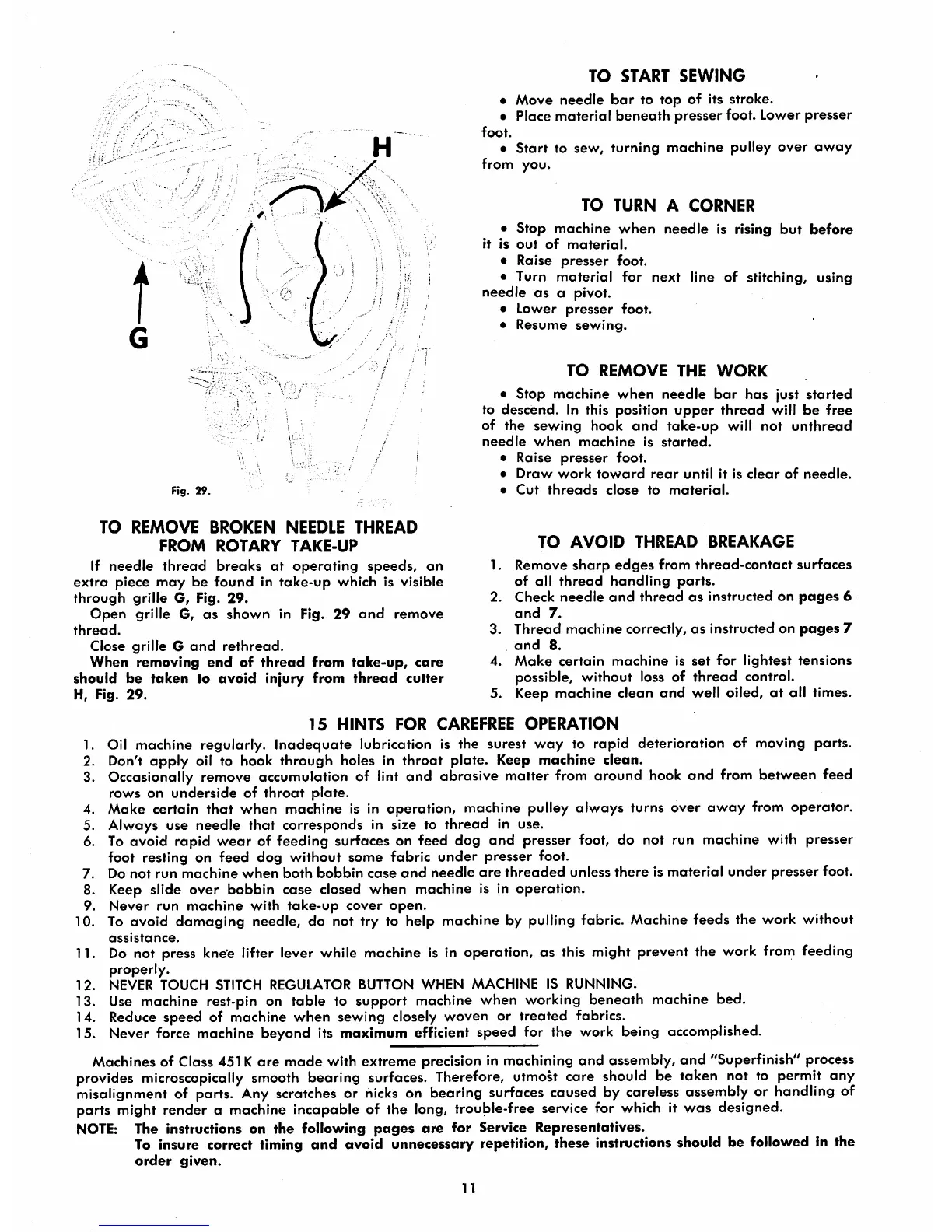
Fig.
29.
TO
REMOVE
BROKEN
NEEDLE
THREAD
FROM
ROTARY
TAKE-UP
If
needle
thread
breaks
at
operating
speeds,
an
extra
piece
may
be
found
in
take-up
which
is visible
through
grille
G, Fig.
29.
Open
grille G,
as
shown
in Fig.
29
and
remove
thread.
Close
grille
G
and
rethread.
When
removing
end
of
thread
from
take-up,
care
should be
taken
to
avoid
injury from
thread
cutter
H,
Fig.
29.
TO
START
SEWING
• Move
needle
bar
to top of its stroke.
• Place material
beneath
presser foot.
Lovy^er
presser
foot.
•
Start
to sew,
turning
machine
pulley
over
away
from you.
TO
TURN
A
CORNER
•
Stop
machine
when
needle
is rising
but
before
it
is
out
of
material.
• Raise
presser
foot.
• Turn
material
for
next line of stitching, using
needle
as
a pivot.
• Lower
presser
foot.
•
Resume
sewing.
TO
REMOVE
THE
WORK
• Stop
machine
when
needle
bar
has
just
started
to
descend.
In this position
upper
thread
will
be
free
of the
sewing
hook
and
take-up
will not
unthread
needle
when
machine
is
started.
• Raise
presser
foot.
•
Draw
work
toward
rear
until
it
is
clear
of
needle.
•
Cut
threads
close
to
material.
3.
4.
TO
AVOID
THREAD
BREAKAGE
Remove
sharp
edges
from
thread-contact
surfaces
of
all
thread
handling
parts.
Check
needle
and
thread
as
instructed on
pages
6
and
7.
Thread
machine
correctly,
as
instructed on
pages
7
and
8.
Make
certain
machine
is
set
for
lightest
tensions
possible, without loss of
thread
control.
Keep machine clean
and
well oiled,
at
all times.
15
HINTS
FOR
CAREFREE
OPERATION
1. Oil machine regularly. Inadequate lubrication is the surest way to rapid deterioration of moving parts.
2. Don't apply oil to hook through holes in throat plate. Keep machine clean.
3. Occasionally remove accumulation of lint and abrasive matter from around hook and from between feed
rows on
underside
of
throat
plate.
4. Make certain
that
when machine is in operation, machine pulley always turns over
away
from operator.
5. Always use needle that corresponds in size to thread in use.
6.
To
ovoid rapid wear of feeding surfaces on feed dog and presser foot, do not run machine with presser
foot resting on feed dog without some fabric
under
presser foot.
7. Do not run
machine
when
both
bobbin
case
and
needle
are
threaded
unless
there
is
material
under
presser
foot.
8. Keep slide over bobbin
case
closed
when
machine is in operation.
9.
Never
run
machine
with
take-up
cover
open.
10. To avoid damaging needle, do not try to help machine by pulling fabric. Machine feeds the work without
assistance.
11.
Do
not press
kne'e
lifter lever while machine is in operation, as this might prevent the work from feeding
properly.
12.
NEVER
TOUCH
STITCH
REGULATOR
BUTTON
WHEN
MACHINE
IS
RUNNING.
13.
Use
machine rest-pin on table to support machine when working beneath machine bed.
14. Reduce speed of machine when sewing closely woven or treated fabrics.
15. Never force machine beyond its maximum efficient speed for the work being accomplished.
Machines of Class 451K
are
made with extreme precision in machining and assembly,
and
"Superfinish" process
provides microscopically smooth bearing surfaces. Therefore, utmost care should be token not to permit any
misalignment of parts.
Any
scratches or
nicks
on bearing surfaces caused by careless assembly or handling of
ports might render a machine incapable of the long, trouble-free service for which it was designed.
NOTE:
The instructions on the following
pages
are
for Service Representatives.
To
insure correct timing and avoid unnecessary repetition, these instructions should be followed in the
order
given.
11



 To Next Page