60
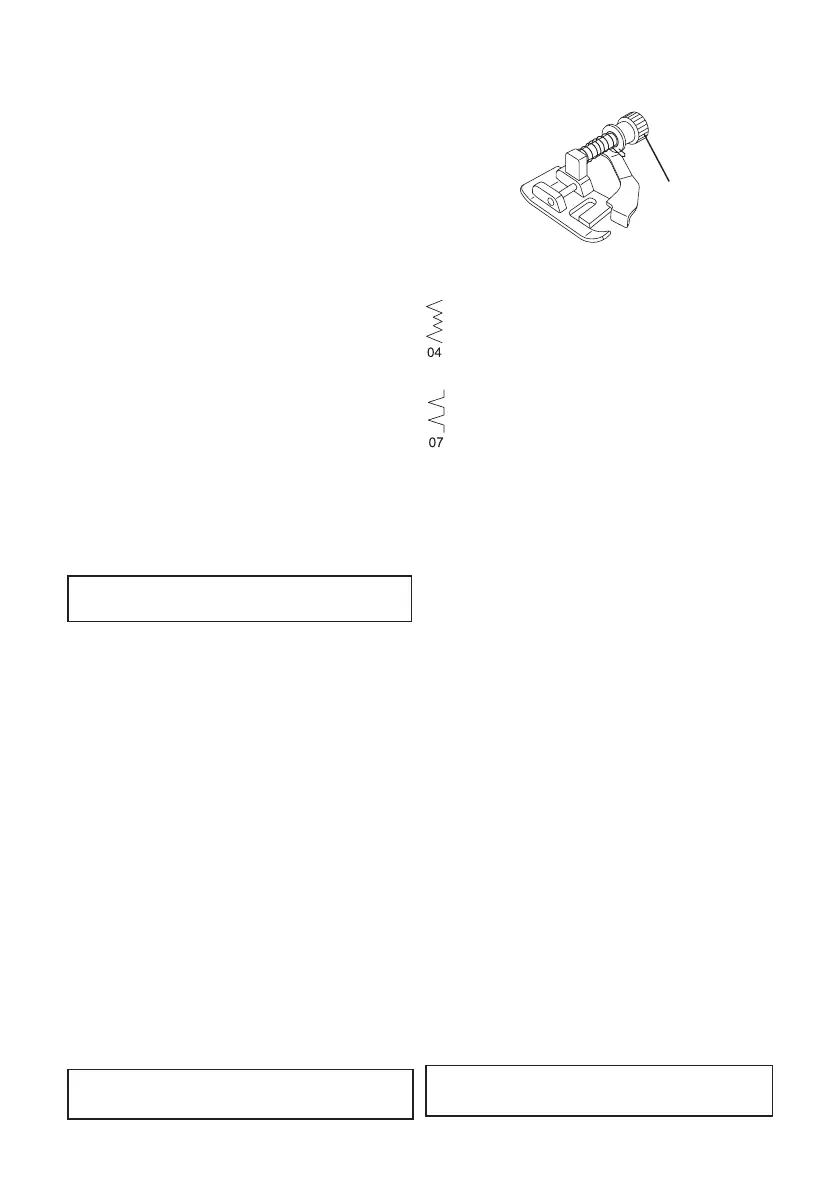
Blind Stitch Foot
Voet voor Blindsteek
Blindstichfuß
The Blind Stitch Foot is primarily used for
creating nearl yinvisible hems on curtains,
trousers, skirts, etc.
Deze voet wordt vooral gebruikt voor het naaien
van een onzichtbare zoom bij gordijnen, broeken,
rokken enz.
Der Blindstichfuß dient in erster Linie dazu,
fast unsichtbare Säume an Gardinen, Hosen,
Röcken, usw. zu nähen.
Machine Preparation
Vorbereitung der Maschine
Peeparacion de la Maquina
B
A
• Install the Blind Stitch Foot
• Select Stitch: 04 or 07
• Tension set at 5
• Blindstichfuß einsetzen
• Stich auswählen: 04 oder 07
• Spannung auf 5 einstellen
• Bevestig de voet voor blindsteek
• Selecteer steek 04 of 07
• Zet de spanning op 5
Elastic Blind stitch for soft, stretchable fabrics.
Punto invisibile elastico per tessuti morbidi, elastici.
Blindsteek voor zachte, rekbare stoen
Regular blind stitch for normal woven fabrics.
Regulärer Blindstich für normale Webstoe.
Normale blindsteek voor normaal geweven stoen
Sewing Instructions
Naaiinstructies
Nähanleitungen
1. With matching thread nish the raw edge. On
fine fabric turn up and press a small 1/2" or
less hem.
On medium to heavyweight fabrics overcast
the fabric's raw edge.
2. Now fold the fabric as with the wrong side up.
3. Place the fabric under the foot. Turn the
handwheel towards you (counter-clockwise) by
hand untill the needle swings fully to the left.
It should pierce the fold of the fabric. If it does
not, adjust the guide (B) on the Blindhem Foot
(A) so that the needle just pierces the fabric
fold and the guide just rest against the fold.
Sew slowly, guiding the fabric carefully along
the edge of the guide.
4. When completed, the stitching is almost
invisible on the right side of the fabric.
Note: It takes practice to sew blind
hems.Doatestsewrst.
1. Naai met een overeenkomende draad de afgesneden
boord. Op een fijne stof maak je een omslag van
ongeveer ½” of minder.
Op een gemiddelde tot zwaardere stof festonneer je de
afgesneden boord.
2. Dan plooi je de stof om met de verkeerde zijde naar
boven.
3. Leg de stof onder de voet Draai het handwiel met
de hand naar je toe(tegen uurwijzerzin) tot de naald
volledig naar links is verplaatst. Ze moet alleen de
omslag doorboren. Als dit niet het geval is moet je de
geleider (B) van de blindsteekvoet(A) verplaatsen totdat
de naald juist de omslag doorboort en de geleider juist
tegen de omslag aanleunt. Stik langzaam terwijl de stof
langzaam langs de geleider glijdt.
4. Als dit gedaan is, dan is het stiksel praktisch onzichtbaar
aan de juiste zijde van de stof.
Nota: een blinde zoom naaien vereist
ervaring. Maak eerst een naaiproef.
1. Die Schnittkante mit passendem Garn säubern. Bei
feinen Stoffen muss der Stoff umgeschlagen und
ein schmaler Saum von maximal 1,3cm gepresst
werden. Bei mittleren bis schweren Stoffen die
Schnittkante des Stoes überwendlich nähen.
2. Nun den Sto so falten, dass die linke Seite nach
oben zeigt.
3. Den Sto unter den Nähfuß legen. Das Handrad auf
sich zu drehen (gegen den Uhrzeigersinn), bis die
Nadel die äußerste linke Position erreicht hat. Sie
müsste dabei die Falte des Stoffes durchstechen.
Ist dies nicht der Fall, die Führung (B) am
Blindstichfuß (A) so verändern, dass die Nadel
gerade die Stofffalte durchsticht und die Führung
an der Falte anliegt. Langsam nähen und den Sto
dabei vorsichtig entlang der Führungskante führen.
4. Bei fertig gestellter Arbeit sind die Stiche auf der
rechten Stoseite kaum erkennbar
Hinweis: Es braucht Übung, Blindsäume
zu nähen. Nähen Sie zuerst eine Probe.



 To Next Page