INTRODUCTION
7
A hipot test attempts to detect or measure phenomena that indicate electrical problems
such as leakage, breakdown and arcing.
Leakage is a flow of current. Leakage becomes significant under two conditions. Any
increase in resistive leakage is a "red flag" indication that quality in insulating materials
used in the device has in some manner deteriorated. Total leakage becomes significant if it
reaches such a level that it becomes perceptible to the user of the equipment. UL
extensively researched the area of perception threshold and electrical shock. They found
that, generally, "women are more sensitive to leakage current than men and a current flow
of 0.5 milliamperes or less at 60 hertz does not produce a reaction which is considered to
be hazardous to the individual or to those nearby."
Some leakage exists in any product, though, in many cases, it will be so minute to defy
measurement. It exists for two reasons; first leakage current exists simply because no
insulating materials are perfect and have infinite resistance. This is generally referred to as
resistive leakage and can be calculated from Ohms Law, E=IR where E is the applied
voltage, I is current flow in amperes and R is the resistance in ohms. Second, any
electrical device, by virtue of the fact that it is made of conductive material with electrical
circuits in close proximity, exhibits what can be called an "inherent capacity effect." This
is actually a capacity and, if we apply AC voltage, current will flow. This is generally
referred to as capacitive leakage. The equivalent resistive value of the capacitance (Xc)
may be calculated from the formula, Xc=1/(2πfC) where Xc is the equivalent resistance in
ohms, f is frequency of the applied voltage in hertz and C is the capacitance in farads. The
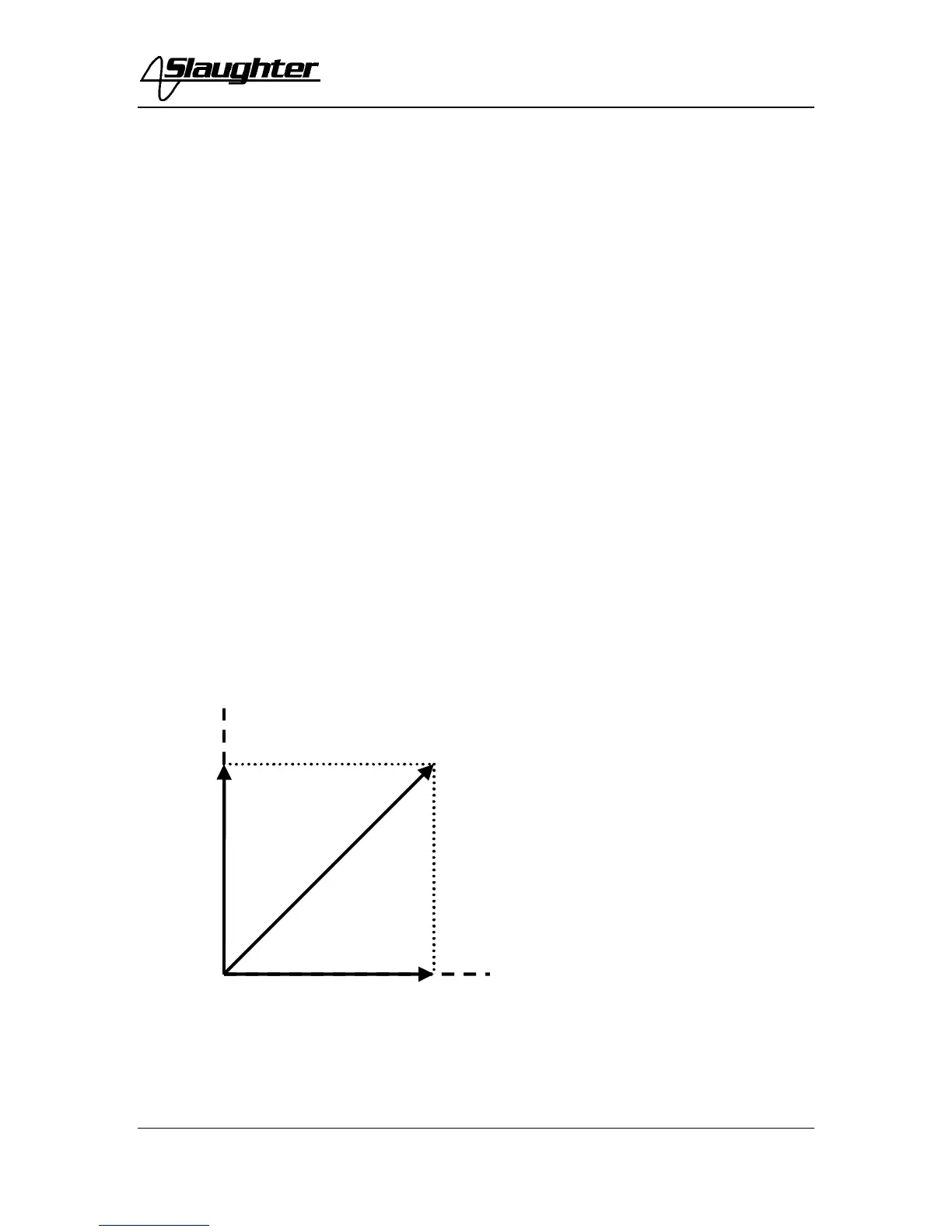
combination of these two components of leakage (figure 1.) is referred to as the total or
complex leakage.
Current Vector
figure 1.
I(r)
I(c)
I(t)
I(c) = CAPACITIVE CURRENT
I(r) = RESISTIVE CURRENT
I (t) = TOTAL CURRENT


 To Next Page