INTRODUCTION
9
The ability of high voltage test equipment to react to the excessive current flow or failure
of the product under test is often referred to as "sensitivity."
For many years, users of high potential (hipot) dielectric testers tolerated considerable
sensitivity differences between individual testers. Products rejected by one tester might be
accepted by another. If the two testers were distinctly different models or were made by
different manufactures, the question of which tester to rely upon was a difficult one.
Unfortunately, the tester chosen was sometimes the one that would accept the products.
In a majority of these situations, the real problem was a lack of an acceptable standard for
tester sensitivity. Many low cost production line testers in the past were essentially
designed as "go/no-go" testers and sensitivity was often whatever was convenient for the
manufacturer.
The variance of the sensitivity curves between different manufacturers and different
models was a major factor in U.L.'s (Underwriters Laboratories) move to try and
standardize production line hipot test equipment sensitivity. These tester performance
requirements have come to be commonly known as the "120 K requirement."
Unless the hipot tester was designed to meet the "120 K" specifications, it is unlikely that
it will meet all of the requirements. The tester's suitability must be verified.
In general, the original U.L. "120 K" specifications require the tester to reject within .5
seconds when connected to an impedance of 120,000 (120 K) ohms at the specified
testing voltage. Additionally, the output voltage sign wave tolerance is specified and the
output voltage regulation is required to be -0%, +20%.
Various agencies other than U.L. have their own versions of the "120 K" type
specifications. As with all testing specifications, the manufacturer must ensure that they
are in compliance with the latest testing requirements for their particular product.
The Insulation Resistance Test
Some dielectric analyzers today come with a built in insulation resistance tester. Typically,
the IR function provides test voltages from 500 to 1,000 volts DC and resistance ranges
from kilohms to gigaohms. This function allows manufacturers to comply with special
compliance regulations. BABT, TÜV, and VDE are agencies that may under certain
conditions require an IR test on the product before a Hipot test is performed. This
typically is not a production line test but a performance design test.
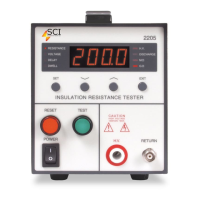
The insulation resistance test is very similar to the hipot test. Instead of the go/no go
indication that you get with a hipot test the IR test gives you an insulation value usually in
Megohms. Typically the higher the insulation resistance value the better the condition of
the insulation. The connections to perform the IR test are the same as the hipot test. The
measured value represents the equivalent resistance of all the insulation which exists
between the two points and any component resistance which might also be connected
between the two points.


 To Next Page