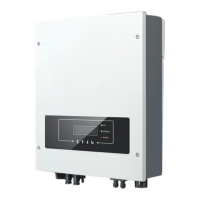
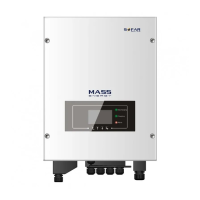
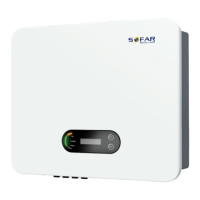
The SOFAR 7K~10.5KTLM-G3 is a series of dual MPPT grid-tied PV inverters designed to convert DC power from photovoltaic arrays into sine wave single-phase AC power for feeding into the public electrical grid. This manual covers models 7KTLM-G3, 7.7KTLM-G3, 8KTLM-G3, 9KTLM-G3, 10KTLM-G3, and 10.5KTLM-G3.
Function Description:
The inverter operates by filtering DC power from the PV array through an Input Board, which also performs insulation impedance detection and DC voltage/current detection. This DC power is then converted to AC power by a Power Board. The AC power is subsequently filtered through an Output Board before being fed into the grid. The Output Board includes functions for grid voltage/output current detection, GFCI (Ground Fault Circuit Interrupter), and an output isolation relay. A Control Board provides auxiliary power, manages the inverter's operation, and displays status via a Display Board. Fault codes are shown on the Display Board during abnormal operation, and the Control Board can trigger relays for internal component protection.
Key functional modules include:
- Energy Management Unit: Allows external (remote) control to switch the inverter on/off.
- Reactive Power Feeding: The inverter can generate and feed reactive power into the grid, with feed-in management controllable by the grid company via a dedicated RS485 serial interface.
- Active Power Limiting: If enabled, the inverter can limit the active power fed into the grid to a desired percentage.
- Self Power Reduction (Over Frequency): When the grid frequency exceeds a set limit, the inverter automatically reduces its output power to maintain grid stability.
- Data Transmission: The inverter, or a group of inverters, can be monitored remotely through an advanced communication system using an RS-485 serial interface or wirelessly via WIFI/GPRS.
- Software Update: Supports local software upgrades via USB flash drive and remote upgrades via WIFI/GPRS.
Important Technical Specifications:
- Recommended Max. PV Input Power: Ranges from 10500Wp (7KTLM-G3, 7.7KTLM-G3) to 15000Wp (10KTLM-G3, 10.5KTLM-G3).
- Max. DC Power for Single MPPT: 6250W/5000W/5000W.
- Number of MPP Trackers: 3.
- Number of DC Inputs: 3.
- Max. Input Voltage: 600V.
- Start-up Voltage: 90V.
- Rated Input Voltage: 360V.
- MPPT Operating Voltage Range: 80V~550V.
- Full Power MPPT Voltage Range: Varies by model, e.g., 200~500V (7KTLM-G3, 7.7KTLM-G3) to 300~500V (10.5KTLM-G3).
- Max. Input MPPT Current: 20A/16A/16A.
- Max. Input Short Circuit Current per MPPT: 30A/22.5A/22.5A.
- Maximum Inverter Backfeed Current to Array: No backfeed current to array.
Output Parameters (AC):
- Rated Power: Ranges from 7000VA (7KTLM-G3) to 10500VA (10.5KTLM-G3).
- Max. AC Power: Ranges from 7700VA (7KTLM-G3, 7.7KTLM-G3) to 10500VA (10.5KTLM-G3).
- Nominal Output Current: Varies by model, e.g., 31.8A (7KTLM-G3) to 45.6A (10.5KTLM-G3).
- Max Output Current: Varies by model, e.g., 35A (7KTLM-G3, 7.7KTLM-G3) to 46A (10KTLM-G3, 10.5KTLM-G3).
- Nominal Grid Voltage: L/N/PE, 220Vac, 230Vac, 240Vac.
- Grid Voltage Range: 180Vac-276Vac (according to local standard).
- Nominal Frequency: 50/60Hz.
- Grid Frequency Range: 45Hz-55Hz/54Hz-66Hz (according to local standard).
- Active Power Adjustable Range: 0~100%.
- THDi: <3%.
- Power Factor: 1 default (adjustable +/-0.8).
- Power Limit Export: Zero export or adjustable power limit export.
- Current (inrush): 200Aac, 1µs.
- Maximum Output Fault Current: 120A/20ms.
- Maximum Output Overcurrent Protection: 48Aac.
- Detection Methods of Isolated Islands: Reactive Power Disturbance.
Efficiency, Protection, and Communication:
- Max Efficiency: 98.1% across all models.
- European Weighted Efficiency: 97.3% across all models.
- Self-consumption at Night: <1W.
- DC Reverse Polarity Protection: Yes.
- DC Switch: Optional.
- AFCI Protection: Optional.
- Protection Class/Overvoltage Category: I/III for AC side, II for DC side.
- Safety Protection: Anti-islanding, RCMU (Residual Current Monitoring Unit), Ground fault monitoring.
- SPD (Surge Protection Device): PV: Type II standard, AC: Type III standard.
- Communication: RS485/USB/Bluetooth, Optional: WiFi/GPRS.
- Operation Data Storage: 25 years.
General Data:
- Ambient Temperature Range: -30°C~+60°C.
- Topology: Transformerless.
- Degree of Protection: IP65.
- Allowable Relative Humidity Range: 0~100%.
- Max. Operating Altitude: 4000m.
- Noise: <25dB.
- Weight: 17kg (7KTLM-G3 to 9KTLM-G3), 19kg (10KTLM-G3, 10.5KTLM-G3).
- Cooling: Natural.
- Dimension (W×H×D): 468mm×380mm×187mm.
- Display: LCD & APP+Bluetooth.
- Standard Warranty: 10 years.
- Over Voltage Category: DC side: overvoltage II, AC side: overvoltage III.
- EMC Standards: EN 61000-6-1, EN 61000-6-2, EN 61000-6-3, EN 61000-6-4.
- Safety Standards: IEC 62109-1/2, IEC 62116, IEC 61727, IEC 61683, IEC 60068.
- Grid Standards: AS/NZS 4777.2020, G99, INMETRO.
Usage Features:
- Installation: The inverter should be installed vertically on a suitable surface with adequate load-bearing capacity (e.g., walls, PV racks). Proper ventilation and fire exit space are crucial. Two persons are recommended for installation due to the inverter's weight.
- Electrical Connections: All electrical connections must comply with current regulations and be performed by a professional electrical engineer. Before connecting, ensure the DC switch is OFF and wait at least 5 minutes for capacitors to discharge. PV modules must be covered with opaque material before connecting DC input power cables to prevent electrical shock. The open-circuit voltage (Voc) of series-connected modules must not exceed 600V.
- Grounding: As a transformer-less inverter, the positive and negative poles of the PV array must NOT be grounded. All non-current carrying metal parts (PV module frame, PV rack, combiner box enclosure, inverter enclosure) should be connected to earth using PGND cables.
- AC Output Connection: AC output cables should be sized to ensure power loss is less than 1% of the rated power. The inverter includes an integrated RCMU; if an external RCD is required, a type-A RCD with a rated residual current of 100mA or higher is suggested, adhering to local regulations.
- Communication Ports: Features COM ports for RS485, WIFI/GPRS, and USB for data acquisition and monitoring. The RS485 interface allows for monitoring power output, alarm information, and operational status, which can be uploaded to a server or viewed on a PC. Multiple inverters can be connected in a daisy chain via RS485/USB converter (max 31 inverters).
- CT Interface: Supports Generation and Export Limit Control functions using an external CT (Current Transformer) or Meter + CT for grid information acquisition.
- Commissioning: Involves turning on the DC switch and AC circuit breaker. The inverter starts automatically if DC power is sufficient. Users must select the correct country code according to local authority requirements.
- Operation Interface: An LCD display and buttons (UP/DOWN) allow for navigation through standard and main interfaces. Indicator lights (RUN green, FAULT red) show the inverter's status (Normal, Wait, Check, Fault, Permanent).
- Settings: The main interface provides access to settings such as Set Time, Clear Energy, Clear Events, Set Country, On-Off Control, Set Energy, Set Address, Set Input Mode (MPPT channels can run independently or in parallel), Set Language, Set Anti Reflux (export limit function with external CT), Logic Interface (for VDE-AR-N 4105:2018-11 and EN50549-1:2019), IV Curve Scan (for tracking maximum power peaks), and PCC Select. Some settings require a password (default 0001).
- Software Update: Software can be updated locally via USB flash drive or remotely via WIFI/GPRS.
- Demand Response Modes (DRMs): Supports AS/NZS 4777.2:2020 DRMs, detecting and responding to commands within 2 seconds. Also supports VDE-AR-N 4105:2018-11 for controlling/limiting output power and EN50549-1:2019 for ceasing active power output.
Maintenance Features:
- Routine Maintenance: Inverters generally require no daily or routine maintenance.
- Cleaning: Before cleaning, ensure the DC switch and AC circuit breaker are OFF, and wait at least 5 minutes. The inverter should be cleaned with an air blower, a dry & soft cloth, or a soft bristle brush. Do NOT use water, corrosive chemicals, or detergents.
- Heat Sink Cleaning: Ensure the heat sink is not blocked by dust, snow, or debris to maintain proper ventilation. Clean the heat sink with an air blower, a dry & soft cloth, or a soft bristle brush. Avoid water, corrosive chemicals, or detergents.
- Troubleshooting: The manual provides a comprehensive event list with codes, names, descriptions, and solutions for common faults (e.g., Grid OVP, UVP, OFP, UFP, GFCI, OVRT, LVRT, Island Fault, hardware faults, communication errors, over-temperature, over-voltage). For persistent issues, contacting technical support is recommended.
- Warranty: SOFARSOLAR offers a 10-year standard warranty for the inverter in Australia, with options for extended warranty periods (10, 15, or 20 years). Accessories like CT Clamps, smart meters, and WIFI dongles have a 24-month warranty. The warranty covers defects in workmanship and materials but excludes damages from improper installation, unauthorized modifications, non-compliance with safety regulations, improper storage, transport damage, force majeure events, or use with unauthorized products.

 Need help?
 General



 To Next Page