Chapter 5 Control From Editing
Control Units
Chapter 5 Control From Editing Control Units 5-11
Control Using GPI Signals
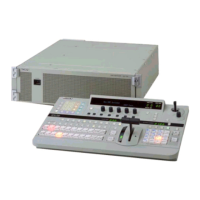
You can combine the DFS-700/700P with any editing control unit capable
of GPI signal output to carry out A/B roll editing using two players and
one recorder.
You can use one GPI signal to execute DFS-700/700P effects, and a
second GPI signal to turn the downstream key function on and off.
Preparations
Make the following preparations to control the DFS-700/700P using GPI
signals output by the editing control unit.
For details about operation, refer to the manuals supplied with your
editing control unit.
On the DFS-700/700P
•In page 1 of the setup menu, set F3(PORTS) to “GPI”.
•Press the EDITOR button on the control panel, turning it on.
(This button is lit when the DFS-700/700P is powered on.)
On the recorder VCR
•Set the recorder VCR so that it enters PB (playback) mode when stopped.
(If the VCR has a selector for PB or PB/EE, set it to PB.)
•If the VCR has a built-in TBC, set the VCR to DELAYED SYNC mode.
On the editing control unit
•Set the GPI signal output timing to 3 frames before the IN point.
•Set the GPI signal pulse length to at least 1 frame.
Notes
•To display the background image during or after a transition, press an
appropriate BACKGROUND bus button on the DFS-700/700P.
•Because the DFS-700/700P has a built-in frame synchronizer, output of
player VCR edit points set on the editing control unit is delayed by 1
frame, so that recording begins with the previous frame. However,
recorder edit points are not delayed. For example, if the IN point of the
player VCR is set to 00:00:10:15, recording begins from 00:00:10:14.


 To Next Page