EasyManua.ls Logo

Sony DPS-R7 - Key Considerations for Sound Editing; Importance of Using Actual Sound; DRY and EFFECT Control Levels; Tempo Synchronization for Effects

Sony DPS-R7
64 pages
Print Icon
To Next Page IconTo Next Page
To Previous Page IconTo Previous Page
Loading...
Important
Points
for
Editing
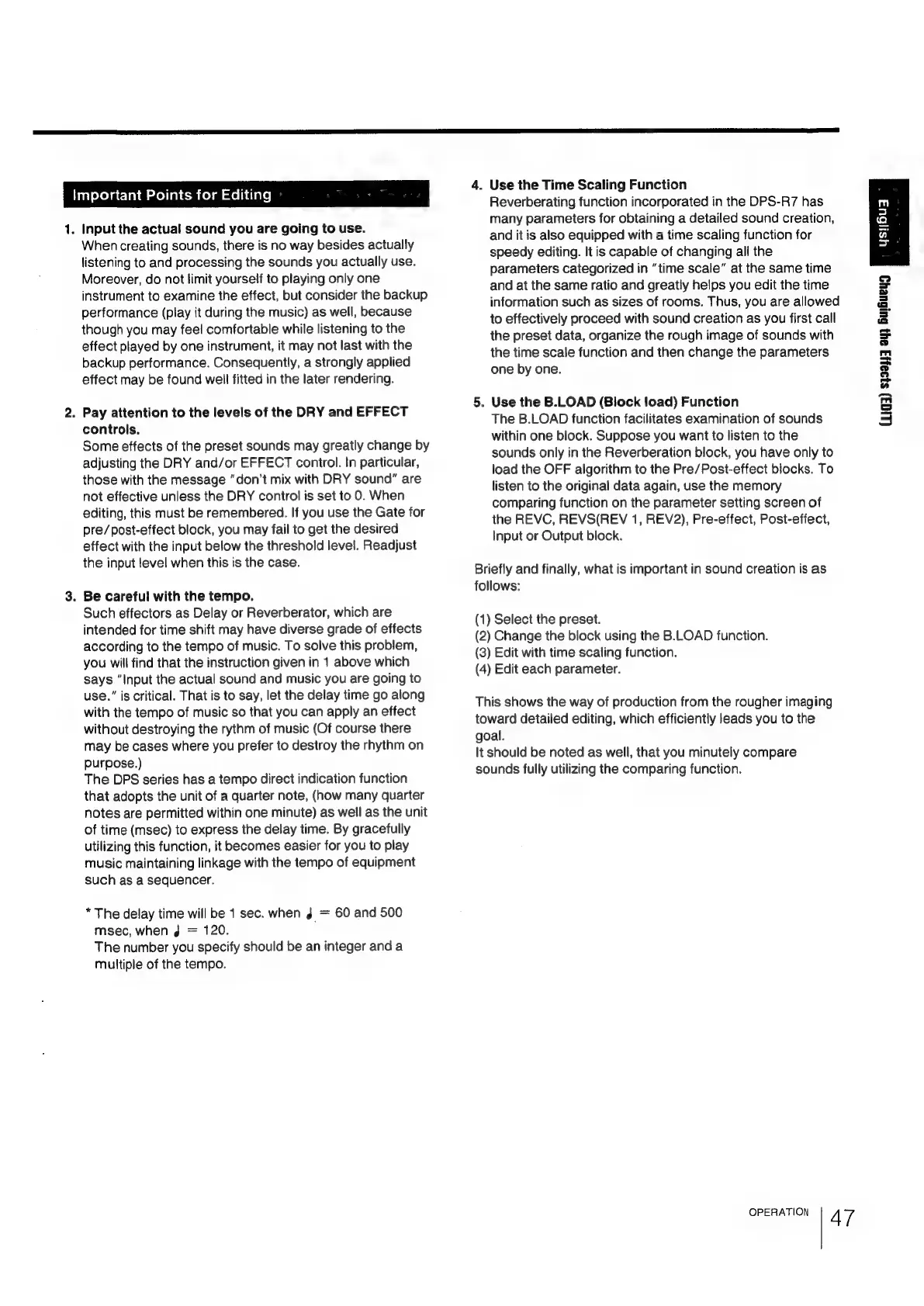
1.
Input
the
actual
sound
you
are
going
to
use.
When
creating
sounds,
there
is
no
way
besides
actually
listening
to
and
processing
the
sounds
you
actually
use.
Moreover,
do
not
limit
yourself
to
playing
only
one
instrument
to
examine
the
effect,
but
consider
the
backup
performance
(play
it
during
the
music)
as
well,
because
though
you
may
feel
comfortable
while
listening
to
the
effect
played
by
one
instrument,
it
may
not
last
with
the
backup
performance.
Consequently,
a
strongly
applied
effect
may
be
found
well
fitted
in
the
later
rendering.
2.
Pay
attention
to
the
levels
of
the
DRY
and
EFFECT
controls.
Some
effects
of
the
preset
sounds
may
greatly
change
by
adjusting
the
DRY
and/or
EFFECT
control.
In
particular,
those
with
the
message
“don’t
mix
with
DRY
sound”
are
not
effective
unless
the
DRY
control
is
set
to
0.
When
editing,
this
must
be
remembered.
If
you
use
the
Gate
for
pre/post-effect
block,
you
may
fail
to
get
the
desired
effect
with
the
input
below
the
threshold
level.
Readjust
the
input
level
when
this
is
the
case.
3.
Be
careful
with
the
tempo.
Such
effectors
as
Delay
or
Reverberator,
which
are
intended
for
time
shift
may
have
diverse
grade
of
effects
according
to
the
tempo
of
music.
To
solve
this
problem,
you
will
find
that
the
instruction
given
in
1
above
which
says
"Input
the
actual
sound
and
music
you
are
going
to
use.”
is
critical.
That
is
to
say,
let
the
delay
time
go
along
with
the
tempo
of
music
so
that
you
can
apply
an
effect
without
destroying
the
rythm
of
music
(Of
course
there
may
be
cases
where
you
prefer
to
destroy
the
rhythm
on
purpose.)
The
DPS
series
has
a
tempo
direct
indication
function
that
adopts
the
unit
of
a
quarter
note,
(how
many
quarter
notes
are
permitted
within
one
minute)
as
well
as
the
unit
of
time
(msec)
to
express
the
delay
time.
By
gracefully
utilizing
this
function,
it
becomes
easier
for
you
to
play
music
maintaining
linkage
with
the
tempo
of
equipment
such
as
a
sequencer.
*
The
delay
time
will
be
1
sec.
when
¢
=
60
and
500
msec,
when
¢
=
120.
The
number
you
specify
should
be
an
integer
anda
multiple
of
the
tempo.
4.
Use
the
Time
Scaling
Function
Reverberating
function
incorporated
in
the
DPS-R7
has
many
parameters
for
obtaining
a
detailed
sound
creation,
and
it
is
also
equipped
with
a
time
scaling
function
for
speedy
editing.
It
is
capable
of
changing
all
the
parameters
categorized
in
"time
scale”
at
the
same
time
and
at
the
same
ratio
and
greatly
helps
you
edit
the
time
information
such
as
sizes
of
rooms.
Thus,
you
are
allowed
to
effectively
proceed
with
sound
creation
as
you
first
call
the
preset
data,
organize
the
rough
image
of
sounds
with
the
time
scale
function
and
then
change
the
parameters
one
by
one.
5.
Use
the
B.LOAD
(Block
load)
Function
The
B.LOAD
function
facilitates
examination
of
sounds
within
one
block.
Suppose
you
want
to
listen
to
the
sounds
only
in
the
Reverberation
block,
you
have
only
to
load
the
OFF
algorithm
to
the
Pre/Post-effect
blocks.
To
listen
to
the
original
data
again,
use
the
memory
comparing
function
on
the
parameter
setting
screen
of
the
REVC,
REVS(REV
1,
REV2),
Pre-effect,
Post-effect,
Input
or
Output
block.
Briefly
and
finally,
what
is
important
in
sound
creation
is
as
follows:
(1)
Select
the
preset.
(2)
Change
the
block
using
the
B.LOAD
function.
(3)
Edit
with
time
scaling
function.
(4)
Edit
each
parameter.
This
shows
the
way
of
production
from
the
rougher
imaging
toward
detailed
editing,
which
efficiently
leads
you
to
the
goal.
It
should
be
noted
as
well,
that
you
minutely
compare
sounds
fully
utilizing
the
comparing
function.
OPERATION
4
7.
iJ
ss
a
=
a
I
2
ak
=
t.)
foal
=
eo
3
a
me?
m
3
3

Related product manuals