EasyManua.ls Logo

Sony DPS-R7 - Page 63

Sony DPS-R7
64 pages
Print Icon
To Next Page IconTo Next Page
To Previous Page IconTo Previous Page
Loading...
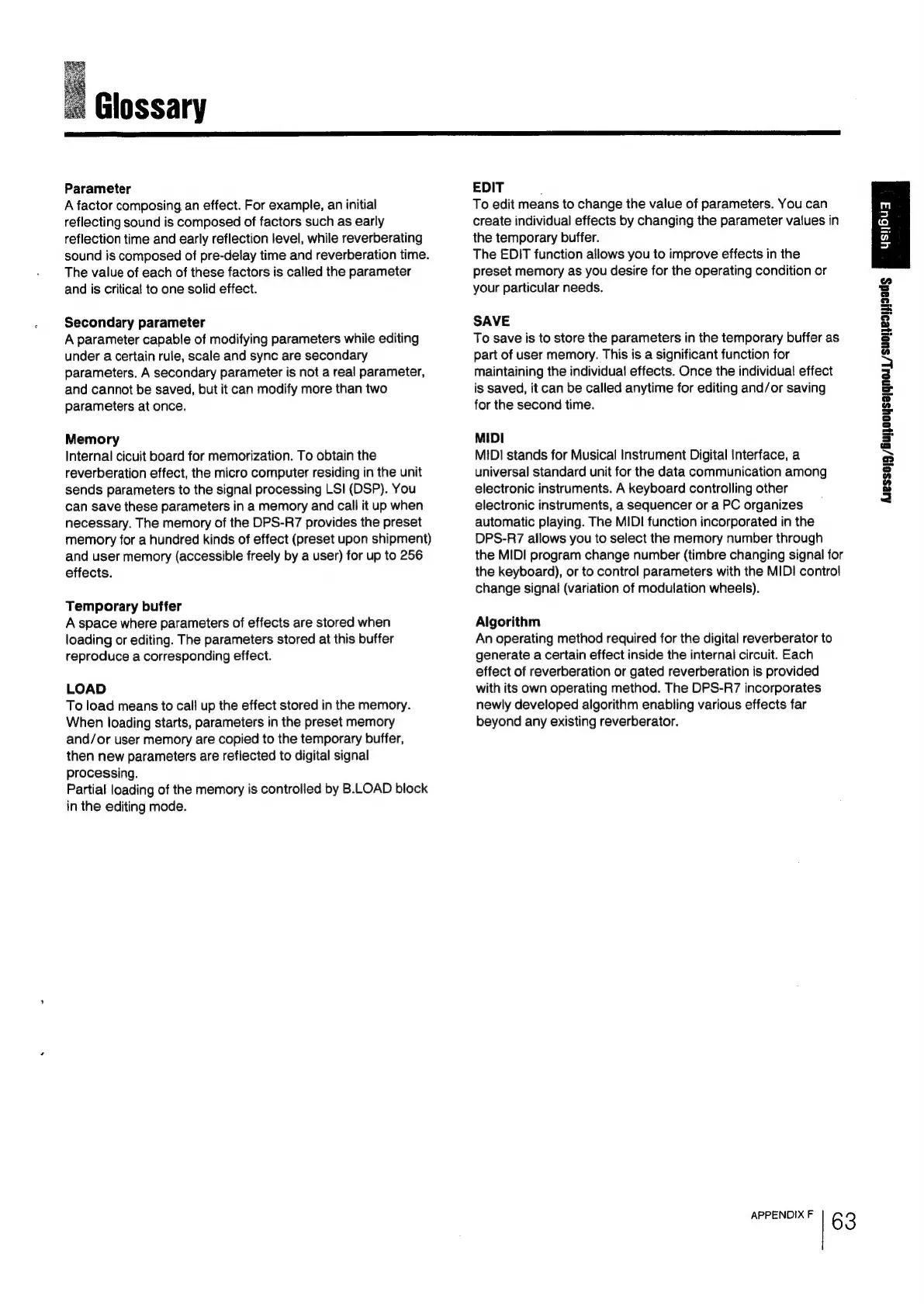
Glossary
Parameter
A
factor
composing
an
effect.
For
example,
an
initial
reflecting
sound
is
composed
of
factors
such
as
early
reflection
time
and
early
reflection
level,
while
reverberating
sound
is
composed
of
pre-delay
time
and
reverberation
time.
The
value
of
each
of
these
factors
is
called
the
parameter
and
is
critical
to
one
solid
effect.
Secondary
parameter
A
parameter
capable
of
modifying
parameters
while
editing
under
a
certain
rule,
scale
and
sync
are
secondary
parameters.
A
secondary
parameter
is
not
a
rea!
parameter,
and
cannot
be
saved,
but
it
can
modify
more
than
two
parameters
at
once.
Memory
Internal
cicuit
board
for
memorization.
To
obtain
the
reverberation
effect,
the
micro
computer
residing
in
the
unit
sends
parameters
to
the
signal
processing
LSI
(DSP).
You
can
save
these
parameters
in
a
memory
and
call
it
up
when
necessary.
The
memory
of
the
DPS-R7
provides
the
preset
memory
for
a
hundred
kinds
of
effect
(preset
upon
shipment)
and
user
memory
(accessible
freely
by
a
user)
for
up
to
256
effects.
Temporary
buffer
A
space
where
parameters
of
effects
are
stored
when
loading
or
editing.
The
parameters
stored
at
this
buffer
reproduce
a
corresponding
effect.
LOAD
To
load
means
to
call
up
the
effect
stored
in
the
memory.
When
loading
starts,
parameters
in
the
preset
memory
and/or
user
memory
are
copied
to
the
temporary
buffer,
then
new
parameters
are
reflected
to
digital
signal
processing.
Partial
loading
of
the
memory
is
controlled
by
B.LOAD
block
in
the
editing
mode.
EDIT
To
edit
means
to
change
the
value
of
parameters.
You
can
create
individual
effects
by
changing
the
parameter
values
in
the
temporary
buffer.
The
EDIT
function
allows
you
to
improve
effects
in
the
preset
memory
as
you
desire
for
the
operating
condition
or
your
particular
needs.
SAVE
To
save
is
to
store
the
parameters
in
the
temporary
buffer
as
part
of
user
memory.
This
is
a
significant
function
for
maintaining
the
individual
effects.
Once
the
individual
effect
is
saved,
it
can
be
called
anytime
for
editing
and/or
saving
for
the
second
time.
MIDI
MIDI
stands
for
Musical
Instrument
Digital
Interface,
a
universal
standard
unit
for
the
data
communication
among
electronic
instruments.
A
keyboard
controlling
other
electronic
instruments,
a
sequencer
or
a
PC
organizes
automatic
playing.
The
MIDI
function
incorporated
in
the
DPS-R7
allows
you
to
select
the
memory
number
through
the
MIDI
program
change
number
(timbre
changing
signal
for
the
keyboard),
or
to
control
parameters
with
the
MIDI
control
change
signal
(variation
of
modulation
wheels).
Algorithm
An
operating
method
required
for
the
digital
reverberator
to
generate
a
certain
effect
inside
the
internal
circuit.
Each
effect
of
reverberation
or
gated
reverberation
is
provided
with
its
own
operating
method.
The
DPS-R7
incorporates
newly
developed
algorithm
enabling
various
effects
far
beyond
any
existing
reverberator.
APPENDIX
F
6 3
fuessoj9/Guijooysajqnosy
/Suo}esyisads

Related product manuals