2.10. Low-Pass Filter.
After I/V conversion, a simple low-pass filter is
all that's required to produce an analog output.
Conventional low-pass filters use transistors, op
amps or other active circuit elements in the sig-
nal path. Because Sony was intent on preserv-
ing the simplest possible signal path, we chose
a different design. Our General Impedance
Circuit (GIC) low-pass filter positions the active
circuit elements outside the signal path, to
preserve the integrity of the original sound.
The GIC low-pass filter takes transistors,
op amps and other active circuit elements
out of the signal path.
Super Audio Compact Discs can have frequency
response to 100,000 Hz. As such, the cut-off
frequency and characteristics of the low-pass
filter have a direct impact on the audio
specifications—and sound quality—of the player.
Refining the sound means balancing the various
design goals: flat amplitude response, maximum
high-frequency extension, low noise, optimum
phase characteristics and suitability with
downstream audio equipment.
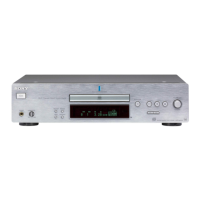
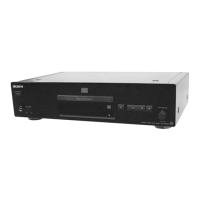
The GIC circuit of the Sony SCD-1 and
SCD-777ES take all these factors into account.
Frequency response is flat to 50,000 Hz (some
two and a half times the response of a CD player).
Above 50,000 Hz, response begins to roll off
slowly. The result is smooth, open, non-fatiguing
sound with exceptional definition and dynamics.
Sony's filter design achieves
flat response to 50,000 Hz.
The GIC filter is followed by a discrete
component buffer amp, for optimum coupling
to a preamplifier.
Analog circuit with GIC low-pass filter.
Fig. 12 Characteristics of Low-Pass Filter Used in SCD-1
Fig. 11 GIC Type Low-Pass Filter


 To Next Page