Sony solves the problem with Accurate
Complementary Pulse Density Modulation. ACP
represents each digital 1 as wide 1 followed by a
narrow 0. ACP represents each digital 0 as a
narrow 1 followed by a wide 0. In this way, every
sample includes both a 1 and 0. So every sam-
ple has the same minimal switching distortion.
As a result, the distortion is easy to remove in
subsequent processing.
The ACP system establishes extraordinary
precision on the amplitude axis, a crucial factor
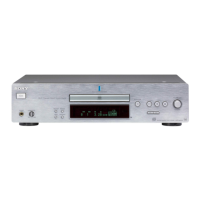
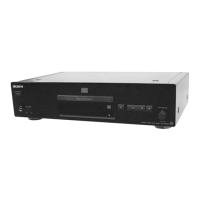
in the audio performance of the SCD-1 and
SCD-777ES players.
2.8. Synchronous Time Accuracy
Controller (S-TACT).
From the early days of digital audio, it was obvi-
ous that amplitude errors would equal distor-
tion. Less obvious, but equally true was that
time-base errors could also distort the analog
waveform. For this reason, the SCD-1 and
SCD-777ES have Sony's most comprehensive
defense against time-base errors.
All digital playback circuits incorporate quartz
crystal oscillators to regenerate precisely timed
pulses. But not all circuits achieve the full preci-
sion of the quartz crystal. A major cause of time-
base error is digital noise, introduced through the
clock generator's power supply. For example,
the digital filter, noise shaper and ACP systems
all have high-speed IC circuitry, handling digital
words up to 50 bits long—at clock speeds up to
8 times the sampling frequency of Super Audio
Compact Disc.
Conventional circuits place the clock generator
on the same IC chip as high-speed digital opera-
tions. The arrangement is efficient, but it expos-
es the clock generator to high levels of digital
noise through the power supply voltage. The
result is distortion of the clock signal—jitter.
7


 To Next Page