2.6. DSD™ Decoder.
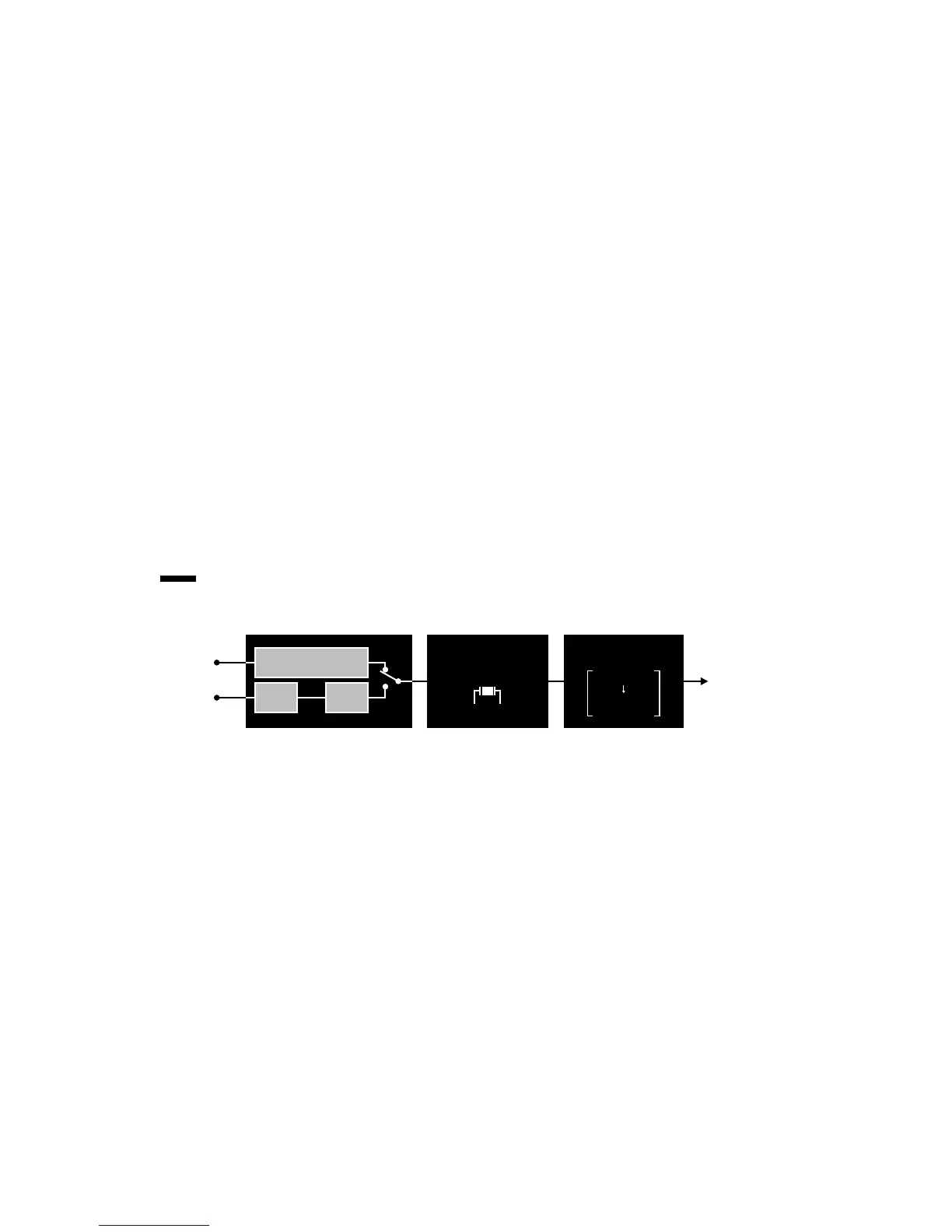
The RF processor extracts the data contained on
the disc, without interpreting, analyzing or read-
ing it. Organizing the data into left and right
pulse streams is the job of the DSD decoder.
Another Sony-built LSI, the DSD decoder first
reads the invisible watermark—a key anti-piracy
feature—and then decodes the incoming data.
Data on the disc originate as alternating bursts
of left-channel and right-channel information.
Buffer memory and master clock sync enable the
bursts to be output as two continuous, simulta-
neous streams.
The DSD decoder also reads sub code data,
including text and Table of Contents information
such as track number and playing time.
2.7. ACP System.
In principle, it is possible to convert the Direct
Stream Digital signal into analog with nothing
more than a low-pass filter. In practice, the DSD
signal benefits from some highly specialized pro-
cessing. To preserve the maximum accuracy of
the DSD pulses, our design program identified
two basic goals:
* Amplitude axis precision
* Time axis precision
Sony's Accurate Complementary Pulse Density
Modulation (ACP) system and Current Pulse D/A
Converter meet the first goal. The second goal is
achieved by Sony's Synchronous Time Accuracy
Controller (S-TACT).
5
The entire conversion system is optimized for precision on the amplitude axis and the time axis.


 To Next Page