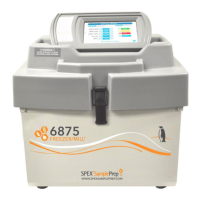
2010 Geno/Grinder
Page 4 of 28 SPEX® SamplePrep LLC July 2014
1.0 INTRODUCTION
The Geno/Grinder® is designed to effectively disrupt cellular materials by oscillating two or
more deep-well titer plates vertically. This motion allows the unit to be used to prepare
sample tissue for extractions of nucleic acid, protein, and other constituents by shaking the
tissue, steel balls and a buffering agent together in each well of the titer plate.
Operation is simple: the titer plates are secured in a clamp, and the cabinet cover closed.
The controls are checked for the proper running time and stroke rate, and the START button
pushed. When the run is complete, the top cover is lifted and the titer plates unclamped.
(Run times are typically less than two minutes.)
The isolation of nucleic acids from intact samples requires mechanically disrupting the
samples, followed by the extraction and subsequent purification of the nucleic acid.
Mechanical tissue disruption is often performed manually with a mortar and pestle, an
approach that is not practical for high-throughput screening since manual grinding of
tissues is slow, and re-use of mortars and pestles may lead to cross-contamination.
Alternatively, nucleic acids can be isolated in a multi-well plate format using a ball mill that
mechanically disrupts the sample. Conventional isolation methodologies can then be used
to extract the nucleic acids from the homogenates.
In seed processing, the efficiency of seed disruption is dependent upon the type of ball mill
used in the grinding process. Standard bead mills adapted to multi-well plates are modeled
after paint shakers and move the plates in an arc or “figure-eight”. This motion does not
lead to uniform disruption from well to well of the titer plate.
Sample materials that can be prepared include seeds, stems, roots, leaves, and certain
animal tissue. Because the unique vertical shaking motion of the Geno/Grinder is so strong,
many seeds and other forms of plant tissue can also be pulverized dry in titer plates with
the help of one or two grinding balls per well.
The Geno/Grinder is also highly effective at improving extractions from food products, such
as for pesticide analysis according to the QuEChERS
1
method. A pre-homogenized fruit or
vegetable sample of 10-15 g is placed in a 50 mL round-bottomed centrifuge tube and the
appropriate salts and solvent are added. Two ceramic grinding cylinders are added; the
tubes are capped and shaken on the Geno/Grinder for 1 min. Following clean-up, the
samples are analyzed by LC or GC-MS. Pesticide recovery in samples prepared using the
Geno/Grinder has been found to be significantly improved over samples prepared
manually.
1
QuEChERS method developed by the USDA Eastern Regional Research Center. M. Anastassiades, S.J. Lehotay,
D. Stajnbaher, F.J. Schenck, J. AOAC International 86, p. 412-431 (2003).


 To Next Page