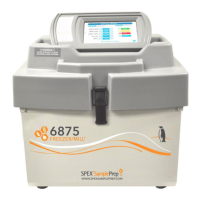
2010 Geno/Grinder
Page 20 of 28 SPEX® SamplePrep LLC July 2014
7.0 OPERATION
Before operating the Geno/Grinder, make sure it is plugged in and switched on. The power
cord inlet is located on the rear of the cabinet, next to the off/on switch and the fuse tray.
The off/on switch is a standard rocker switch with symbols 0 (for OFF) and I (for ON).
The following steps outline a standard operating cycle:
1. Load and seal the titer plates or load and cap the sample vials.
2. Clamp the titer plates/vials in place, using spacers as needed.
3. Close the top cover.
4. Set the timer.
5. Set the clamp stroke rate.
6. Press the START button to run the Geno/Grinder.
7. When the run is complete, lift the cover.
8. Unclamp the titer plates/vials.
7.1 Preparing the Titer Plates
While the precise details are left to the individual user, each well in the titer plate can be
loaded with a seed, plant tissue, or other sample, and an eluent, solvent, etc. If it is
necessary to disrupt the sample, a grinding element is typically added first. The 2100
Grinding Ball Dispenser available for the Geno/Grinder will deposit one 5/32” (4 mm) steel
ball layer in each well of the titer plate. Dry grinding may require a second ball in each well,
possibly sandwiching the sample between them during grinding.
To use the 2100 Grinding Ball Dispenser, fill the tray with more than enough steel balls to
cover the bottom, and shake it gently until a steel ball falls into every hole. Then place the
dispenser over an empty titer plate and push in the slide, releasing the balls caught in the
slide. Set the dispenser aside, and check that a ball is in each well of the titer plate.
Sealing the loaded titer plate is, again, a matter of choice, which can vary with the brand of
titer plate and the necessity of sealing a fluid in each well. Some manufacturers of titer
plates make sealing systems; many technicians have also developed other methods for
plugging the top of each well. Users must decide for themselves which method is most
effective. What matters most is that the contents of one well do not contaminate the
sample in an adjacent well.
NOTE: Because the action of the Geno/Grinder is so energetic and efficient, run times are
short, typically from 10 seconds to 2 minutes. When developing a procedure, always start
with a short running time and increase it only if needed.


 To Next Page