EasyManua.ls Logo

ST ST7 Series - User Manual

ST ST7 Series
14 pages
Print Icon
To Next Page IconTo Next Page
Loading...
ST7 FAMILY
USB LOW-SPEED
EVALUATION BOARD
GETTING STARTED
October 2002
DOC-USB LOW-SPEED Evaluation Board
Question and Answer IconNeed help?

Do you have a question about the ST ST7 Series and is the answer not in the manual?

Summary

Introduction to the ST7 USB Evaluation Board

Getting Started with the ST7 USB Evaluation Board

System Requirements

Specifies necessary OS, software versions, and HID.dll files for evaluation board operation.

Package Contents

Lists hardware (microcontroller devices, board) and software (firmware, PC app) included in the package.

Software Installation Guide

Provides step-by-step instructions for installing the PC HID demonstrator and its components.

Hardware Installation and Configuration

Covers board layout, power supply, jumper settings (W1, W6, W7), and device selection for the evaluation board.

Running the USB Low-Speed Evaluation Board

Application Introduction and Communication

Overview of the evaluation board application, USB pipes, and data transfer methods.

HID Demonstrator and Device Interaction

Explains the HID demonstrator interface, USB enumeration, controlling LEDs, and displaying board status via the PC.

Remote Wake-Up Functionality

Details how to configure and use the board to wake up a PC from Stand-By mode.

Wire-Wrap Area Circuitry

Defines connection points for microcontrollers on the wire-wrap area for signal probing or rewiring.

SDIP42;DIP20 Adaptor Proposal

Presents a proposal and layout for an adapter to connect SDIP42 to DIP20 packages.

Overview

The ST7 USB Low-Speed Evaluation Board is a comprehensive development package designed to facilitate the creation of USB applications using STMicroelectronics' ST7 family of low-speed microcontrollers. This board serves as a peripheral device, interacting with a Windows-based host software application to demonstrate data exchange via HID (Human Interface Device) class protocols.

Function Description:

The primary function of the evaluation board is to provide a complete environment for developing and testing USB low-speed applications. It integrates a ST7 microcontroller (either an ST72F62 or ST72F63B, pre-programmed with demonstration firmware) and a USB core library developed by STMicroelectronics. This library simplifies USB interface hardware control, allowing developers to focus on application-specific logic. The package includes both PC executable software (with C source code) and ST7 firmware (C source code) for demonstrating HID transfers, offering a clear example of data exchange between the PC and the ST7 peripheral.

The board incorporates basic input and output sources to enable immediate interaction and application development. These include push-buttons (SW1, SW2, SW3), an analog trimmer (RV1), and LEDs (LD1, LD2, LD3). The host software provides a graphical interface (HID Demonstrator) to control these elements and display the board's state. For instance, users can switch LEDs on/off, adjust LED brightness via a slider bar (which converts to a Pulse Width Modulation signal by the microcontroller), and monitor the state of push-buttons and the analog trimmer's value.

The communication between the PC and the ST7 board utilizes different USB pipes:

  • Control IN and OUT: Used during enumeration with the bi-directional Endpoint 0.
  • Interrupt IN: From Endpoint 1, for data transferred from the ST7 to the PC.
  • Interrupt OUT: To Endpoint 2, for data transferred from the PC to the ST7. Notably, the Windows 98 HID driver automatically uses the control OUT pipe to Endpoint 0 instead of interrupt OUT transfers for the Set-Output function.

The board also supports a remote wake-up function, allowing the PC to be woken from Stand-By mode by pressing specific buttons on the evaluation board (SW3 for ST72F62/ST72F61 or SW2 for ST72F63B). This feature requires enabling the remote wake-up capability in the PC's Device Manager settings.

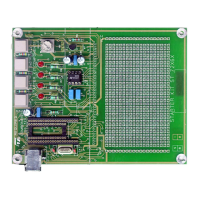
For advanced development, the board includes a wire-wrap area with 43 holes, providing access to all microcontroller pins and one side of the analog trimmer. These connection points are crucial for signal probing, rewiring, and adding custom circuitry.

Important Technical Specifications:

  • Microcontrollers Supported:
    • ST72F62 in SDIP42 package (external socket)
    • ST72F63B in SDIP32 package (internal socket)
    • ST72F61 in DIP20 (requires a user-supplied SDIP42-DIP20 adaptor)
  • Memory: Flash devices, allowing up to 100 reprogramming cycles.
  • Power Supply: Bus-powered via the USB connector. An external 12V charge pump is provided for In-Application Programming (IAP) of the ST7 embedded Flash program memory. If components added to the wire-wrap area draw more than 500mA, an external power supply is required.
  • Operating System Compatibility: Requires a recent version of Windows (Windows 98, Windows 98 SE, Windows Millennium, Windows 2000, or Windows XP). Specific HID.dll file versions are required for each OS.
  • Input/Output Features:
    • Push-buttons (SW1, SW2, SW3)
    • Analog trimmer (RV1)
    • LEDs (LD1, LD2, LD3)
  • Connectivity: USB connector for PC interface.
  • Development Tools (ordered separately): Assembler, linker, C compiler, source level debugger, hardware emulator, programming boards, and gang programmer.
  • Documentation Included: USB library interface documentation, ST7262 and ST7263B Datasheets, and Application Note AN1325.

Usage Features:

  • Ease of Use: The board is designed for quick setup. After connecting to a PC via a USB cable, it is enumerated as an HID device and ready for use with the provided HID Demonstrator software.
  • Demonstration Firmware: The microcontrollers come pre-programmed with demonstration firmware, allowing immediate interaction with the HID Demonstrator software.
  • Graphical User Interface: The HID Demonstrator on the PC offers a user-friendly graphical interface to control the evaluation board's features and display its status.
  • Flexible Device Selection: Users can select between different ST7 microcontrollers (ST72F62, ST72F63B, ST72F61) depending on their application needs, utilizing different sockets or an adaptor.
  • Analog Trimmer Control: Jumper W1 allows selection of the analog trimmer. Removing the jumper disconnects the trimmer from Ground to conserve power in USB suspend state, which can be replaced by a switch transistor for A/D conversion in application development. Jumper W6 connects the analog trimmer to a specific I/O port (PA0 for ST72F62, PB0 for ST72F63B), with flexibility to wire it to other analog input pins.
  • Flash Programming: Jumper W7 enables connection/disconnection of an external 12V charge pump for programming the Flash memory.
  • Expandability: The wire-wrap area provides ample space and connection points for adding custom circuitry, allowing developers to extend the board's functionality for specific applications.
  • Remote Wake-Up: The ability to wake up the PC from Stand-By mode via board buttons enhances convenience for certain applications.

Maintenance Features:

  • Reprogrammable Flash: The ST7 microcontrollers are Flash-based, supporting up to 100 reprogramming cycles, which is beneficial for iterative development and debugging without needing to replace the chip.
  • Comprehensive Documentation: The package includes detailed documentation, such as datasheets and an application note, which are essential for understanding the device's operation, troubleshooting, and developing custom applications.
  • Software Updates: While not explicitly detailed as a maintenance feature, the reliance on Windows OS and HID.dll versions implies that keeping the host PC's drivers and OS updated is crucial for optimal performance and compatibility.
  • Modular Design: The use of sockets for microcontrollers allows for easy replacement or swapping of different ST7 devices, simplifying maintenance and enabling testing with various chip configurations.
  • Debug and Probing Points: The wire-wrap area's connection points serve as convenient locations for signal probing, aiding in debugging and verifying circuit behavior during development.

ST ST7 Series Specifications

General IconGeneral
BrandST
ModelST7 Series
CategoryMotherboard
LanguageEnglish

Related product manuals