BASH_02_1.FM
1 Safety instructions
510.08
1.3 Use for intended purpose
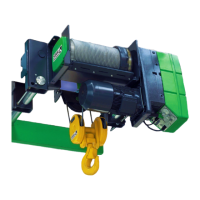
• Wire rope hoists are intended for lifting freely movable and guided loads that
cannot tilt. Depending on their design, they are for stationary or mobile use. If
loads are to be towed horizontally, or in the case of guided loads, automatic opera-
tion, continual deadweight or constantly repeated hoisting motions, the individual
application must be assessed. Please contact the manufacturer in case of doubt.
• Any fundamental alterations and modifications to the wire rope hoist, such as e.g
welding on load-bearing components, structural alterations to load-bearing com-
ponents, alteration of drives, alteration of speeds and motor outputs, replacing
trolleys, etc. must be authorised by the manufacturer, otherwise the declaration of
conformity will be invalidated.
• Also any work on or additions to the control must be authorised by the manufactu-
rer. The manufacturer cannot accept any liability for malfunctioning after unautho-
rised work on the control.
Not permitted:
• Exceeding the safe working load
• Transporting persons
• Pulling loads at an angle
• Pulling loads loose
• Pulling or towing loads if the wire rope hoist has not been especially designed for
this application.
• Manipulating the overload cut-off, apart from corrections as described on page 57.
• Operating the hoist with slack rope.
• If the hoist forms "part of a machine," the person placing it on the market must
ensure that the hoist meets the specific regulations of the application
1.4 Safety-conscious operation
SH wire rope hoists are constructed according to the state of the art and equipped
with an overload cut-off. In spite of this, dangers may arise from incorrect use or use
for an unintended purpose.
• The user is responsible for ensuring that work is carried out with safety in mind
and avoiding risks, see page 2.
• Read the operating instructions before starting to work with the wire rope hoist.
• Do not lift any loads heavier than the rated load.
• Standing under a suspended load is forbidden. Danger to life and limb!
• Observe the "Duties of crane operator", see page 30.
• Before starting work, find out where the EMERGENCY STOP button is (usually in
the control pendant).
•Do not put your hand between edges which might pinch or cut.
• Do not use the emergency limit switch (ultimate limit switch for highest and lowest
hook position) as an operational limit switch.
• Report damage and defects to the wire rope hoist (abnormal noises, impaired
braking function, deformations, ...) to the person responsible immediately. Do not
use the wire rope hoist until the faults have been eliminated.
• Do not remove information plates from the wire rope hoist. Replace illegible or
damaged plates.
• Have hoist inspected by the relevant authority before commissioning.
1.5
Organisational safety precautions
• Only direct persons to operate the hoist if they have been trained or instructed in
its use. Observe the legal minimum age!
• At regular intervals, check that work is being caried out in a safety-conscious
manner.
• Observe the intervals specified for periodic tests. File the test reports in the test log
book.
• Store the operating instructions within easy reach where the wire rope hoist is
operated.



 To Next Page