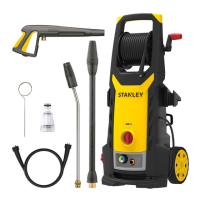
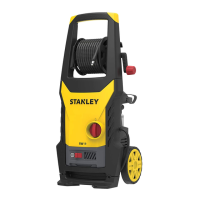
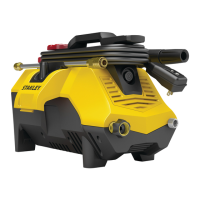
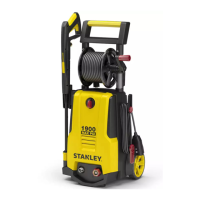
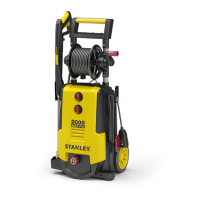
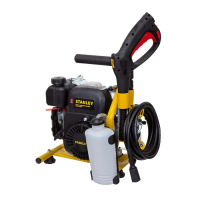
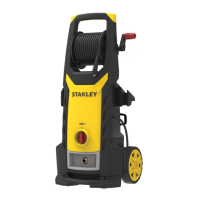
This document describes the STANLEY SW22 pressure washer, a device designed for individual use in cleaning vehicles, machines, boats, masonry, and other surfaces by removing stubborn dirt using clean water and biodegradable chemical detergents.
Function Description
The STANLEY SW22 is a high-pressure cleaner that utilizes a powerful water jet to dislodge dirt and grime. It is equipped with a starter device (12) to prevent accidental use and a safety catch (19) on the gun to prevent accidental spraying of water. The appliance can deliver detergent, with the quantity adjusted by a regulator (11) and the nozzle (2) set to the appropriate position. The device is designed to be connected to a mains drinking water supply, provided a backflow preventer valve with a drain facility is installed in the supply hose.
For models with the Total Stop System (TSS), the motor automatically cuts out when the gun trigger is released and restarts with a slight delay when the trigger is depressed, provided operations are at least 4-5 seconds apart. This system helps prevent damage to the appliance from operating dry or overheating.
Important Technical Specifications
The STANLEY SW22 operates on a rated voltage of 220-240V~ at a frequency of 50Hz. It has a power consumption of 2200W. The working flow rate is 7 l/min, with a maximum water flow of 8 l/min. The operating pressure is 12 MPa (120 bar), and the maximum pressure can reach 14.5 MPa (145 bar), corresponding to a MAX PSI of 2103. The maximum input temperature for water is 50 °C, and the maximum input pressure is 1 MPa. The repulsive force of the gun at maximum pressure is 12.5 N. The device has a degree of protection rated at IPX5.
Regarding noise levels, the sound pressure level (LPA) is 72 dB(A) and the sound power level (LWA) is 88 dB(A), both with a K=2.5 dB(A) uncertainty. Unit vibrations are less than 2.5 m/s² (K=1 m/s²). The total weight of the appliance is 20.5 kg (45.2 lb).
The appliance is compliant with IEC 60335-1 and IEC 60335-2-79 standards. The intake water pressure should be between min. 0.1 MPa and max. 1 MPa, and the operating ambient temperature should be above 0 °C.
Usage Features
Assembly and Installation: All assembly operations, as illustrated in Fig. B, must be performed with the appliance disconnected from the mains power supply. The appliance should be placed as close as possible to the water supply system. Only clean or filtered water should be used for intake, and the delivery of the water intake tap should match the pump capacity.
Nozzle and Detergent Adjustment: The appliance includes a rotating nozzle kit (1) which provides greater washing power, though it may reduce pressure by 25% compared to the adjustable nozzle. The water flow can be adjusted by regulating the nozzle (2). For detergent delivery, the nozzle (2) should be set to the "SOAP" position (Fig. C), and the quantity of detergent is adjusted using the regulator (11).
Starting and Stopping: To start, turn on the water supply tap fully, release the safety catch (16), depress the gun trigger for a few seconds, and then start the appliance using the starter device (ON/I). It is crucial to ensure the appliance is receiving water correctly before starting to prevent damage. Do not cover ventilation grilles during use. To stop, set the starter device switch to (OFF/0), depress the gun trigger to discharge residual pressure, and engage the safety catch (16). For TSS models, the gun trigger operations must be at least 4-5 seconds apart for correct functioning.
Recommended Cleaning Procedure: For optimal results, apply detergent mixed with water to the dry surface, working from bottom upwards on vertical surfaces. Allow the detergent to act for 1-2 minutes without letting the surface dry. Use the high-pressure jet at a minimum distance of 30cm, again working from the bottom. Avoid letting rinse water run onto unwashed surfaces. Note that high pressure is not always the best solution for delicate or painted parts, or pressurized components like tires; the finest adjustable nozzle jet setting or the rotopower nozzle should not be used on such surfaces.
Safety Features: The appliance is equipped with a safety valve and/or pressure limiting valve that opens to recirculate water through the pump inlet or discharge it onto the ground when the gun trigger is released. Some models may include a thermostat valve that discharges hot water and draws in cold water if the temperature exceeds a set limit. An overload cutout stops the appliance in case of overload.
Extension Cables: If an extension cord is used, it must be suitable for outdoor use, kept dry and off the ground, and have an "IPX5" protection level. The cross-section of the cable should be proportionate to its length.
Maintenance Features
General Maintenance: Any maintenance operations not covered in the manual should be performed by an authorized sales and service center. Always disconnect the plug from the power socket before performing any work on the appliance.
Motor Unjamming: In cases of lengthy stoppages, limescale sediments may cause the motor to seize. To unjam the motor, turn the drive shaft with a tool (Fig. E).
End-of-Season Storage: Before storing for winter, treat the appliance with non-corrosive, non-toxic antifreeze. Store the appliance in a dry place, protected from frost. Accessories should be stored as shown in Fig. E.
Troubleshooting: The manual provides a comprehensive troubleshooting guide for common issues such as the pump not reaching working pressure, pressure drops, motor failure, water leakage, and noisy operation. Solutions range from cleaning filters and nozzles to checking hose fittings, power supply, and contacting an authorized service center. For instance, if the nozzle is worn, it should be replaced. If the inlet filter (6) is fouled, it should be cleaned (Fig. E). If the motor "buzzes" but fails to start, possible causes include low power supply voltage or problems with the TSS device, requiring checks of the extension cable or contacting a service center.
Environmental Protection: The product must not be disposed of with normal household waste. It should be made available for separate collection to allow for recycling and reuse of materials, preventing environmental pollution.
Service Information: STANLEY offers a full network of company-owned and authorized service locations with trained personnel for efficient and reliable power tool service. For warranty purposes, repairs, maintenance, and adjustments (other than those listed in the manual) must be performed by authorized service centers or qualified organizations using identical replacement parts. The unit contains no user-serviceable parts inside. If the power cord is damaged, it must be replaced by the manufacturer, an authorized STANLEY Service Center, or an equally qualified person to avoid damage or injury; otherwise, the warranty will not be valid.


 To Next Page

 General