EasyManua.ls Logo

Suhr Eclipse - User Manual

Suhr Eclipse
11 pages
Print Icon
To Next Page IconTo Next Page
Loading...
User Guide
Question and Answer IconNeed help?

Do you have a question about the Suhr Eclipse and is the answer not in the manual?

Summary

Overview

Getting Connected

Installing;Replacing The Battery

Details the process for installing or replacing the internal 9V battery.

Channel Selection; Bypass

Controls

Battery Monitor

3-Position Slide Switch

Explains the function of the 3-position slide switch for channel selection or external control.

FX Link (External Control)

Setup

Provides instructions for connecting and setting up external control via the FX LINK jack.

Sample Settings

Technical Specifications

Warranty

Outlines the warranty terms and conditions for the product, covering defects and exclusions.

Overview

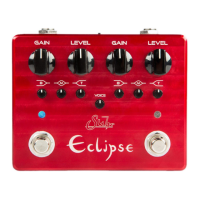
The Suhr Eclipse is a versatile dual-channel overdrive/distortion pedal designed to deliver a wide range of warm, organic, and amp-like tones in a compact form factor. It offers two independent channels, each with its own Gain, Level, and 3-Band passive EQ, similar to a channel-switching amplifier. This design allows for independent voicing of each channel to accommodate various playing needs, from tight, scooped rhythm sounds to saturated, midrange-focused tones for solos.

Function Description:

The core function of the Suhr Eclipse is to provide a comprehensive overdrive and distortion solution for guitarists. Its dual-channel architecture allows for seamless switching between different tonal characteristics, effectively giving the user two distinct drive pedals in one unit. The passive EQ circuit is designed to be as amp-like and natural as possible, making the pedal equally adept at producing low-gain overdriven sounds and aggressive, high-gain distortion.

Each channel features dedicated controls for Gain, Level, Bass (B), Middle (M), and Treble (T). The Gain knob adjusts the amount of drive, ranging from classic crunch to high-gain distortion. The Level knob controls the output volume, providing enough boost to push the front end of a tube amp into natural overdrive. The 3-band EQ knobs (B, M, T) are shelving filters that allow for reduction (counter-clockwise) or boost (clockwise) of their respective frequency ranges. This granular control over each channel's EQ enables players to sculpt their tone precisely, whether aiming for a scooped modern metal sound or a mid-heavy classic rock crunch.

A unique global Voice control allows for fine-tuning the overall brightness of the pedal to match different amplifiers. This knob is particularly useful for compensating for overly dark or bright amps. Turning the Voice knob counter-clockwise reduces high frequencies, while turning it clockwise increases them, affecting both channels globally. This feature ensures that the Eclipse integrates seamlessly into various amplifier setups, maintaining a pleasant overdriven/distortion tone even with amps that have bright switches engaged.

The Eclipse also incorporates advanced features for enhanced usability and integration into complex rigs. The FX LINK (External Control) input allows the pedal to be controlled by external effects switching systems, such as the BOSS ES-8 or ES-5, using a stereo TRS cable. This enables remote switching of channels and bypass, making the Eclipse incredibly rig-friendly. The pedal can be configured to power on in a desired channel (Channel 1 or Channel 2) or to accept external control via the FX LINK jack, with neither channel activated initially.

Usage Features:

  • Dual-Channel Operation: The Eclipse offers two independent channels (Channel 1 indicated by a blue LED, Channel 2 by a red LED) with separate Gain, Level, and 3-band EQ controls. This allows for setting up two distinct overdrive/distortion sounds that can be switched between instantly.
  • Channel Selection/Bypass: Dedicated footswitches for each channel allow for easy activation or deactivation. Stepping on the left switch turns Channel 1 on or off, while the right switch controls Channel 2. Switching from one channel to another automatically deactivates the previously engaged channel. When neither channel is selected, the pedal operates in True Bypass mode, ensuring the guitar signal passes through unaffected via a relay.
  • Intuitive EQ Controls: The passive 3-band EQ on each channel provides familiar and effective tone shaping, mimicking the response of a channel-switching amplifier. This allows for precise adjustments to bass, middle, and treble frequencies to suit different guitars, amplifiers, and musical styles.
  • Global Voice Control: The Voice knob offers a global adjustment to the pedal's high-end response, making it adaptable to various amplifier characteristics. This helps maintain a consistent and pleasing tone regardless of the amp used.
  • External Control via FX LINK: The 1/8” stereo TRS input for FX LINK enables remote control of Channel 1 and Channel 2 activation/deactivation through an external effects switching system. This is ideal for players using complex pedalboards and MIDI switchers, allowing for seamless integration and preset recall.
  • Startup Channel Configuration: A 3-position slide switch located between the Input and Output jacks allows the user to pre-select the power-on state of the pedal. It can be set to power on with Channel 1 activated, Channel 2 activated, or in FL (center) mode, which enables external control via FX LINK and starts with neither channel activated.
  • Versatile Tonal Range: From classic crunch and overdriven tones to tight, high-gain aggressive distortion, the Eclipse is designed to cover a broad spectrum of sounds. The ability to independently voice each channel means one can be set for rhythm and the other for lead, or for two entirely different sonic textures.

Maintenance Features:

  • Battery Power Option: The Eclipse can be powered internally by a 9V battery, offering portability and independence from external power supplies.
  • Battery Monitor: The pedal features an internal 9V battery monitor that alerts the user when the battery voltage becomes low. Upon powering up, if the voltage is low (4.5V), the LEDs will flash three times. If the battery fails completely (<4V), the pedal automatically switches to True Bypass mode, and the LEDs will flash continuously, ensuring the signal remains uninterrupted and undistorted.
  • Easy Battery Replacement: The battery compartment is accessed by unscrewing the backplate of the pedal, allowing for straightforward battery replacement.
  • Power Supply Compatibility: The Eclipse accepts power from 9V to 18V DC power supplies (center negative), providing flexibility for integration into various power setups.
  • Battery Life Optimization: To ensure a long battery life, it is recommended to unplug the cable from the Input jack when the pedal is not in use, as the battery is connected when a cable is plugged into the Input jack and no DC input is used. Using an Alkaline battery is also recommended for extended battery life.
  • Robust Construction: While not explicitly detailed in the provided snippets, Suhr products are generally known for their high-quality components and durable construction, implying a design built for reliability and longevity in demanding performance environments.

Suhr Eclipse Specifications

General IconGeneral
BypassTrue Bypass
Power9V DC
Input Impedance1M ohm
TypeOverdrive
ControlsLevel

Related product manuals