Need help?
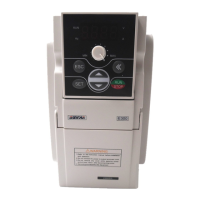
Do you have a question about the Sunfar E500-2S0004(B) and is the answer not in the manual?
Instructions for checking the inverter after unpacking, including damage and order consistency.
Details found on the inverter's nameplate and outer box label for identification.
Essential safety rules, environmental requirements, and physical dimensions for inverter installation.
Guidelines for safe and correct inverter wiring, inspection, maintenance, and operation.
Procedures and considerations for the safe disposal of inverter components.
Explanation of model naming conventions and a list of inverter series models with specifications.
Visual identification of inverter parts and their names, including diagrams.
Detailed technical data, performance specifications, and operating environment requirements for the inverters.
Specifies ambient conditions and placement criteria for optimal inverter operation and safety.
Provides detailed dimensional drawings and spacing recommendations for inverter mounting.
Dimensions for optional accessories like the small keyboard base for installation.
Critical safety and best practice guidelines for connecting inverter power and control wiring.
Explains how to connect external components like contactors, AC reactors, and braking resistors.
Illustrates basic wiring and specific instructions for connecting main power loop terminals.
Details on connecting control signals, analog inputs/outputs, and communication ports.
Explains the purpose and operation of each key on the inverter's control panel.
Guides users through navigating menus, inquiring parameters, and modifying settings via the panel.
A table detailing various parameters that can be monitored on the inverter's display.
Covers initial setup procedures and basic operational methods for running the inverter.
Step-by-step instructions for performing a basic start-up and operation of the inverter.
Parameters related to frequency input, digital setting, and command channel selection.
Configuration for analog signal inputs and outputs, including voltage and current settings.
Parameters controlling start and stop modes, DC braking, and torque adjustments.
Settings for multi-speed operation, liner speed control, and parameter inquiry authority.
Parameters for configuring serial communication settings like baud rate and protocol.
Settings for PID control, including function selection, digital setting, and feedback.
Parameters specific to special machine functions like cutter dragging or cutting control.
Lists fault codes, descriptions, possible reasons, and corresponding solutions for inverter protection.
How to query recent fault codes and procedures for resetting the inverter after a fault.
General information on the SUNFAR protocol, its capabilities, and applicable products/methods.
Details the physical layer, transmission mode, topology, and general protocol rules.
Explains the structure of communication frames, data representation, and formats.
Defines command classifications, operation commands, and provides examples of their usage.
Describes slave machine responses and provides examples of communication frame formats.
Configuration and functional capabilities of the MODBUS RTU protocol for inverter communication.
Explains the MODBUS RTU frame structure, slave address, and PDU parts.
Details on function codes for reading, writing, and modifying parameters via MODBUS.
Lists error codes for MODBUS communication and explains the CRC check calculation.
Maps inverter parameters to MODBUS register addresses and provides communication examples.
Recommendations for selecting brake resistor power and resistance values based on inverter model and loading conditions.
 General
| Model | E500-2S0004(B) |
|---|---|
| Category | Inverter |
| Power | 0.4 kW |
| Frequency | 50/60Hz |
| Protection Features | Overload, Overvoltage, Short circuit |

 To Next Page