
 Need help?
Do you have a question about the Supermicro AOC-MTGN-i2S and is the answer not in the manual?
Lists the primary features of the AOC-MTGN-i2S, including dual SFP+ ports and virtualization support.
Details the general, I/O, and virtualization specifications of the AOC-MTGN-i2S controller.
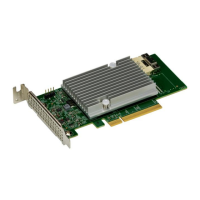
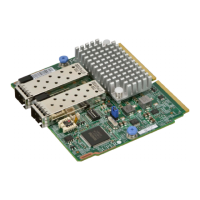
Identifies and describes the key hardware components installed on the AOC-MTGN-i2S.
Details the S1 DIP switch for SMBUS address selection and thermal reading configuration.
Explains Electrostatic Discharge (ESD) risks and necessary precautions during handling and installation.
Provides steps for system preparation before installation and instructions for inserting the card into the SIOM slot.
Details how to install the SIOM card into the motherboard and secure it within the chassis.
Instructions for downloading and installing drivers for Windows operating systems.
The Supermicro AOC-MTGN-i2S is a high-performance add-on card designed to provide flexible and scalable 10 Gigabit Ethernet (10GbE) networking options for demanding data center environments. This Super I/O Module (SIOM) controller is built around the Intel 10GbE network controller 82599, offering advanced features for virtualization, as well as robust LAN and SAN networking capabilities. It is specifically intended to be sold as part of an integrated solution with Supermicro server systems, ensuring optimal compatibility and performance within their ecosystem.
At its core, the AOC-MTGN-i2S serves as a dual-port 10GbE network adapter, facilitating high-speed data transfer and network connectivity. It utilizes SFP+ connectors, supporting both direct attach twinaxial copper cables for shorter distances and fiber-optic cables with optional SFP+ transceivers for longer-range connections. This versatility allows for deployment in various network topologies and distances within a data center.
The card's primary function is to enhance network performance and efficiency, particularly in virtualized environments. It incorporates Intel's QuickData Technology, which offloads data transfer tasks from the CPU, freeing up processing power for other critical operations. Key virtualization features include VMDq (Virtual Machine Device Queues) and Next-Generation VMDq, providing 64 queues per port to improve I/O performance and reduce CPU overhead for virtual machines. Additionally, it supports PC-SIG SR-IOV (Single Root I/O Virtualization) with 64 virtual functions per port, enabling direct assignment of network resources to virtual machines, further enhancing performance and reducing latency. Advanced Packet Filtering and VLAN support allow for the creation of multiple VLAN segments, facilitating network segmentation and traffic management. VXLAN (Virtual Extensible LAN) is also supported through software, enabling scalable virtualized networks.
For general I/O operations, the AOC-MTGN-i2S includes Direct Cache Access (DCA) to minimize cache misses, improving data access efficiency. MSI-X support helps in load-balancing interrupts across multiple CPU cores, reducing interrupt overhead and improving overall system responsiveness. The card also offloads Tx/Rx IP, SCTP, TCP, and UDP checksum calculations for both IPv4 and IPv6, further reducing CPU utilization. Receive and Transmit Side Scaling (RSS) is supported for Windows environments, and scalable I/O is provided for Linux environments, ensuring efficient distribution of network processing across available CPU cores.
The AOC-MTGN-i2S is designed for ease of integration and operation within Supermicro server systems. It supports a wide range of operating systems, including various editions of Windows Server (2012 R2, 2012, 2008 R2 x64 Edition), Windows client operating systems (8.1, 8, 7 x64 Edition), RedHat Linux, SUSE Linux, FreeBSD, UEFI, and VMware, ensuring broad compatibility with existing IT infrastructures.
One of its significant usage features is iSCSI Remote Boot support, allowing servers to boot directly from an iSCSI target over the network, simplifying storage management and deployment. Fibre Channel over Ethernet (FCoE) support enables the convergence of LAN and SAN traffic over a single Ethernet infrastructure, reducing cabling and simplifying network management.
The card also offers robust management features. It supports Preboot eXecution Environment (PXE), allowing network booting of systems. Simple Network Management Protocol (SNMP) and Remote Network Monitoring (RMON) statistics counters provide comprehensive network monitoring capabilities. NC-SI (Network Controller Sideband Interface) is included for remote management, enabling out-of-band management of the network adapter. Furthermore, it supports asset management on Supermicro platforms, providing controller asset tags such as part number, revision, serial number, and MAC addresses, which are crucial for inventory and tracking purposes.
Advanced software features include Teaming support, which allows multiple network adapters to be grouped together to form a single logical interface, providing increased bandwidth and redundancy. IEEE 802.3ad (Link Aggregation Control Protocol) is supported for dynamic link aggregation, and IEEE 802.1Q VLANs are supported for network segmentation. IEEE 802.3 2005 flow control support helps manage network congestion.
The card features LED indicators for each LAN port (LED1 for LAN1, LED2 for LAN2) to provide visual feedback on network status. These LEDs indicate link speed (1Gb or 10Gb) and data activity, allowing administrators to quickly assess network connectivity and traffic flow. A separate Thermal Alert LED (LED3) indicates if the card is experiencing a thermal alert, which is a critical feature for monitoring the health of the device.
Maintenance of the AOC-MTGN-i2S primarily involves driver updates and environmental monitoring. Supermicro provides updated drivers and support information on its website, ensuring that users can keep their systems current with the latest software. The user's guide emphasizes the importance of using the most up-to-date version of the guide available on the Supermicro website for accurate information.
For installation, the guide provides detailed instructions, including precautions for handling static-sensitive devices (ESD) to prevent damage. It recommends using a grounded wrist strap, touching a grounded metal object, and handling the card by its edges. Proper grounding within the system chassis is also highlighted as essential.
The card includes a Thermal Alert LED (LED3) that illuminates yellow when a thermal alert occurs. This visual indicator is a crucial maintenance feature, alerting users to potential overheating issues that could impact performance or longevity. Additionally, a Thermal Alert Connector (JP3) allows for connecting an external cable from the motherboard to monitor the external temperature, providing an additional layer of thermal management.
A DIP Switch (S1) is provided for SMBUS address selection, allowing users to configure the card with a static SMBUS address. This feature can be useful for system integrators who need to manage multiple devices on the SMBUS. Another jumper, JPL1, is available to enable or disable LAN ports 1 and 2, offering flexibility in network configuration.
The guide also outlines the process for returning merchandise for service, emphasizing the need for a receipt or invoice and obtaining a Returned Merchandise Authorization (RMA) number. This structured approach to service ensures efficient handling of warranty claims. The warranty covers normal consumer use but excludes damages from shipping, alteration, misuse, abuse, or improper maintenance, highlighting the importance of correct installation and handling.
Overall, the AOC-MTGN-i2S is designed to be a reliable and high-performance network adapter, with features that support efficient operation, comprehensive monitoring, and straightforward maintenance within Supermicro server environments.
 General
| Product Type | Network Adapter |
|---|---|
| Product Name | AOC-MTGN-i2S |
| Manufacturer | Supermicro |
| Category | Computer Hardware |
| Data Transfer Rate | 10 Gbps per port |
| Form Factor | Low Profile |
| Ports | 2 x SFP+ |
| Supported Protocols | iSCSI |
| Interface | PCI Express 3.0 x8 |
| Compatibility | Supermicro servers |


 To Next Page