H PISTON FILLERS/STUFFERS
EN-23
Important!
ALWAYS fill the reservoir up to, but not exceeding, the dipstick’s “MAXIMUM” level mark since the more oil
there is in the reservoir, the more effectively the hydraulic assemblage will be cooled. This helps lengthen
the life of the oil.
Under normal circumstances, the level of hydraulic oil in a well-maintained machine should remain constant
for several years (between 2,500 and 5,000 hours of use). For more information, see the MAINTENANCE
section below.
Use oils for medium pressure hydraulic systems (approx. 100 bar) and with a viscosity of approximately 5º
Engler (equivalent to IS03498: cat HL VG46 or DIN8659: HL-46).
5.3 Connecting to a Power Source
Electrical Hazard:
Take the necessary steps to protect yourself from:
Electric shock due to direct or indirect contact with electrical current.
Electric shock due to defective electrical parts.
Only a qualified electrician may service or perform authorized modifications (e.g., change of voltage) to the
machine’s electrical systems.
The electrical installation of the workplace should be equipped with power surge full protection (magneto
thermic circuit breaker) and leakage (diferential), which must be adjusted to the technical specifications of
your particular machine (see section 3 Technical data).
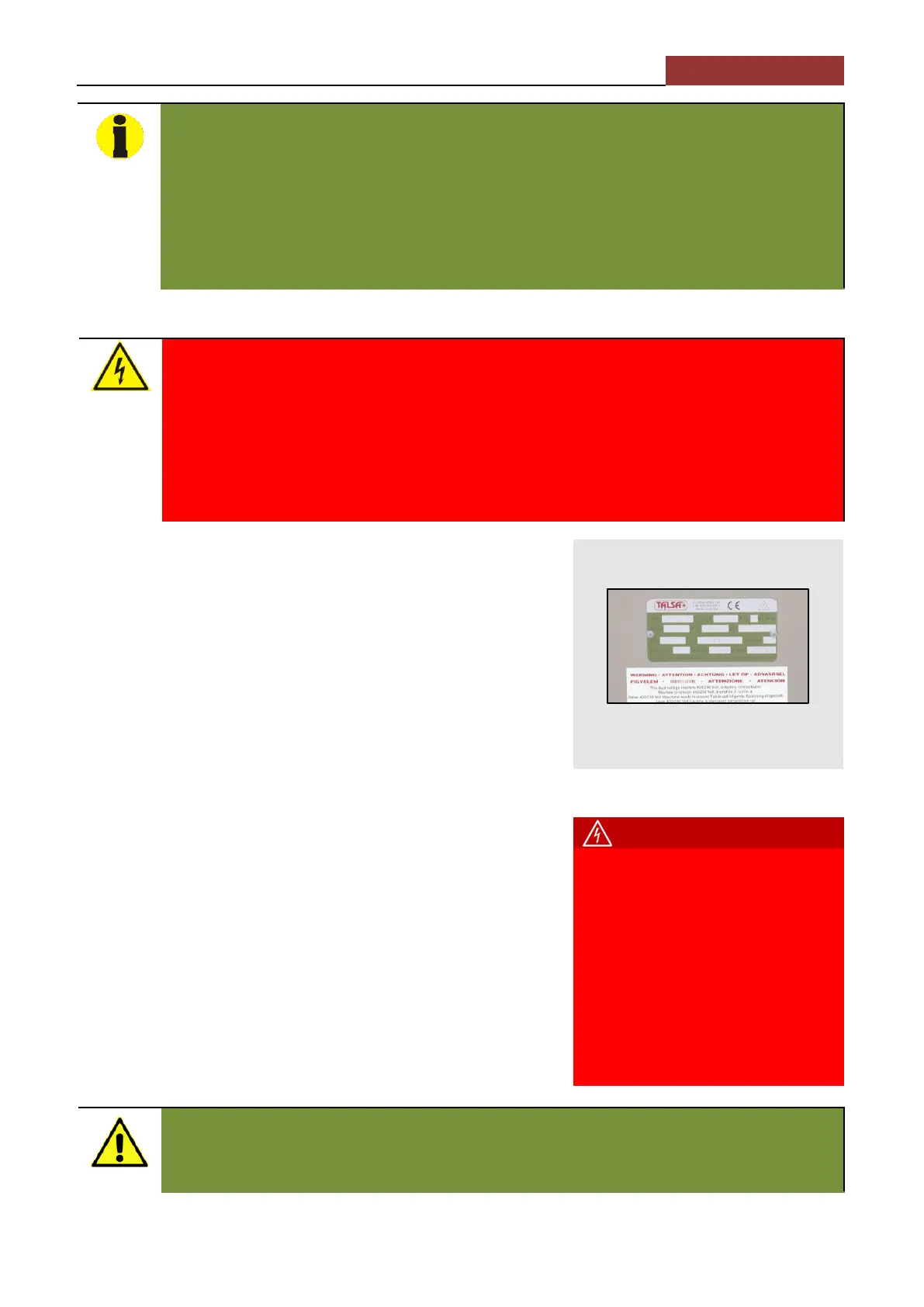
Confirm that the electrical requirements listed on the machine’s specifications plate
(voltage, frequency, etc.) (IMG. 6) are compatible with your electrical service. There
is a tolerance of ±10% for voltage and of ±2% for frequency. The line voltage
must be up to specification. Rated voltage of the machine shall be identical with full
supply voltage.
1. If the machine’s specifications are compatible with the electrical wiring,
proceed to check that the phases are adjusted correctly as described below.
2. If the machine’s specifications are NOT compatible with your electrical
wiring and the machine is a dual voltage, three-phase unit, have a qualified
electrician adjust the voltage as described below. If, however, the machine is not
a dual voltage, three-phase unit, call a qualified electrician. After the
incompatibility is resolved proceed to check the phases as described below.
IMG. 6 : Specifications plates
5.4 Changing the Voltage
1. Remove the screws that secure the detachable steel panel to the base. Dismount
the panel and carefully set it aside somewhere out of the way (IMG.7). Reattach
the panel once the work is completed.
2. Depending on your stuffer/filler model, do the following:
TO THE MOTOR (applies to all models):
a. Open the motor’s connection terminal box by removing the four screws.
b. Loosen the six small holding nuts on the connection terminals.
c. Place the plates in the correct position and tighten the holding nuts.
d. Reseal the terminal connection box
TO THE CONTACTOR (applies only to “A” models with microswitch &
contactor):
Have a qualified electrician replace the contactor with a new one of the same
voltage as the power supply. The electrician MUST follow the electrical diagrams
included in this manual.
The voltage may ONLY be changed on
three-phase machines with dual
voltage motor 380/220 V (400/230 V in
the EU), etc.
The machine must remain discon-
nected from the electrical outlet during
any service to its electrical systems!
Only a qualified electrician may
service or perform authorized
modifications (e.g., change of voltage)
to the machine’s electrical systems.
Important:
The following pictures (IMG. 8 and IMG. 9) are provided as visual references only. The qualified electrician
tasked with changing the machine’s 3-phase voltage must refer to the appropriate electrical diagrams at the
beginning of this manual.
www.talsaparts.com
www.davisonsbutcher.com
www.davisonsbutcher.com
www.davisonsbutcher.com



 To Next Page