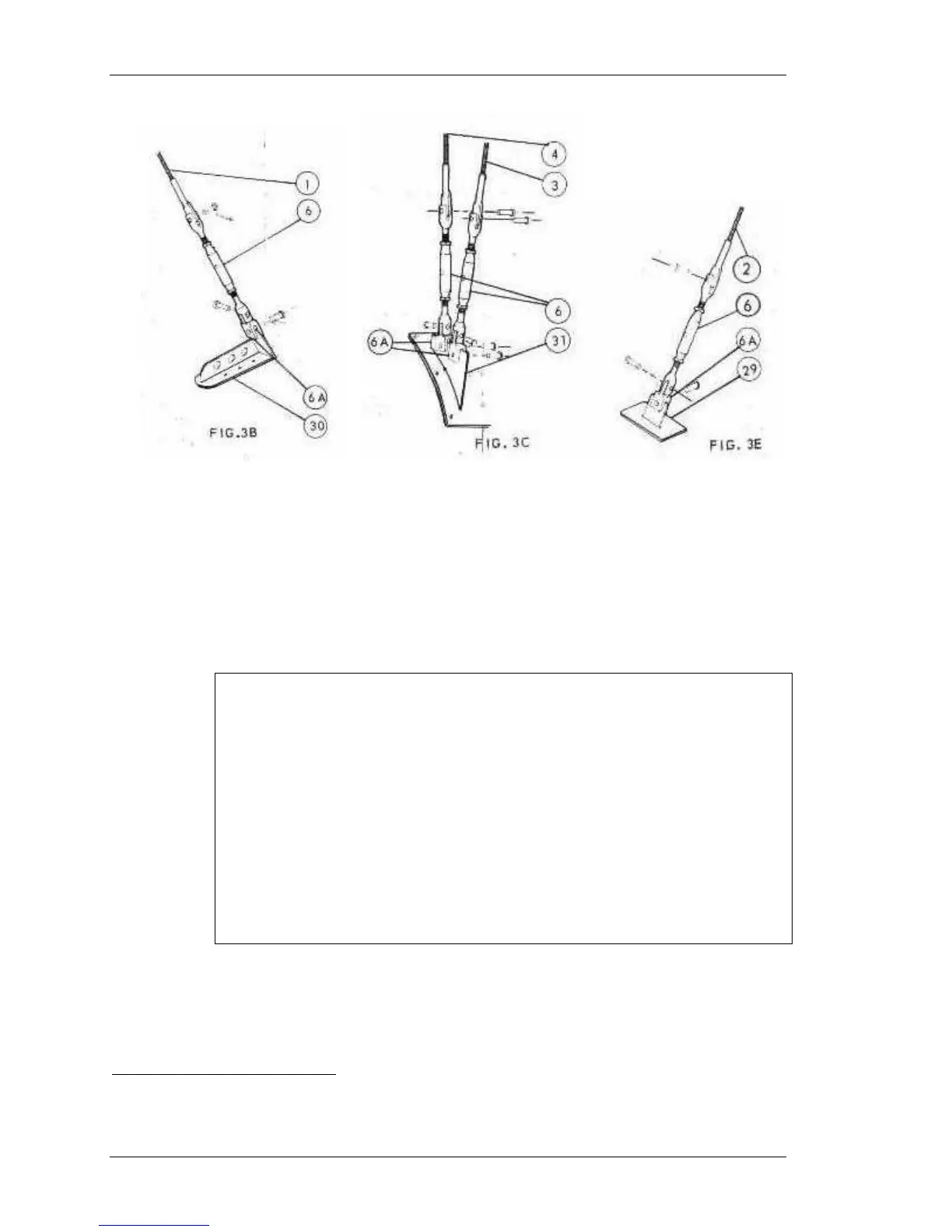
The mast is now stepped. The barrels of all turnbuckles should be turned to
tighten the standing rigging appropriately. The lower shrouds should be
taut but not so tight that they twang; nor floppy.
The forestay, backstay and upper shrouds should be somewhat tighter
than the lowers. It should be kept in mind that all standing rigging will
stretch after sailing and will require re-adjustment. If you have a Loos
tension gauge, the rigging should be set to the following tension:
1
Shroud tension should be more less equal between the upper and lower
shrouds, and based on a standard of 10-12% of breaking strength, around
400 pounds, or a scale reading of 41-42 on a Standard Loos Gauge.
Sailing tests may show that this is a little soft, requiring one more turn of the
screw which should bring you up to about 500 lb or 43-44 on the Loos. This
is enough tension for these rigs, and more would not ordinarily be justifed.
Tensioning the uppers significantly greater than the lowers does not make
much sense in these rigs, given that there is no means to prevent the spar
from being forced into an "S" curve. I would not tension the uppers more
that about 10% over the lowers at the most, if I felt that the masthead was
sagging off too much. The mast, by its robustness, will only let you
compensate so much, before it begins to collapse downward. Have a
problem with leaking chainplates? Like 700 lbs of tension on the shrouds?
Hmm.
1
This information was missing from the original copy, so I’ve included an excerpt from
Paul Coppin’s Tuning Guide on the Tanzer 22 Class Association website.


 To Next Page