Chapter 4 Pressure/Flow @ 50 and @ 25 Modes
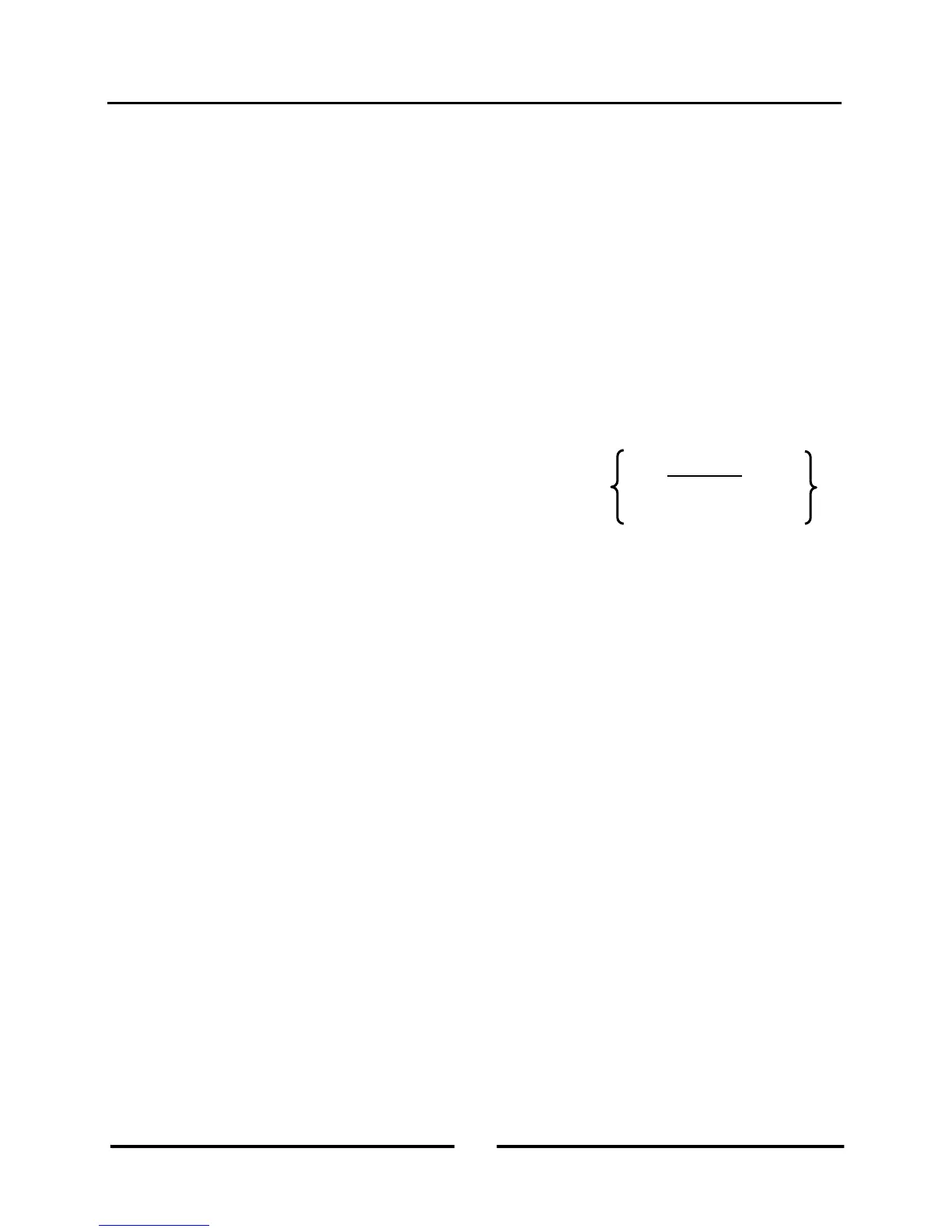
The following equation is used to estimate leakage area when in the @ 50 mode (square centimeters):
Note: Leakage areas calculated by the DG-700 are Equivalent Orifice Leakage Areas (EOLA), which are defined as
the area of a sharp edged hole that would leak at the same flow rate as the estimated leakage rate, when the hole is
subjected to the target test pressure (e.g. 50 Pa or 25 Pa). The purpose of the EOLA estimate is to provide a simple
physical interpretation of the cumulative size of the leaks measured by the airtightness test. The EOLA estimates are
not appropriate for use in specific infiltration models (such as the LBL or AIM infiltration models) which require
leakage area estimates calculated using different equations and assumptions.
4.8.b @ 25 Mode:
The following equation is used to estimate leakage rates when in the @ 25 mode:
The following equation is used to estimate leakage area when in the @ 25 mode (square inches):
The following equation is used to estimate leakage area when in the @ 25 mode (square centimeters):
4.8.c Errors in Leakage Estimates:
Tables 4.1 and 4.2 below show the errors in the @ 50 and @ 25 leakage estimates from the following 2 sources:
- The actual test pressure (Channel A) not being equal to the target pressure (i.e. 50 or 25 Pascals), and
- The actual exponent of the leaks being measured differing from the assumed exponent of 0.65 (for @ 50) and
0.60 (for @ 25).
For example, Table 4.1 shows that for a one-point 50 Pa Blower Door building airtightness test, a 2.5% error would
be introduced if the leakage estimate was determined at an actual test pressure of 30 Pa (Channel A), and the actual
exponent of the leaks was 0.60 rather than the assumed value of 0.65.
Current Test Pressure (Pa)
(Channel A)
(Channel B)
Measured Duct
Blaster Air Flow Rate
(Channel B)
Rate
(CFM50)
(Channel B)
Rate
(CFM25)
(Channel B)
Rate
(CFM25)
17
Operating Instructions
for the DG700



 To Next Page