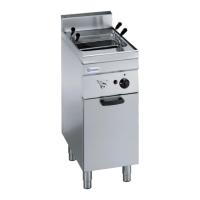
This document describes the Tecnoinox Rectangular Bratt Pans, Gas Type, specifically models B8FXGN9 and B8FIGN9, as well as B12FXGN9 and B12MFIGN9. These are freestanding 80-liter gas tilting bratt pans with stainless steel tanks on closed cabinets, designed for professional kitchen use.
Function Description
The bratt pan is a versatile cooking appliance capable of performing various cooking operations such as frying, braising, stewing, and boiling. It features a main structure in steel with adjustable height feet and an exterior and top finish entirely made of stainless steel. The cooking vat is made of stainless steel (INOX AISI 304) with a hinged and spring-balanced lid that opens to all positions. Heating is provided by stainless steel burners, resistant to mechanical stress and thermal shocks, with gas supplied through a multiple thermostatic valve. The main burner is lit by means of a pilot, and the pan can be tilted either by a motor or optionally by a manual by-pass system (BAM0010). The appliance is equipped with a thermostatic gas valve, pilot burner ignition button, ignition of the pilot burner incorporated in the gas valve, a control knob for temperature regulation, and a tilting handwheel.
Important Technical Specifications
The document provides detailed technical data for two main categories of models: B8FXGN9 – B8MFXGN9 / B8FIGN9 – B8MFIGN9 and B12FXGN9 – B12MFXGN9 / B12FIGN9 – B12MFIGN9.
Dimensions (B8FXGN9/B8FIGN9 | B12FXGN9/B12FIGN9):
- Equipment dim. A: 800 mm | 1200 mm
- Equipment dim. B: 900 mm | 900 mm
- Equipment dim. H: 900 mm | 900 mm
- Equipment dim. H2: 1630 mm | 1630 mm
Functionality (B8FXGN9/B8FIGN9 | B12FXGN9/B12FIGN9):
- Pan dimension A: 698 mm | 1098 mm
- Pan dimension B: 564 mm | 564 mm
- Pan dimension H: 200 mm | 200 mm
- Pan area: 39 dm² | 62 dm²
- Overall volume: 81 lt | 127 lt
- Useful volume: 60 lt | 100 lt
- Temperature: 45÷295 °C
Installation (B8FXGN9/B8FIGN9 | B12FXGN9/B12FIGN9):
- Gas power: 20 kW | 30 kW
- Gas connection: ¾" | ¾"
- Water pressure: 50÷300 kPa
- Hot water inlet: ½" | ½"
- Latent heat emission: 450 W/kW | 450 W/kW
- Direct heat emission: 450 W/kW | 450 W/kW
- Moisture emission: 630 g/h / kW | 630 g/h / kW
- Sound level: < 70 dBA | < 70 dBA
- Electric power: 0.2 kW | 0.2 kW
- Voltage/input (standard): 220-240 V 1N 50/60Hz | 220-240 V 1N 50/60Hz
- Cable connection: 3 x 1.5 mm² | 3 x 1.5 mm²
Packaging Data (B8FXGN9/B8FIGN9 | B12FXGN9/B12FIGN9):
- Packaging dim. A: 1070 mm | 1300 mm
- Packaging dim. B: 870 mm | 1050 mm
- Packaging dim. H: 1270 mm | 1220 mm
- Volume: 1.2 m³ | 1.68 m³
- Net weight: 144 kg | 217 kg
- Gross weight: 169 kg | 255 kg
The document also includes tables for gas inlet pressures for various appliance categories and countries, as well as gas consumption data for different gas types (G20, G25, G25.1, G25.3, G2.350, G30/G31) and nozzle (pilot) and primary air distance specifications.
Usage Features
The bratt pan is designed for ease of use and safety in a professional kitchen environment.
- Positioning: The appliance must be installed in perfect conditions, away from combustible materials, and on a level surface. Small differences in level can be eliminated by screwing or unscrewing the adjustable feet.
- Gas Connection: The choice of gas piping depends on the diameter required for the type of gas, appliance, and installation, and should conform to current regulations. A pressure regulator must be installed to stabilize the pressure of the gas inlet.
- Checking Operation: Before using the appliance, ensure the gas system is checked for leaks and proper operation. The calorific power of the gas must correspond to the values specified in the technical data.
- Control of Gas Inlet Pressure: The supply pressure is measured using a liquid pressure gauge at the inlet pressure intake.
- Commissioning and Testing: All connections must be checked, and the appliance must be tested to ensure proper operation. The flue gas exhaust must not be clogged.
- Starting Cooking: To start, the pilot burner is lit, then the gas-valve knob is turned to the desired temperature between 45° and 295°. The main burner ignites automatically.
- End Cooking: To turn off, the gas-valve knob is turned to the "0" position, which prevents the main burner from lighting.
- Emptying the Cooking Pan: The pan can be emptied by a handwheel located on the right side, which tilts the tank. Motorized versions tilt the pan automatically. An optional manual tilt by-pass (BAM0010) is available for power failure.
- Safety Warnings: Users must follow fire prevention regulations, wear personal protective equipment (gloves type athermal), and be aware of the danger of burns. The maximum cooking vat level is 40 mm under the overflow border.
Maintenance Features
Regular maintenance is crucial for the longevity and efficient operation of the bratt pan.
- Periodic Maintenance (Every three months or whenever an overturn is tiring or noisy):
- Greasing Screw Without End: Turn the tank completely, connect a grease fitting to the connection on the lower front, and use a grease nipple to apply grease 3/4 times. Move the tank to an intermediate position and apply grease 2/3 times. Move the tank (cycle completely overturned and in a horizontal position) 2/3 times.
- For the Technical Service: Close all panels carefully, keep the inside of the sides clean and dry, and keep wiring and electrical connections in good condition.
- Checks / Annual Interventions: Grease the tilting rod bearing, remove the front panel, connect a grease fitting to the bearing located behind the wall from which the tilt rod comes out, and use a grease nipple 2/3 times. Check the panels coupling, check water supply seal, and verify closing terminals of electrical parts connections and cleaning of electrical parts.
- Cleaning and Care:
- Avoid aggressive substances or abrasive detergents when cleaning stainless steel components.
- Do not use metal pads or abrasive paper.
- Use a powder pumice stone for particularly resistant dirt.
- Use advisable to use abrasive sponges (e.g., Scotch-Brite).
- The appliance must be disconnected from the power supply during cleaning.
- Never use direct jets of water to prevent infiltration of liquid and damage to components.
- Clean the cooking vat with water and a detergent, rinse thoroughly, and dry well with a soft cloth.
- External surfaces should be washed down using a sponge and hot water with a suitable proprietary cleaner.
- Rinse always thoroughly and dry with a soft cloth.
- Special Procedures in Case of Prolonged Inactivity: If the appliance is to stand idle for any length of time, it must be cleaned thoroughly, leaving not traces of food or dirt. Leave the lid open so that air can circulate inside the vat. For added care after cleaning, the external surfaces can be protected by applying a proprietary metal polish. Be absolutely sure to shut off all utilities (electrical power supply and water). Air the room appropriately.
- Possible Failures and Their Elimination: The document provides a comprehensive troubleshooting guide for common issues such as the pilot burner not lighting up, the pilot burner turning off when the control knob or ignition button is released, the pilot burner not lighting up but the main burner does not light, and the heating vat temperature cannot be adjusted. It also details steps to access components and perform repairs, including removing power to the unit, replacing the spark plug, thermocouple, and gas valve.
- Conversion to Other Types of Gas: The document outlines the procedure for replacing main burner nozzles, adjusting primary air, and replacing pilot burner injectors when converting the appliance to a different gas type.

 Need help?
 General

 To Next Page