longed turn. Good operating practices include:
•Adjust radar and obtain weather picture before takeoff
•Compensate antenna tilt for gyro precession
•Evaluate weather in the immediate sphere of operation
•Do not “over-scan” weather targets
•
stabilization
9.0ANTENNA STABILIZATION
Airborne radar antennas are stabilized to preserve a normal cockpit display
when the aircraft is climbing, descending or turning. When the aircraft
departs from straight and level flight, the stabilization system automatically
adjusts the antenna position to compensate for the change. Both limits and
errors associated with antenna stabilization are important to the pilot.
9.1LIMITS
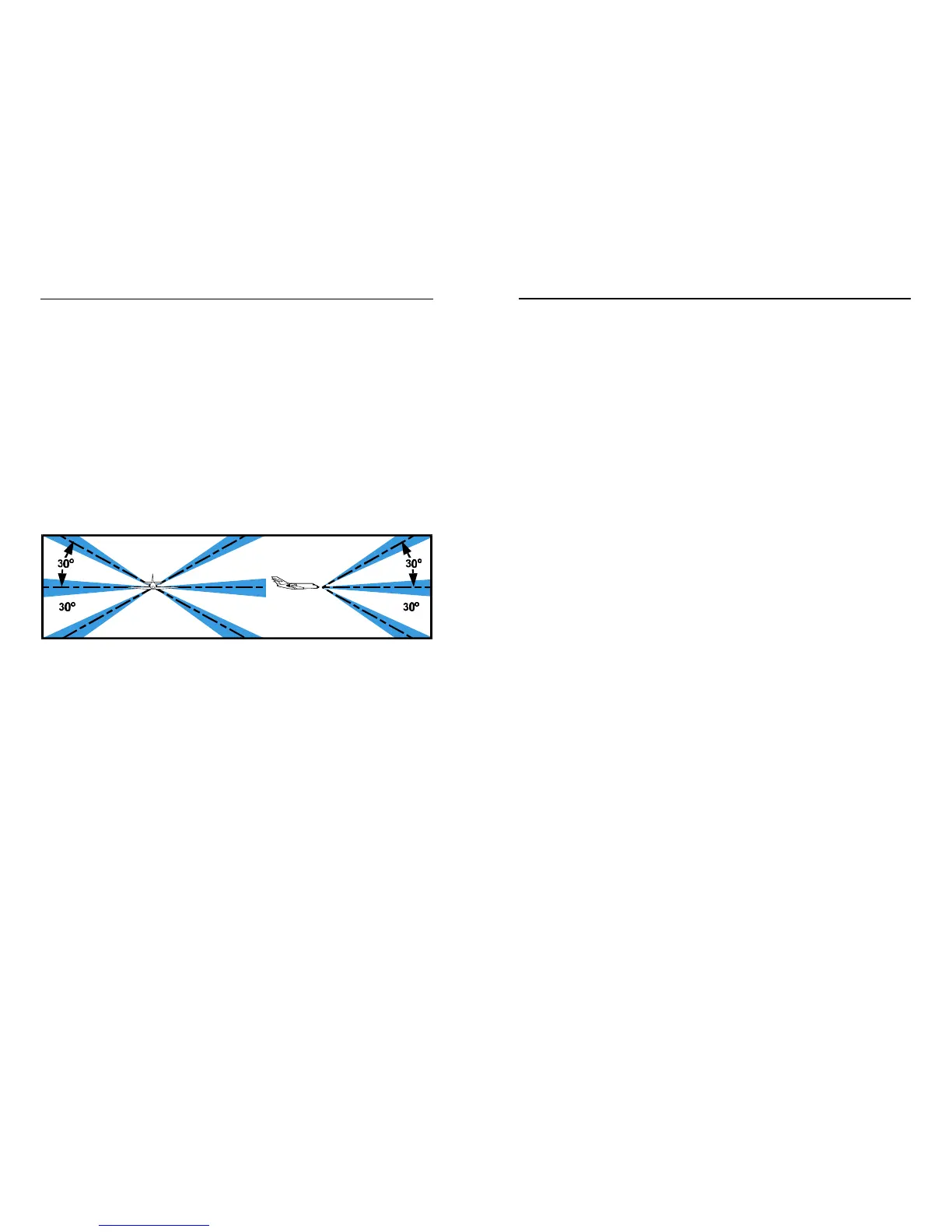
The limits of antenna stabilization are different for climbing or descending
and turning while climbing or descending. For straight ahead climbs and
descents, the limits are simply the mechanical stops at 30 degrees. When
turning, the tilt and bank angles determine the stabilization limits (the rule
of thumb is a total of 30 degrees) so moderate turns combined with mod-
erate climbs and descents will stay within limits.
Figure 9.1-1.Aircraft Pitching/Rolling ±30°
9.2ERRORS
There are two sources of stabilization errors: acceleration and drift.
Accelerations and decelerations cause the gyro to precess in pitch. The
pilot may not notice a small temporary discrepancy between the altitude
indicator and visible horizon, but on the radar screen the antenna pitch pre-
cession will appear as an exaggeration of the desired tilt. Drift errors
(appearing on the attitude indicators pitch and roll precession accumulate
in turns) disappear slowly after the aircraft returns to straight and level.
Gyro precession errors directly affect radar stabilization and the quality of
the return displayed on the screen.



 To Next Page