beam would come upon another aircraft in flight.
WARNING
Weather radar is not practical as a pilot operable collision
avoidance system. Weather analysis and avoidance are the
primary functions of the radar system.
5.2RADAR PRINCIPLES
Radar is fundamentally a distance measuring system using the principle of
radio echoing. The term RADAR is an acronym for Radio Detecting And
Ranging. It is a method for locating targets by using radio waves. The trans-
mitter generates microwave energy in the form of pulses. These
pulses are then transferred to the antenna where they are focused into a
beam by the antenna. The radar beam is much like the beam of a flashlight.
The energy is focused and radiated by the antenna in such a way that it is
most intense in the center of the beam with decreasing intensity near the
edge. The same antenna is used for both transmitting and receiving. When
a pulse intercepts a target, the energy is reflected as an echo, or return
signal, back to the antenna. From the antenna, the returned signal is trans-
ferred to the receiver and processing circuits located in the receiver
transmitter unit. The echoes or returned signals are displayed on an
indicator.
Radio waves travel at the speed of 300 million meters per second and thus
yield nearly instantaneous information when echoing back. Radar ranging
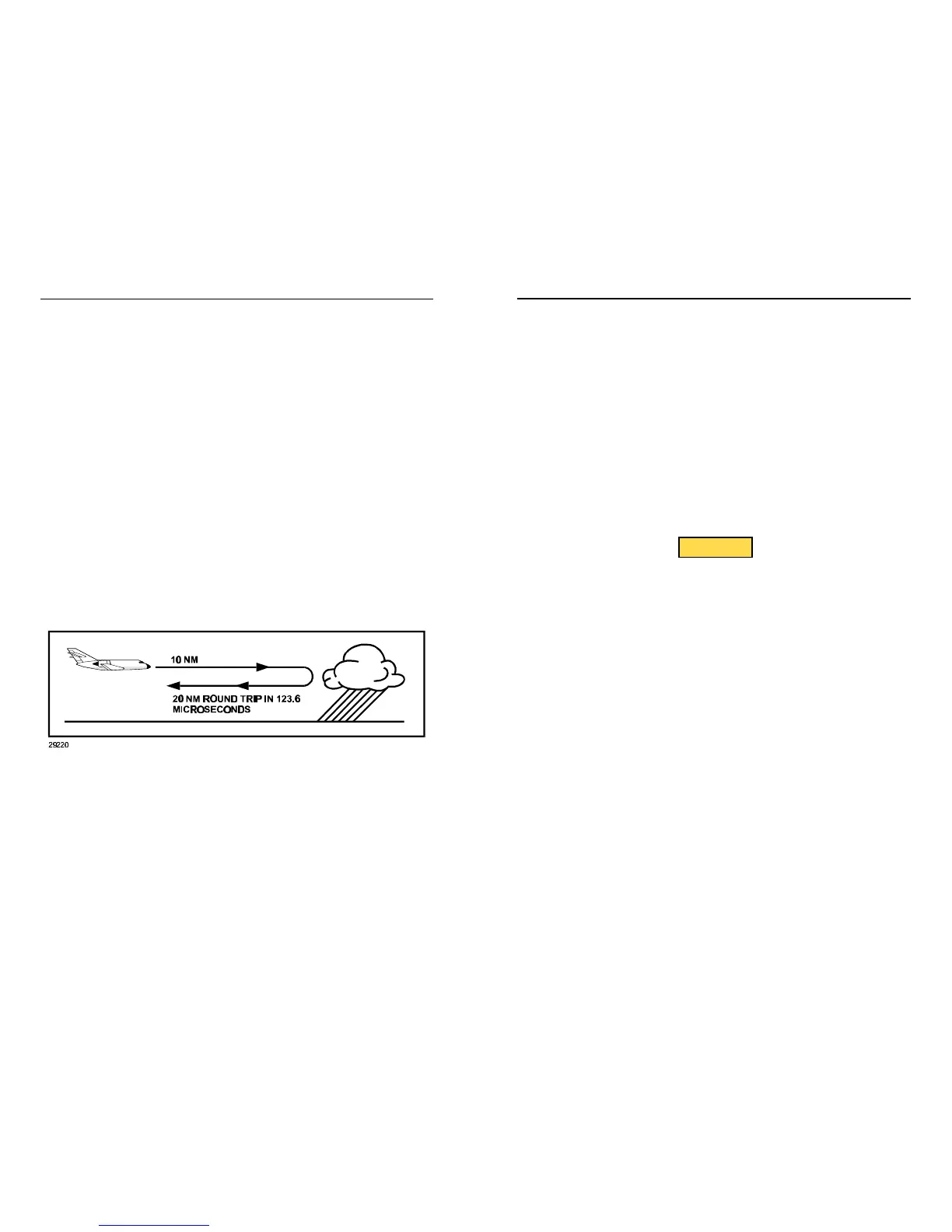
is a two-way process that requires 12.36 micro-seconds for the radio wave
to travel out and back for each nautical mile of target range. As shown in
the distance illustration in Figure 5.2-1, it takes 123.6 micro-seconds for a
transmitted pulse of radar energy to travel out and back from an area of
precipitation 10 nautical miles away.
Figure 5.2-1.Radar Transmit-Receive Timing



 To Next Page