So, the better you understand how this receiver works, the more
you learn about modern electronics!
"Regenerative" Receivers: THE STORY . . .
The "regenerative receiver" moved the world of radio reception
and broadcasting beyond the limits of crystal sets useful only
for hearing a strong local signal. For over a decade, these
magical, whistling, squawking, glowing boxes were the norm for
home listening as well as for the first generation of radio hams.
Receiver design evolved swiftly. The "superheterodyne"
became the norm during the 1930's. Regenerative receivers,
often called "Gennies," were left to tinkerers and beginners.
Even though these receivers were simple and quite sensitive,
they had a number of shortcomings: instability, touchiness,
difficulty in separating strong stations, a tendency to generate
interference to other receivers, and a general reputation for
making odd sounds that resembled everything from birds to
motorboats.
However, the sheer SIMPLENESS of the regenerative circuit
remained attractive to experimenters and beginners. ln fact, as
recently as the 1960's, one company marketed a $ 14 kit for
building a complete transceiver using only one vacuum tube: half
of the tube served as a regenerative receiver, and the other half
was a low-power crystal-controlled transmitter. In addition,
many thousands of engineering careers as well as ham radio
licenses were launched with the building of "my first shortwave
radio" from do-it-yourself regenerative receiver kits offered by
the major radio companies of several decades ago. (The fondest
daydream back then of most of these radio builders was to be
ab[e to afford to move up to a "superhet communications
receiver." Their fondest memory TODAY is that very first
receiver kit!)
From the late 1970's through the '80's, as consumer electronics
and new ham radio equipment became more sophisticated so
very rapidly, interest declined not only in regenerative receivers,
but-also in kit-building and even in shortwave radio listening.
One or two generations of Americans simply missed out on the
thrill and satisfaction of building and understanding a simple
radio set which could receive signals from around the world.
Today, both shortwave radio listening and building electronic kits
are again popular pastimes. Your T-KIT 1253 is a much better
receiver than the "classic" radio sets which attracted several
1253 - 4
generations of Americans to the excitement of radio and
electronics. In fact, its basic performance is superior to many of
the simplest superhet receivers which were considered such a
great step beyond one's first regenerative set'
The reason why this receiver works so well is because there is
much more precision in today's engineering designs and the
manufacturing of electronic parts. we looked carefully at the
practical problems associated with yesteryear's technology and
used today's know-how and components to minimize those
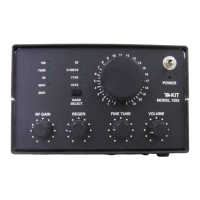
problems. The push-button bandswitching is made possible by
an IC (integrated circuit) designed for computer circuits.
The generous speaker volume is made possible by an IC designed
for car stereos. The simplicity of the multi-band coverage is
made possible by tiny molded coils (L1 to L9). The frequency
stability, quite a problem in older designs, is the result of the
voltage regulator IC and the fairly cool operating temperature of
all the components. And, even though air-variable tuning
capacitors have become quite expensive these days, smooth
main tuning and fine tuning controls are made possible by
"varactor diode" technology.
1253 - 5


 To Next Page