4004-8
33
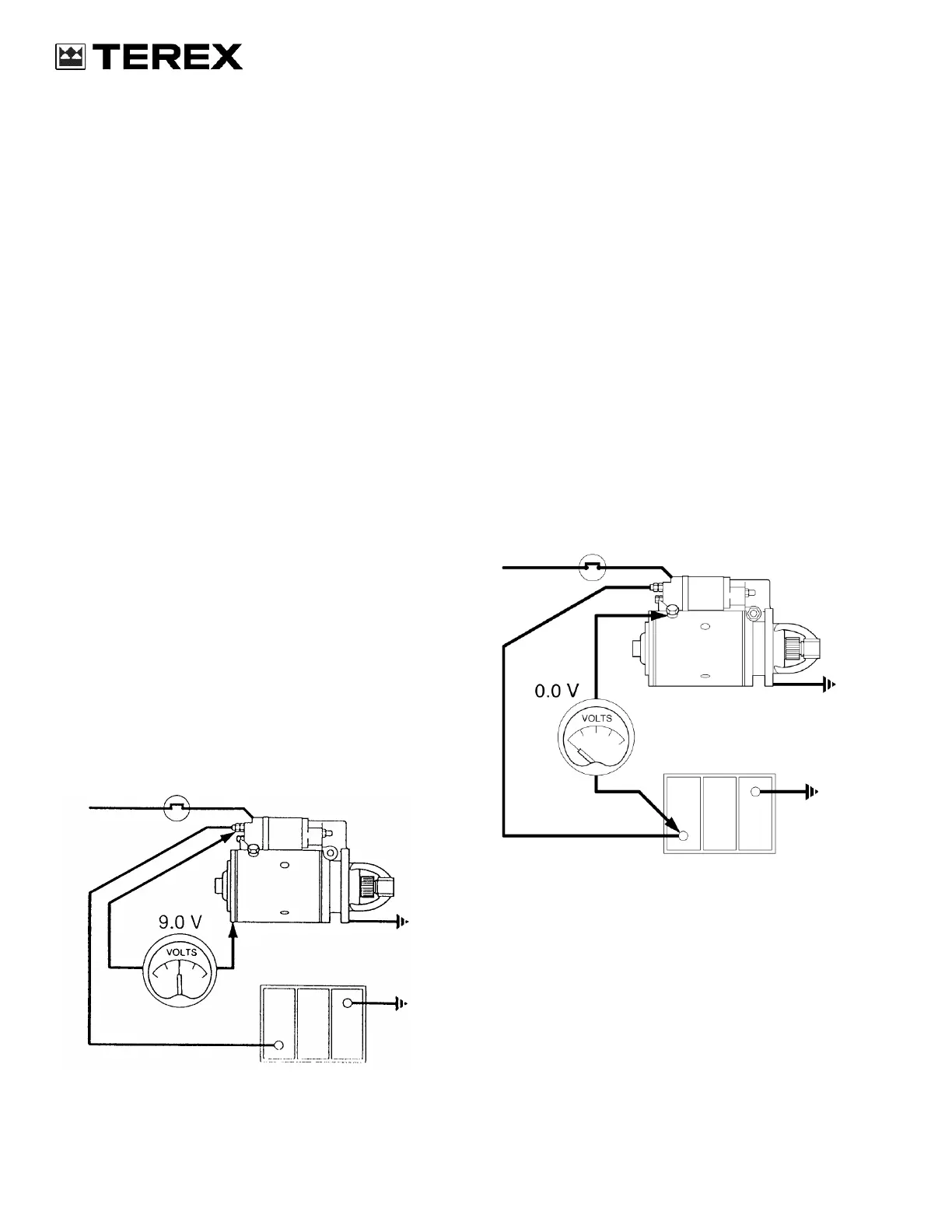
Testing the starter motor terminal voltage
under load
Test equipment
0 to 20 V dc voltmeter
NOTE :
This test can be made with the starter motor
still installed on the machine.
Do the starter motor terminal voltage under load test
as follows:
1. Open the hood.
2. Remove the protective cover (13), the nut (12)
and the cover (14).
3. Disconnect the wire from the fuel injection pump,
to prevent the engine from starting.
4. Connect the voltmeter between the starter input
terminal and earth (end bracket). Crank the
engine with the fuel cut off. The voltmeter read-
ing should not be more than 0.5 V lower than in
the battery voltage under load test, refer to page
Testing starter.
5. A low reading (more than 0.5 V difference
between tests 1 and 2) indicates high resistance
in cables or contacts.
6. High readings indicate high resistance in the
starter motor itself.
7. Reconnect the wire to fuel injection pump if no
further tests are required.
8. Install the cover (14), the nut (12) and the pro-
tective cover (13).
9. Close the hood.
789M053A
Testing the voltage drop on the insulated
line
Test equipment
0 to 20 V dc voltmeter
NOTE :
This test can be made with the starter motor
still installed on the machine.
Do the voltage drop on the insulated line as follows:
1. Open the hood.
2. Connect the voltmeter between the starter termi-
nal and the battery terminal.
3. When the starter switch is open, the voltmeter
should register battery voltage. When the starter
switch is closed, the voltmeter should read prac-
tically zero.
4. A high voltmeter reading indicates a high resis-
tance in the starter circuit. Check all the insu-
lated connections.
5. Do the voltage drop across the solenoid con-
tacts test.
789M054A


 To Next Page
 Loading...