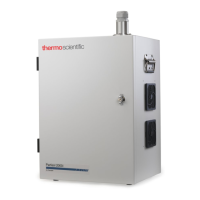
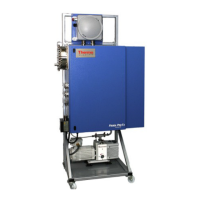
The Thermo Scientific Prima PRO / Sentinel PRO Mass Spectrometers are industrial process analyzers designed for continuous operation in a process environment. They are based on a scanning magnetic-sector mass spectrometer with a 6 cm radius, utilizing a variable magnetic field produced by an electromagnet with a laminated core for rapid and stable analysis of multiple user-defined gases. The instruments are modular for ease of maintenance and operation, with most components mounted within or on the instrument enclosure, excluding the host PC.
Function Description:
The core function of the device is to analyze gas samples by ionizing them and then separating the resulting ions based on their mass-to-charge ratio using a magnetic field. The ion signal is then measured at a detector, providing a proportional reading to the concentration of the corresponding gas component in the sample. This enables the mass spectrometer to be used as a compositional gas analyzer. Calibration against known gas standards determines the constant of proportionality.
Important Technical Specifications:
- Mass Spectrometer Type: Scanning magnetic-sector mass spectrometer.
- Magnetic Field: Variable, produced by an electromagnet with a laminated core.
- Ion Energy: Nominally 1000 V for a 150 amu mass range or 800 V for a 200 amu mass range. A lower voltage setting achieves a higher mass range.
- Electron Energy: Typically set between 40 and 70 V, affecting the types and ratios of ions (fragmentation pattern).
- Filament Current: Varies by filament type: 2.4-2.9 A for Thoria coated iridium, 1.5-2.5 A for W/ThO coiled, and 3.0-3.8 A for Re filament.
- Trap Current: Within the range 10 µA to 100 µA, regulating electron emission.
- Source Current: Within 2 to 15 times the Trap Current.
- Source Temperature: Normally 140°C to 200°C, application-dependent.
- System Pressure (Operating): Typically 1-10 x 10⁻⁶ mbar with the inlet open, 10⁻⁷ mbar with the inlet blocked.
- High Pressure Trip: 3 x 10⁻⁵ mbar (approximate).
- Low Pressure Trip: 1 x 10⁻⁷ mbar (approximate).
- Turbo Speed: 100% is full speed.
- Detectors: Faraday detector (standard) and optional Secondary Emission Multiplier (SEM) for low concentration measurements (ppm and lower).
- Resolving Power: Prima PRO: 20 and 60; Sentinel PRO: 85 and 140.
- Power Supply: Single phase, either 115 Vac (± 5 Vac) or 230 Vac (± 10 Vac), 50 Hz or 60 Hz. Ex-rated systems operate at a specific frequency.
- Power Consumption (Typical Startup, 240 Vac, single rotary pump, RMS inlet): Safe area: 2.0 kVA; Ex systems: 2.5 kVA.
- Over-current Protection: Maximum 40 A continuous operation, specified for motor starting.
- Dry Gas Vent: 1/4” / 6 mm compression, 0.5 to 2 bar(g) pressure.
- Enclosure Purge (Compressed Air): 100 Nl/min continuous flow for cabinet purge.
- Air Conditioner (Compressed Air): Up to 300 Nl/min, 4.0 to 6.9 bar(g) pressure.
- Rotary Pump Purge (Nitrogen): 0.6 Nl/min for ATEX, IECEx, and Div. 1 systems.
- Turbo Pump Bearing Purge: Very low flow, internally regulated, nitrogen preferred.
- Inlet Gas Connections: Swagelok compression fittings (1/8”, 1/4”, or 6 mm).
- Sample Flow Rate: Prima PRO: 0.5 Nl/min (typical), 0.1-5.0 Nl/min (range); Sentinel PRO: 5.0 Nl/min (typical), 2.0-10.0 Nl/min (range).
- Sample Gas Inlet Pressure (Max): 0.2 bar(g) for Prima PRO Ex; < 0.0 bar(g) for Sentinel PRO Ex.
- Maximum Sample Gas / Line Temperature: 200°C.
- Maximum Operating Temperature (Inlet): 120°C.
- Exhaust Gas Connections: 1.0" OD tube stub for RMS, 1/4” or 6 mm for other inlet types.
- Hazardous Area Certification: ATEX (EN 60079-0:2012 + A11:2013, EN60079-2:2014) and IECEx (IEC 60079-0:2011 6th Ed, IEC 60079-2:2014 6th Ed, IEC 60079-28:2015 2nd Ed). Complies with NFPA 496 for North American standards.
- Batteries: Lithium thionyl chloride (Li/SOCl₂) ½ AA (3.6V, 1.2Ah) for processor, Lithium manganese dioxide (Li/MnO₂) coin cell (3V, 48mAh) for turbo pump.
Usage Features:
- User Interface: Windows-based computer running Thermo Scientific GasWorks software.
- Connectivity: Serial link (RS232, RS422, RS485) to host PC or DCS. Fibre optic communication option for extended distances (up to 1000 meters).
- Startup Procedure: Includes checking rotary pump oil, ensuring main electrical isolator is OFF, switching internal circuit breakers ON, and turning the TURBO RUN toggle switch ON.
- Instrument Status Monitoring: GasWorks software displays instrument status, including vacuum level, filament emission, and alarm thresholds.
- Control Centre: Provides tabs for adjusting tuning parameters such as Emission, Peak Shape, Sensitivity, Detectors, Mass Alignment, and Heaters.
- Scheduled Analysis: Initiated via the Traffic Lights button in GasWorks, selecting enabled streams, measuring concentrations, and outputting data.
- Inlet Systems: Rapid Multi-Stream Sampler (RMS) for selecting multiple gas streams (32 or 64 inlets) or Solenoid Inlet for limited sample inlets (1 or 6 options).
- Hazardous Area Operation: Explosion protection achieved by pressurizing and purging the instrument enclosure with clean air or inert gas to prevent ingress of flammable gases.
- Remote Mounting: RMS can be mounted remotely in its own enclosure for hazardous areas.
- Dual RMS: Option to connect a second RMS unit for increased port availability (up to 127 ports for Sentinel PRO Ex).
Maintenance Features:
- Maintenance Schedule: Weekly checks for rotary pump oil level; monthly checks for air conditioner external air circulation and cleanliness; every 6 months for rotary pump oil changes; every 3 years for turbo molecular pump service.
- Filament Replacement: Procedure involves switching off the filament and electrical power, allowing the turbo pump to vent, removing the source connector and nuts, lifting the source flange, disconnecting socket connectors, and withdrawing the filament.
- Ion Source Cleaning: Involves dismantling the ion source, cleaning metal electrode surfaces with abrasive paste, and ceramics with detergent or acid, followed by rinsing and drying.
- Magnet Pole Piece Cleaning: Involves disconnecting wiring, jacking up coils and yoke assembly, lifting out the coil assembly, unscrewing pole piece locating screws, and polishing surfaces with abrasive paste.
- Fuses: Various ATO and ceramic fuses for power distribution, CPU, I/O carrier, and inlet control.
- Leak Detection: Using helium as a search gas to detect leaks in the vacuum chamber or inlet system.
- RMS Maintenance: Includes filter replacement, sample arm seal inspection, sample tube seal inspection, and main shaft seal inspection.
- Solenoid Inlet Maintenance: Involves disconnecting cables and external lines, removing the assembly, unscrewing knurled nuts, inspecting valve parts, and cleaning or replacing as required.
- Air Conditioner Maintenance: Diagnosing faults based on symptoms like cabinet temperature, 24VDC alarm, and cycling time, with procedures for checking supply, filters, sensors, and compressor operation.
- Service Replacement Items: Factory-supplied replacement parts are essential to maintain certification and safe operation in hazardous areas.

 Need help?
 General


 To Next Page