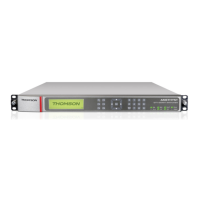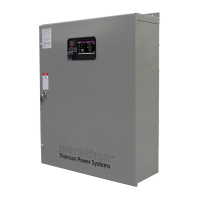
Do you have a question about the THOMSON TS 870 and is the answer not in the manual?
Historical summary of changes made to the product since original release.
Procedures for correct storage of the transfer switch prior to installation.
Permits required by local authorities for installing standby generator sets and ATS.
UL listing and intended applications for emergency power systems per NEC.
Requirements for installation environment, temperature, humidity, and sunlight.
Requirements for power cabling installation, conduit, ampacity, and connections.
Requirements for control wiring installation, conduit, sizing, and routing.
How the TS 870 operates with generator sets using remote automatic starting.
Suitable load types and limitations for the TS 870.
Requirement for upstream over current protection for non-service entrance models.
Over current protection for utility source and generator for service entrance models.
Reference to electrical ratings for withstand/interrupting current.
Requirement to set over current protection prior to operation for integrated models.
Confirmation of correct system voltage configuration for multi-tap capability.
Guidelines for remote engine start control field wiring.
Warning against dielectric testing with TSC 900 controller connected.
Reference to factory for additional information on open type installation.
Information on seismic certification and anchoring requirements.
Details on anchoring design standards, details, and expansion anchors.
Description of the TSC 900 microprocessor-based controller and its components.
Overview of the four types of ATS power switching mechanisms.
Details of the S-Style ATS mechanism, its configuration, and operation.
Details of the T-Style ATS mechanism, its configuration, and operation.
Details of the MO-Style ATS mechanism for closed transition.
Details of the MO-Style ATS mechanism for open and closed transition.
Explanation of the 21-digit product code structure and definitions.
Safety precautions and general information for commissioning procedures.
Describes the automatic sequence for open transition during power failure and return.
Describes the automatic sequence for closed transition during power failure and return.
Two positions: Open Transition (break-before-make) and Closed Transition (make-before-break).
Details on synchronizing protection using TSC 900 in-phase monitor and factory settings.
Specifies the time period for parallel operation during closed transition.
Describes how the TSC 900 monitors and reacts to closed transition failures.
Explains the transfer fail alarm for switching device failure to close.
Information on optional dual source system configurations.
How the Dual Utility ATS operates with preferred and standby sources.
How the Dual Prime Generator ATS operates with preferred and standby generators.
Operation of Dual Standby Generator ATS in a Master/Slave configuration.
Notes applicable only to Service Entrance configured transfer switches.
Describes normal operation for Service Entrance rated ATS.
Actions taken by TSC 900 controller during over current trip conditions.
Step-by-step procedure for performing a service disconnect.
Additional procedures if the Service Disconnected pilot light is not illuminated.
Procedures for manual operation of the transfer switch mechanism to neutral position.
Additional procedures for MO Style ATS mechanism service disconnect.
How to test the transfer switch using TSC 900 display or test switches.
Information on standard models requiring upstream over current protection.
Details on optional integral over current protection for utility source.
Checks for mechanical integrity of transfer switch mechanisms.
Checks for electrical integrity, connections, and insulation.
Checks for operational integrity of control devices and calibration.
Procedure for manual operation of S-Style ATS.
Steps for inserting and rotating the manual handle for S-Style ATS.
Procedure for manual operation of T-Style ATS.
Steps for pulling and pushing the manual handle for T-Style ATS.
Overview of MO Style ATS manual operation methods.
Explanation of AUTO and MAN modes for electrically operated push buttons.
Procedure for manually transferring to generator supply in open transition.
Details on charging the generator power switching device and closing it.
Procedure for manually transferring to utility supply in open transition.
Details on charging the utility power switching device and closing it.
Details on mechanical push buttons for power switching devices.
Steps for opening the generator power switching device and closing the utility power switching device.
Table of withstand current ratings for models without integral overcurrent protection.
Table of interrupting capacity current ratings for models with integral overcurrent protection.
Details on performance testing using calibrated current injection apparatus.
Lists probable causes and corrective actions for failure to re-transfer to utility.
Continues listing causes and actions for failure to re-transfer to utility.
Lists causes and actions for failure to transfer to generator.
Continues listing causes and actions for failure to transfer to generator.
Lists causes and actions for transfer to generator without utility failure.
Lists causes and actions for generator start/stop issues.
Lists causes and actions for missing time delays.
Lists causes and actions for apparent source connection issues.
Lists causes and actions for motor overheating and thermal protection.
Lists causes and actions for GHC display issues.
Continues listing causes and actions for GHC display issues.
Information on ordering replacement parts for the transfer switch.
Table of component descriptions, part numbers, and comments.
Procedures for S-Style 100A-800A ATS commissioning.
Checks to be performed before energizing the ATS.
Procedures for energizing the ATS and checking initial boot-up.
Verifying indicator lights, generator voltage, phase rotation.
Testing generator start/transfer and utility power outage test.
Procedure for changing system voltage on the TS 870.
Steps for changing voltage transformer primary taps.
Steps for logging in and changing system voltage via software.
Certification for seismic applications per AC156.
Loading...