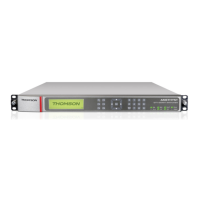
TS 880 TRANSFER SWITCH
PM064 REV8 10/01/25 6 Thomson Technology
transfer switch to a control panel should conform to the following guidelines to avoid
possible controller malfunction and/or damage.
3.5.1. Minimum #14 AWG (2.5mm
2
) wire size shall be used for distances up to
100ft (30m)
1
). For distances exceeding 100 ft. (30m) consult Thomson Technology
3.5.2. Remote start contact wires should be run in a separate conduit.
3.5.3. Avoid wiring near AC power cables to prevent pick-up of induced voltages.
3.5.4. An interposing relay may be required if field-wiring distance is excessively
long (i.e. greater than 100 feet (30m)) and/or if a remote contact has a resistance of
greater than 5.0 ohms.
3.5.5. The remote start contact must be voltage free (i.e. dry contact). The use of a
“powered” contact will damage the transfer controller.
3.6. DIELECTRIC TESTING
Do not perform any high voltage dielectric testing on the transfer switch with the TSC 800
controller connected into the circuit as serious damage will occur to the controller. All AC
control fuses and control circuit isolation plugs connected to the TSC 800 must be removed
if high voltage dielectric testing is performed on the transfer switch.
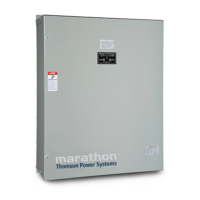
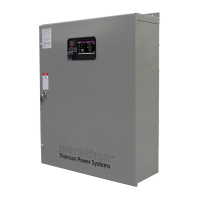
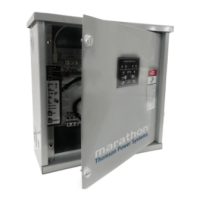
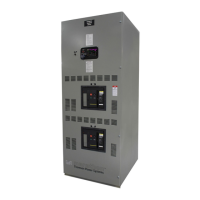
3.7. MOUNTING OF ENCLOSED TRANSFER SWITCHES
Model TS840, TS870 and TS880 Automatic Transfer Switches and Automatic
Transfer and Bypass Isolation Switches in "standard" enclosures are seismic
certified under AC156 building code for non-structural components.
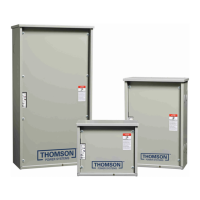
"Standard" enclosures are all transfer switch enclosures Thomson Technology offers
in NEMA 1, NEMA 2, NEMA 3R and NEMA 4X for the above listed product. If a
customer requests a custom enclosure it would not be covered under the generic
certificate; if certification were a requirement Consult factory before ordering.
The Automatic Transfer Switches are qualified to the highest known level in North
America; based on site class D. Specifically this is a spectral acceleration of 342%.
The transfer switch must be installed per the anchoring details provided for seismic
qualification. The equipment can be mounted in alternate means and still qualify if a
qualified Civil Engineer designs the alternate method of anchoring.


 To Next Page