WEIGHING, LOADING, AND TOWING
47THOR MOTOR COACH | MADE TO FIT
4
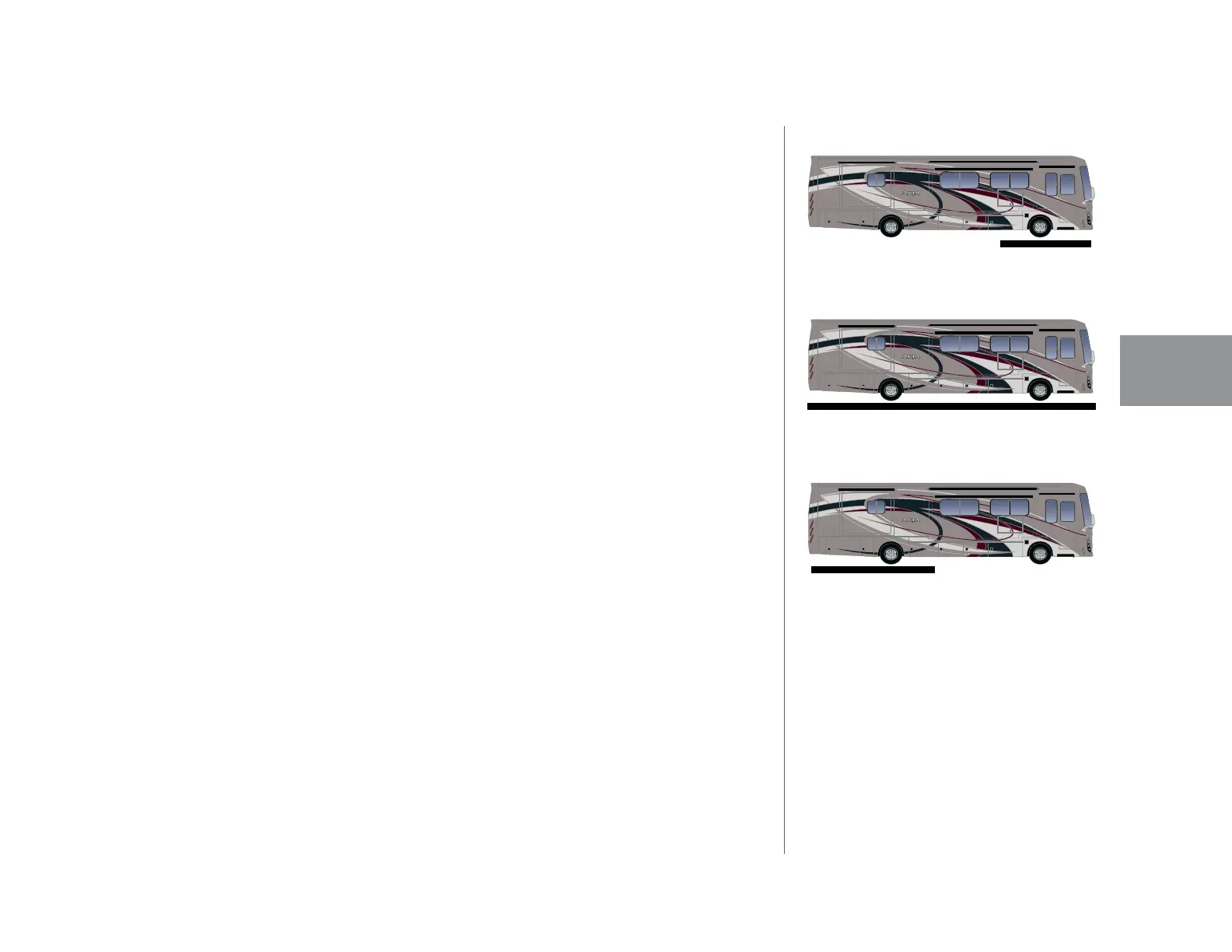
Reading A: Front
Reading B: Total Coach
Reading C: Back
NOTE: Thick Black Lines in the illustrations
above represent a vehicle weighing scale.
Weighing Your Motorhome
When loading your cargo, be sure it is distributed evenly to prevent overloading front to
back and side to side. Heavy items should be placed low and as close to the axle positions
as reasonable. Too many items stored on one side of your motorhome may overload a tire.
Periodically weigh your motorhome at a public scale to determine axle loads.
To weigh your motorhome correctly, measure the fully loaded vehicle axle by axle and wheel
position by wheel position. You can nd certied public or commercial vehicle scales at
moving and storage lots, farm suppliers with grain elevators, gravel pits, recycling companies,
and large commercial truck stops. You can also look in the telephone book under “weighers”
or “weighing”.
Allow adequate time, since the entire weighing process can take around 30 minutes. ere
may be a small fee for each weight taken, but the expense is a worthwhile investment toward
the safe and economical operation of your motorhome.
Your motorhome must be weighed fully loaded. at is with passengers, food, clothing, fuel,
water, propane, supplies etc. Any towed vehicle (car/pickup, boat, or trailer) or item loaded on
brackets on the back of the motorhome should also be included in the weighing.
e following procedure is suggested when using a long platform scale, although any method
recommended by the scale operator which correctly determines weight value is acceptable.
During all measurements, it is important to keep the vehicle as level as possible.
1. Pull onto the scale so that only the front axle is on the platform with the end of the scale
midway between the front and rear axles and record the weight (Reading A).
2. Pull forward until the full unit is on the scale and record the weight (Reading B).
3. Pull forward so that only the rear axle is on the scale and record the weight (Reading C).
4. To determine the weight of individual wheel positions, repeat the previous three steps, but
this time, use only one side of the motorhome on the scale. Record the weight readings. To
calculate the wheel position weight for the opposite side of the motorhome, subtract these
weight readings from weight readings A, B, and C recorded in steps 1, 2, and 3.
Your motorhome must remain as level as possible on the scale, even though an axle or side


 To Next Page