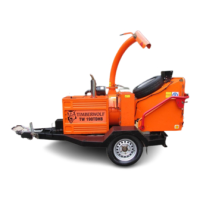
TW 230DHB
7
/ 55
SAFE WORKING
C190-0101 25.07.2017 Rev: 1.0
Check ball head is well greased.•
Wind jockey wheel assembly anticlockwise until the•
tow head is above the height of the ball hitch on the
vehicle.
Reverse vehicle so the ball hitch is directly below •
the tow head.
Attach breakaway cable to a strong point on the•
vehicle, not the ball hitch.
Grasp handle on tow head and push back catch with•
thumb.
Wind jockey wheel assembly clockwise, to lower the•
tow head onto the ball hitch.
Release handle and continue to wind jockey wheel•
clockwise. The tow head should snap into place on
the ball hitch. If it doesn't, repeat previous 2 steps.
Wind jockey wheel up until fully retracted and the•
jockey wheel frame is seated in its notch on the stem.
The chipper weight should be fully on the vehicle.
Check jockey wheel handle is secure before•
transportation. Do not overtighten jockey wheel
handle.
Release jockey wheel clamp and slide the jockey •
wheel assembly fully up.
Tighten clamp on jockey wheel assembly.•
Connect electrical plug to socket on rear of towing•
vehicle and check operation of all the trailer and
vehicle lights.
The chipper is now properly attached to the vehicle.•
SAFE TRANSPORTATION
HITCHING ONTO THE TOW BALL
UNHITCHING THE CHIPPER
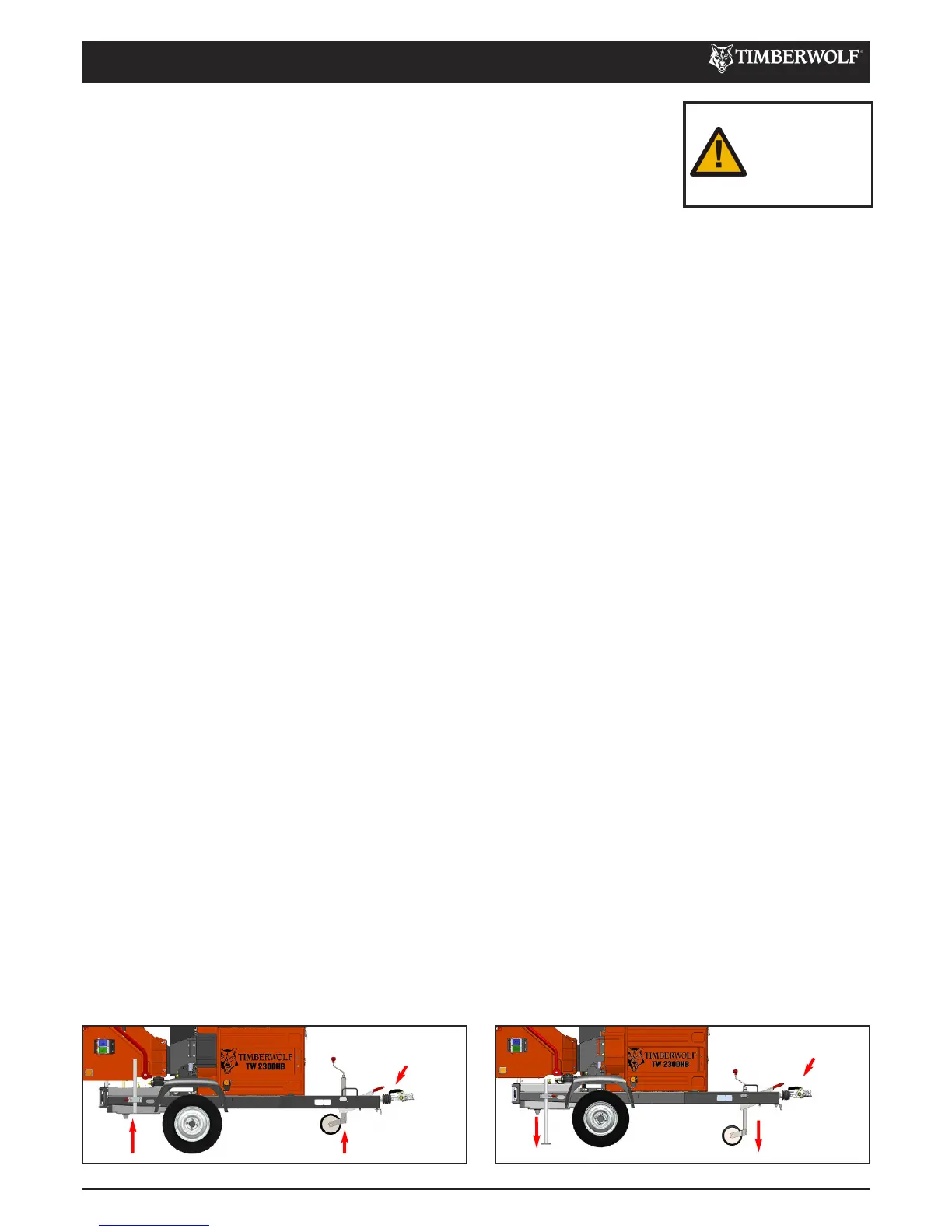
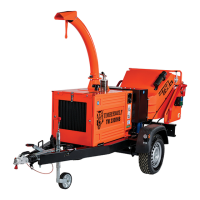
When hitched to a vehicle the chipper handbrake
should be released and the prop stand and jockey
wheel stored in the towing position (a).
Ensure the chipper will not roll away after being •
disconnected from the vehicle.
Disconnect the electrical cable from the vehicle•
socket and stow in the dock provided on the chassis
when not in use.
Release breakaway cable and stow in the dock•
provided on the chassis when not in use.
Release the jockey wheel assembly clamp.•
Lower the jockey wheel assembly fully.•
Retighten the jockey wheel assembly clamp.•
Wind the jockey wheel assembly anticlockwise until it•
starts to take the weight of the chipper.
Grasp the handle and release the catch with your•
thumb.
Continue to wind the jockey wheel anticlockwise. This•
should lift the tow head clear of the ball hitch.
Drive the vehicle clear of the chipper.•
Wind the jockey wheel assembly to a suitable point•
where the chipper is level. Do not overtighten jockey
wheel handle.
The chipper is now fully detached from the vehicle.•
When towing a chipper the maximum speed limit is 60•
mph.
O
n rough or bumpy road surfaces reduce speed•
a
ccordingly to protect your machine from unnecessary
v
ibration.
When towing off road be aware of objects that may•
catch the chipper undergear.
When towing off road ensure inclination is not•
excessive.
Avoid excessively pot holed ground.•
When reversing the chipper the short wheel base will•
react quickly to steering.
Always check the discharge is tight before moving.•
Keep tyre pressures•
inflated to 2.2 bar or 32
psi.
C
heck wheel nuts are•
t
ightened to 90nm or 65
lbs ft.
Clear loose chippings and debris from the machine•
before departing.
Ensure feed funnel is closed and the catch is properly•
engaged before departing.
NEVER transport any items in feed funnel.•
Ensure tow hitch lock mechanism is locked before•
transporting.
(a)
(b)
STABILISING THE CHIPPER
WARNING
D
O NOT RIDE ON
T
HE CHIPPER
W
HEN IT IS
B
EING TOWED.
When the chipper is unhitched it should be level and made
secure before starting work by applying the handbrake and
lowering the prop stand and jockey wheel (b).
During unhitched storage the chipper must be level with
the discharge chute pointing towards the towhead.


 To Next Page