Rack Control Module
TM
Product Manual
Rev. 1.2, May 9, 2014 Page 32
6. Defective electrical component such as connector, switch, plug, socket, terminal
strip or junction box
3. Confirm presence of an open circuit in wiring
An open circuit in wiring may be confirmed after testing by temporarily bridging the break
with a short length of wire bared at both ends or a jumper with alligator clips. Care must
be taken to ensure that only the open circuit is bridged and not any other part of the
circuit. Confirm normal circuit operation with the wire in place. Repair the wiring as
necessary.
The test light may also be used to bridge a wire break. It is current limited and will
indicate current flow in the circuit. The internal resistance of the light bulb will allow some
circuit components to operate such as horns, relays and lights. It will not provide
operating power for a full system and indicates low current with a dim light.
4. Short circuit isolation
This can be done by disconnecting the devices from the affected wire or signal, then
testing at each circuit point until the short circuit or defective component is isolated.
1. Short circuit to ground isolation.
a. Disconnect the shorted wire at each component to isolate the short
circuit.
b. Clip on battery power; probe each component at the shorted terminal
and disconnected wire. A short circuit to ground is indicated by the light
partially or fully illuminating.
2. Short Circuit to power isolation.
a. Disconnect the shorted wire at each component to isolate the short
circuit.
b. Clip on ground; probe each component at the shorted terminal and
disconnected wire. A short circuit to power is indicated by the light
partially or fully illuminating.
TD80 System Specific Troubleshooting 4.2
Verify correct TD80 level gauging system operation before continuing with the RCM.
Resolve all problems at this point before continuing.
Specific parts of the TD80 and RCM overfill prevention system are tested using a
combination of voltage checking with the test light and DMM. The test light does not
precisely measure the circuit voltage and must be kept in-mind during the troubleshooting
process.
Finding the defective component is troubleshooting or sometimes described as fault
isolation. Once the defective component is determined, it is replaced or repaired and the
system is fully tested to confirm correct operation. It is common for more than one
defective component to cause a system failure.
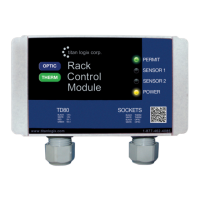
The RCM front panel has four indicators to view the permit status, alarm states and
vehicle battery voltage. These indicators will guide you through a logical troubleshooting
process to the component requiring repair or replacement.


 To Next Page
