EasyManua.ls Logo

TMC MCI mc-9 - Page 34

Default Icon
57 pages
Print Icon
To Next Page IconTo Next Page
To Previous Page IconTo Previous Page
Loading...
In
the
event
of
a ir pressure loss
in
the
service
broke
system, oir
pressure,
modulated
by
the
drivers
broke
pedal
, is
supp
li
ed
from
the
emergency
tonk
to
the
emergency
or
pork
chambers
on
the
rear
axle
. A
minimum
of
three
broke
app
lications
and
re
lea
ses
ore
possible
,
up
to
the
po
i
nt
when
pressure is
so
l
ow
as
to
automat
i
cal
ly
trigger
the
pork
brakes
to
come
full
on
.
IMPORTANT
BEFORE
STARTING
ENGINE:
1.
Make
sure
thot
parking
broke
is
applied
(contr-:.1
button
is
up).
2.
Gearshift
lever
in
"
neutral".
3.
DO
NOT
Depress
clutch
when
starting
engine.
(Standard
Trans•
mission
Only)
.
BEFORE
MOVING
COACH:
1.
Air
pressure
gouge
must
read
100
p .s.i. (
689
kPo)
or
more.
2.
Make
a
full
servi
ce
broke
application.
Ho
ld servi
ce
broke
,n
applied
position.
3. Push
parking
broke
control
button
down.
Parking
brakes
sbould
release
.
4.
If
brakes
do
not
release.
reduce
air
pressure
to
below
75p
.s.i.
(517
kPo
)
by
pumping
broke
pedal.
Operate
engine
until
compressor
cuts
out,
then
repeat
above
procedure
.
DO
NOT
A
TT
EMPT TO
BRAKE
COACH
FREE
IF
BRAKES FAIL
TO
RELEASE
PARKING
1.
Gearshift
l
ever
in
neutral.
2.
Always
app
ly
parking
brakes
(
control
button
up)
before
leaving
coach
.
Brakes
will
remain
applied
even
if
coach
air
pressure
is
lost.
TO
EMERGENCY
Fill
PARK
BRAKE
SYSTEM APPLY
AIR
TO
VALVE
LOCATED
IN
TOOL
COMPARTMENT.
32
NOTE
:
Air
pressure
gouge
on
dash
does
not
s
how
park
i
ng
broke
reservoir
pressure.
If
pre
ssure
on
gouge
drops
during
ope
r
ation
, four
parking
brake
applications can still be
made
.
Parking
and
'
emergency
brakes
wi
ll
not
apply
au
t
omatically
until
park
i
ng
res
ervoi
r
pressure
drops
below
40
lb
s. (
276
kPo).
If
pressure
on
gouge
drops
be
l
ow
70-75
lbs
. (
487
-
517
kPo)
during
operat
i
on
, "
LOW
AIR
"
tell-to
le
will
flash
and
warning
buzzer
w
ill
sound
. Coach
should
be stopped
immediately
and
cause of
air
loss
corrected before proceeding.
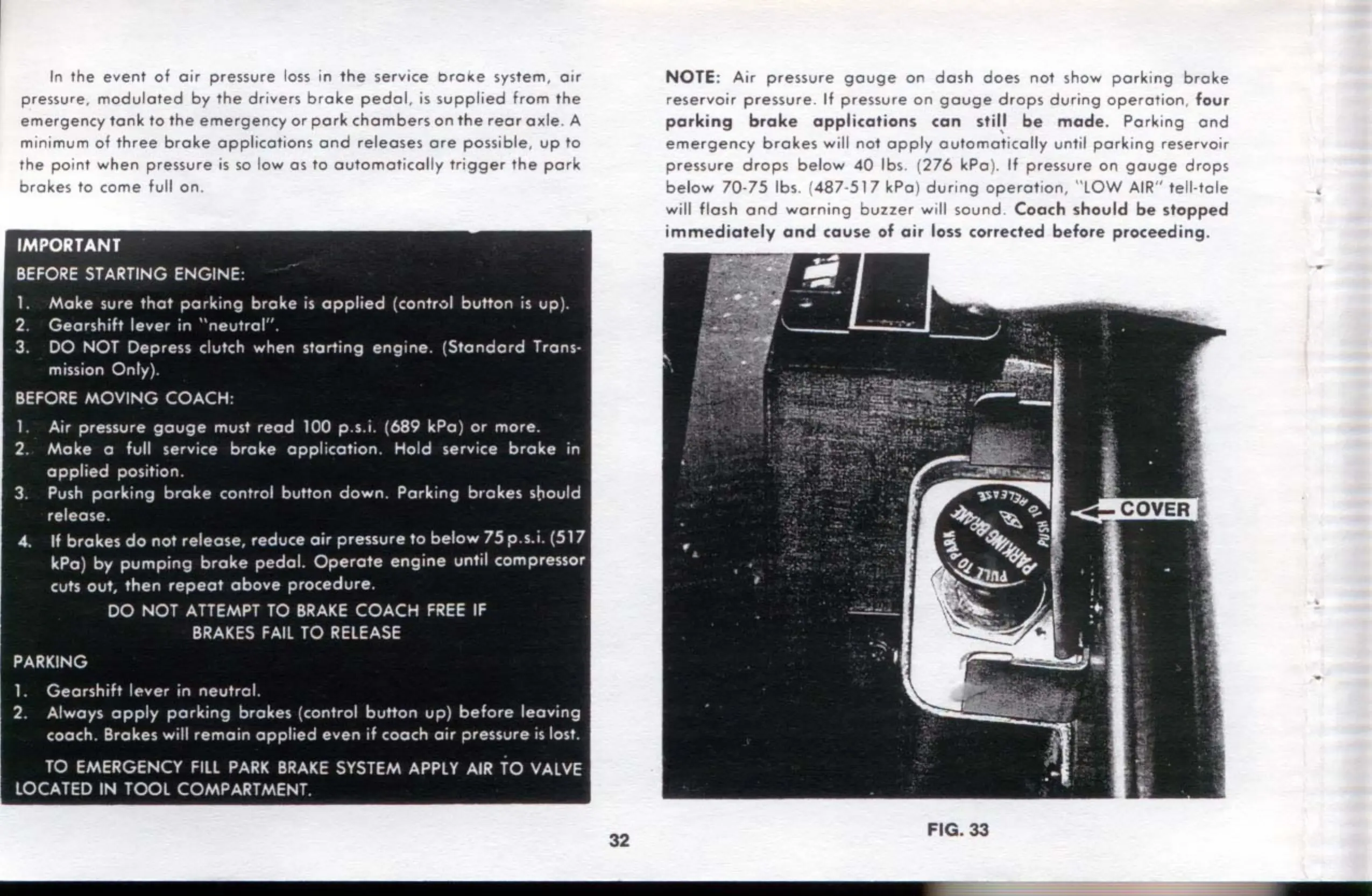
FIG. 33
-