HIGHALTITUDEADJUSTMENTTIPS AND CHART
• The altitude chart is not a recipe but a guide to use to change key ingredients in a recipe if it doesn't
work as printed.
• All recipes were developed at sea level-approximately. Adjustments may be necessary if your altitude
is 2000 feet or higher.
• Try the recipe as printed first unless you have experimented on other recipes and have an idea of
what to change.
• REMEMBER only change one ingredient in the recipe at a time. Then use this guide to change
other recipes.
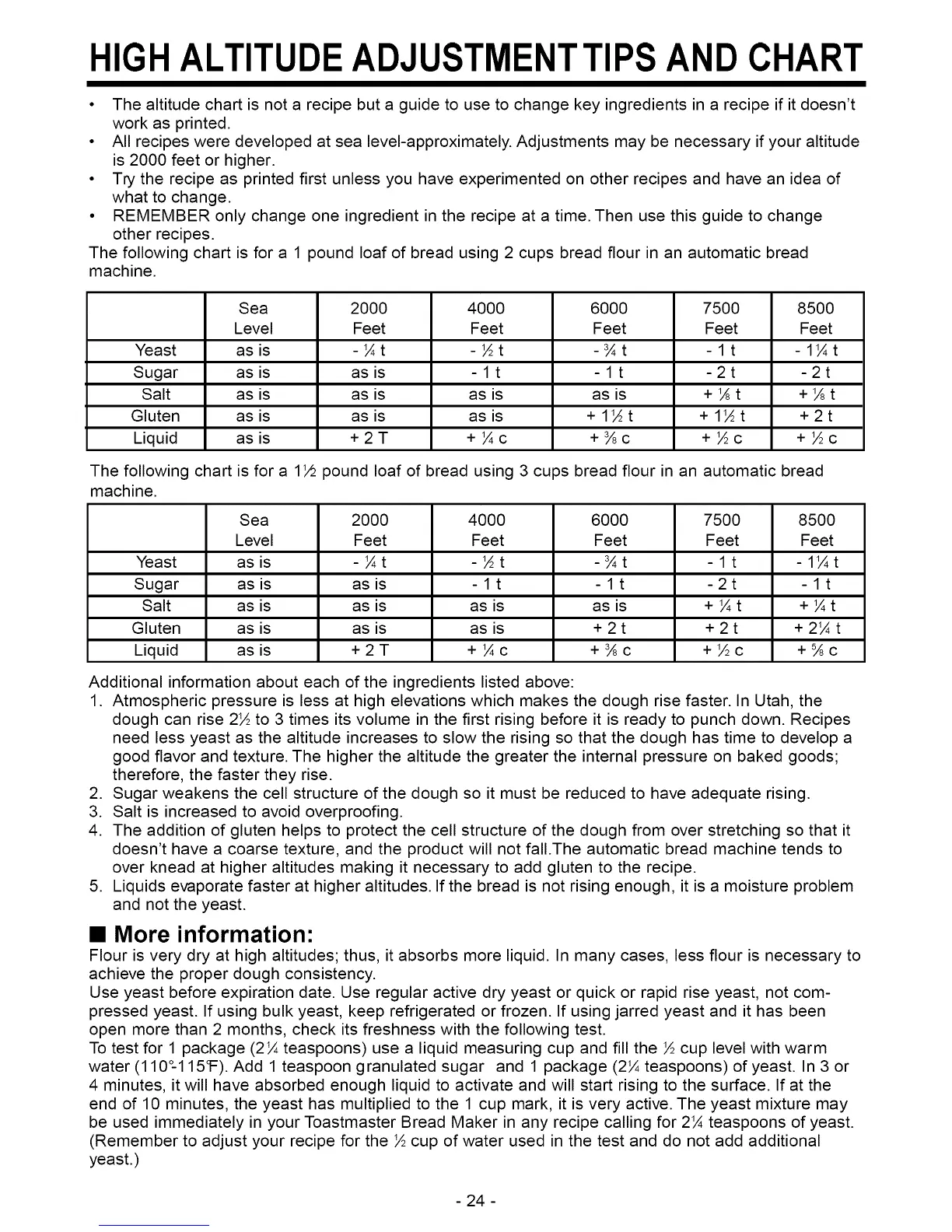
The following chart is for a 1 pound loaf of bread using 2 cups bread flour in an automatic bread
machine.
Sea 2000 4000 6000 7500 8500
Level Feet Feet Feet Feet Feet
Yeast as is - ¼ t - ½ t _ 3_t - 1 t - 1¼ t
Sugar as is as is - 1 t - 1 t - 2 t - 2 t
Salt as is as is as is as is + 1,4t + ¼ t
Gluten as is as is as is + 15,5t + 15,5t + 2 t
Liquid as is + 2 T + ¼ c + % c + ½ c + ½ c
The following chart is for a 1½ pound loaf of bread using 3 cups bread flour in an automatic bread
machine.
Sea 2000 4000 6000 7500 8500
Level Feet Feet Feet Feet Feet
Yeast as is - ¼ t - 5,5t - _4t - 1 t - 11,4t
Sugar as is as is - 1 t - 1 t - 2 t - 1 t
Salt as is as is as is as is + ¼ t + ¼ t
Gluten as is as is as is + 2 t + 2 t + 21/_t
Liquid as is + 2 T + ¼ c + % c + ½ c + % c
Additional information about each of the ingredients listed above:
1. Atmospheric pressure is less at high elevations which makes the dough rise faster. In Utah, the
dough can rise 2½ to 3 times its volume in the first rising before it is ready to punch down. Recipes
need less yeast as the altitude increases to slow the rising so that the dough has time to develop a
good flavor and texture. The higher the altitude the greater the internal pressure on baked goods;
therefore, the faster they rise.
2. Sugar weakens the cell structure of the dough so it must be reduced to have adequate rising.
3. Salt is increased to avoid overproofing.
4. The addition of gluten helps to protect the cell structure of the dough from over stretching so that it
doesn't have a coarse texture, and the product will not fall.The automatic bread machine tends to
over knead at higher altitudes making it necessary to add gluten to the recipe.
5. Liquids evaporate faster at higher altitudes. If the bread is not rising enough, it is a moisture problem
and not the yeast.
• More information:
Flour is very dry at high altitudes; thus, it absorbs more liquid. In many cases, less flour is necessary to
achieve the proper dough consistency.
Use yeast before expiration date. Use regular active dry yeast or quick or rapid rise yeast, not com-
pressed yeast. If using bulk yeast, keep refrigerated or frozen. If using jarred yeast and it has been
open more than 2 months, check its freshness with the following test.
To test for 1 package (2¼ teaspoons) use a liquid measuring cup and fill the ½ cup level with warm
water (110°-1151=). Add 1 teaspoon granulated sugar and 1 package (2¼ teaspoons) of yeast. In 3 or
4 minutes, it will have absorbed enough liquid to activate and will start rising to the surface. If at the
end of 10 minutes, the yeast has multiplied to the 1 cup mark, it is very active. The yeast mixture may
be used immediately in your Toastmaster Bread Maker in any recipe calling for 2¼ teaspoons of yeast.
(Remember to adjust your recipe for the ½ cup of water used in the test and do not add additional
yeast.)
- 24 -



 To Next Page