Section 2 – Operation
TOELLNER Electronic Instrumente GmbH
If, instead of this, DIL switch S2 + 0.1 Ω is set to ON , discharging is via a series resistor of
0.1 Ω, e.g. for realization of the test signal according to LV 124, version 2009, test E-10, test
case 3. Again, the green LED next to the related switch symbol is illuminated for indication.
This setting is only possible if not already the discharging without series resistor was chosen.
If no discharging is to carried out using S2, make sure that the two named DIL switches are
in the left-hand positions.
It must always be noted with buffered consumers that the rise and fall times are lengthened.
High buffer capacities with low series resistance values (ESR) can also result in triggering of
the overcurrent fuse.
Feedback from the (buffered) load side to the OUT output of the power switch must have
the indicated polarity and not exceed the rated voltage of the TOE 9261! A voltage
inversion into the negative is only permissible after blocking S1 by means of inductance-
dependent, further flowing load current.
Non-observance of this may result in damage to the Electronic Switch.
In the configuration for switching the return line (ground), the switching path S1 is parallel to
the consumer. If e.g. a test setup in accordance with LV 124, version 2013, test E-13 is used
and this test is applied to a ground line, discharging of the load is not intended during the
ground interruption. The DIL switch S1 ENABLE must then be set to OFF .
If in other applications the consumer is to be jumpered during the ground interruption, the
switching path S1 can be used for this by setting the DIL switch S1 ENABLE to the left-hand
position. Direct load jumpering is then available during the ground interruption; the looping-in
of a series resistor into the jumpering path is not possible in this configuration.
Note that with buffered consumers the rise and fall times are lengthened. High buffer
capacities with low series resistance values (ESR) can also result in triggering of the
overcurrent fuse.
Feedback from the (buffered) load side to the OUT output of the power switch must have
the indicated polarity and not exceed the rated voltage of the TOE 9261, i.e. the voltage
connected to OUT must not be more positive than the voltage at the Plus sockets or more
negative than the voltage at the Minus sockets! A voltage exceedance into the positive is
only permissible after blocking S2 by means of inductance-dependent, further flowing load
current.
Non-observance of this may result in damage to the Electronic Switch.
2.4.10 High-impedance base load
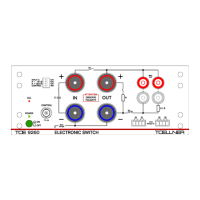
DIL switches R = 10 kΩ / ON and R = 100 kΩ / ON can be used to permanently switch
corresponding resistances to the output socket pair OUT – Minus, i.e. independent of the
switching state of paths S1 and S2. These serve in the configuration for switching the
positive supply line as high-impedance base loads. For indication the green LED next to the
related switch symbol is illuminated. It is also possible to select both resistors at the same
time, i.e. as a parallel circuit.
No connectable base loads are available in the configuration for switching the return line
(ground).
2.4.11 PWM operation of a consumer
Consumers which are suitable for use with pulse width modulation (PWM) can be used with
the TOE 9261. The frequency of the digital switching signal which is sent to one of the
CONTROL inputs corresponds to the frequency of the PWM signal; the pulse/pause ratio of
the switching signal results in the duty cycle of the PWM.
The current which is drawn by the consumer during the turn-on phase of the PWM is allowed
to have values up to the rated current of the TOE 9261. If the current draw is higher, the
overcurrent protection on the TOE 9261 may be triggered during the turn-on phase of the
PWM.
The TOE 9261 is in principle suitable for switching frequencies up to 100 kHz. Depending on
the voltage and current requirement of the consumer as well as the cable inductance from


 To Next Page