EasyManua.ls Logo

Trane 4TWA7 - User Manual

Trane 4TWA7
24 pages
Print Icon
To Next Page IconTo Next Page
Loading...
18-BC96D1-1A-EN
ALL phases of this installation must comply with NATIONAL, STATE AND LOCAL CODES
IMPORTANT — This Document is customer property and is to remain with this unit. Please return to service informa-
tion pack upon completion of work.
Heat Pumps
These instructions do not cover all variations in systems or provide for every possible contingency to be met in connection with
the installation. Should further information be desired or should particular problems arise which are not covered sufficiently for the
purchaser’s purposes, the matter should be referred to your installing dealer or local distributor.
Note: The manufacturer recommends installing only approved matched indoor and outdoor systems. All of the manufacture’s split
systems are AHRI rated only with TXV/EEV indoor systems. Some of the benefits of installing approved matched indoor and out-
door split systems are maximum efficiency, optimum performance and the best overall system reliability.
4TWA7
Installer’s Guide
Table of Contents
Section 1. Safety ..................................................................................... 2
Section 2. Unit Location Considerations.............................................. 3
Section 3. Unit Preparation .................................................................... 5
Section 4. Setting the Unit ..................................................................... 5
Section 5. Refrigerant Line Considerations ......................................... 6
Section 6. Refrigerant Line Routing ..................................................... 8
Section 7. Refrigerant Line Brazing ...................................................... 8
Section 8. Refrigerant Line Leak Check ............................................. 10
Section 9. Evacuation ........................................................................... 12
Section 10. Service Valves ................................................................... 12
Section 11. Electrical - Low Voltage .................................................... 13
Section 12. Electrical - High Voltage ................................................... 15
Section 13. Start Up .............................................................................. 16
Section 14. System Charge Adjustment ............................................. 17
Section 15. Checkout Procedures and Troubleshooting ................... 23

Question and Answer IconNeed help?

Do you have a question about the Trane 4TWA7 and is the answer not in the manual?

Overview

This document is an installer's guide for Trane 4TWA7 series heat pumps, providing comprehensive instructions for installation, startup, and troubleshooting. It emphasizes compliance with national, state, and local codes throughout all installation phases.

Function Description:

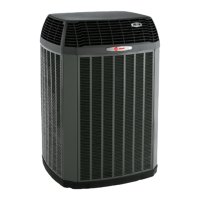
The Trane 4TWA7 heat pump is an outdoor condensing unit designed to work in conjunction with an indoor evaporative coil to provide heating and cooling for residential or commercial buildings. It utilizes R-410A refrigerant and is part of a split system, meaning it requires both an outdoor and indoor unit for operation. The system is designed for maximum efficiency, optimum performance, and overall system reliability when installed as a matched indoor and outdoor system with TXV/EEV indoor systems, as AHRI rated.

Important Technical Specifications:

  • Refrigerant Type: R-410A. This refrigerant operates at 50 to 70% higher pressures than R-22 and requires R-410A approved service equipment. It uses POE oil, which is hygroscopic, necessitating careful handling to prevent moisture absorption.
  • Unit Dimensions and Weight (Estimated):
    • 4TWA7036A3/4: 45 x 34 x 37 inches (H x D x W), 245 lbs.
    • 4TWA7048A3/4: 45 x 34 x 37 inches (H x D x W), 265 lbs.
    • 4TWA7060A3/4: 45 x 34 x 37 inches (H x D x W), 265 lbs.
  • Refrigerant Piping Limits:
    • Maximum TOTAL length of refrigerant lines (outdoor to indoor unit): 150 feet (including lift).
    • Maximum vertical change (lift): 50 feet.
    • Specific line sizes and service valve connection sizes vary by model and are detailed in Table 5.1.
  • Factory Charge: The unit is factory charged for the outdoor condensing unit, 15 feet of tested connecting line, and the smallest indoor evaporative coil match. Adjustments are necessary for longer line lengths or larger indoor coils.
  • Low Voltage Wiring: Maximum wire lengths for 24 volts are specified: 18 AWG for 150 Ft., 16 AWG for 225 Ft., and 14 AWG for 300 Ft.
  • Defrost Control: Features a selectable termination temperature, factory set at 47°F. Jumper J2 can be cut to achieve a 70°F termination temperature.
  • Electrical: High voltage power supply must match the equipment nameplate and comply with national, state, and local codes. A separate disconnect switch is required at the outdoor unit.

Usage Features:

  • Installation Flexibility: Can be mounted on a support pad or rooftop, with recommendations for proper isolation to prevent sound/vibration transmission.
  • Airflow and Clearance: Requires a minimum of 5 feet unrestricted clearance above the unit and 3 feet in front of control box/access panels for service. A minimum of 12 inches clearance from walls or shrubbery is needed for adequate airflow.
  • Cold Climate Considerations: Recommendations include elevating the unit 3-12 inches above the pad/rooftop to allow for snow/ice drainage and installing a snow drift barrier if necessary.
  • Refrigerant Line Routing: Emphasizes precautions to prevent noise from vibration transmission, such as using isolation type hangers and insulating lines. Minimizing 90° turns is also recommended.
  • System Start-Up: Includes a mandatory one-hour waiting period before starting the unit if a compressor crankcase heater accessory is used and the outdoor ambient is below 70°F.
  • Charging Methods: Subcooling charging is the recommended method for cooling mode when outdoor ambient temperature is above 55°F. For temperatures below 55°F (heating only), the weigh-in method is recommended, referencing refrigerant pressure curves for typical performance.
  • System Stabilization: A minimum 20-minute operation period is required for the system to stabilize before accurate charge measurements can be made.

Maintenance Features:

  • Service Access: Designed with access panels for easy servicing of the control box.
  • Refrigerant Handling: Strict warnings regarding R-410A refrigerant and POE oil handling, including the need for R-410A approved service equipment, keeping the system sealed, and replacing compressor oil if the system has been open to the atmosphere for more than 4 hours. Driers must be changed when opening the system for component replacement.
  • Leak Check: A mandatory leak check procedure using dry nitrogen at 150 PSIG is required after brazing refrigerant lines.
  • Evacuation: The system must be evacuated to no higher than 350 microns, with a subsequent check to ensure the micron gauge does not rise above 500 microns in one minute.
  • Service Valve Operation: Detailed instructions for opening gas and liquid service valves, emphasizing caution for the liquid line service valve to prevent abrupt release of system charge.
  • Troubleshooting Guide: A comprehensive system faults table is provided, categorizing issues by refrigerant circuit, electrical, and defrost, with primary and secondary causes identified for cooling and heating modes.
  • Record Keeping: The guide includes a section for recording system information, pressures, and temperatures after charging for future reference.
  • Final Inspection: A final unit inspection is recommended to ensure factory tubing has not shifted, wiring connections are tight, and all components are properly secured.

Trane 4TWA7 Specifications

General IconGeneral
BrandTrane
Model4TWA7
CategoryHeat Pump
LanguageEnglish

Related product manuals