29
28
Trouble Analysis
Trouble Analysis
Repair or replace blade
Tighting lever fixings
Refit actuator correctly
Prevent bypass with block-off
Clean and unblock tubes
Check water pumps, valves and lines for
obstructions
Provide proper water temperature
Prevent bypassing with block-off
Clean and unblock tubes
Check fan-operating conditions
Check sensing bulb location and TXV operation
Check for blockage in distributor and tube
Repair damaged part
Check support and alignment of pipework and
rectify
Check frost protection method and correct, improve
Trapping of steaam supply
Resize / fit trap and check air break arrangement
Clean trap and refit
Clean drain line
Level unit
Design trap per unit installation instructions
Reduce fan speed
Design trap per unit installation instructions
Repair leaks
Insulate surfaces
Replace filters
Reduce filters bypass
See “Standing water” symptom
See “Wet interior insulation” section
Adjust tension
Replace belt or belt set. Check sheave alignment
Replace sheaves
Replace sheaves
Realign drive with MVP sheave set at mean pitch
diameter
Check for leaky bearings. Clean belts and sheaves
Adjust tension
Remove obstruction or realign drive for clearance
Check belt tension and overhung load
Replace sheave with larger one
Blade bent
Spindle or mechanism loose
Actuator loose
Air is by passing coil
Coil tubes are blocked
Incorrect airflow (CFM)
Incorrect water flow rate (GPM)
Incorrect water temperature
Air is by passing coil
Coil tubes are blocked
Incorrect airflow
Expansion valve not operating
Poor refrigerant distribution
Header / exposed pipe damage
Cracks in joints due to strain of pipework
on headers
Swelling of joints due to frost
(Water-hammer Steam Coils)
Incorrect hydraulic trapping
Blockage in trap
Plugged Drain Line
Unit not level
Improper trap design
Coil face velcity too high
Improper trap design
Drain pan leaks / overflows
Condensation on surfaces
Missing filters
Filter bypass
Standing water in drain pan
Moisture problems
Motor is poorly positioned
Worn or damaged belt
Worn Sheaves
Worn Sheaves
Misalign belt
Grease or oil on belts
Belt slipping
Belts rubbing
Excessive overhung load due to
overtensioned drive
Excessive overhung load due to a small
Damper seizing
Low coil capacity (Chilled Water)
Low coil capacity (Refrigerant)
Leaking Coil
Drain pan overflow
Standing water in drain pan
Wet interior insulation
Excess dirt in unit
Microbial growth (mold) inside
air handler
Loose fan belt
Short belt life
Rapid motor bearing wear
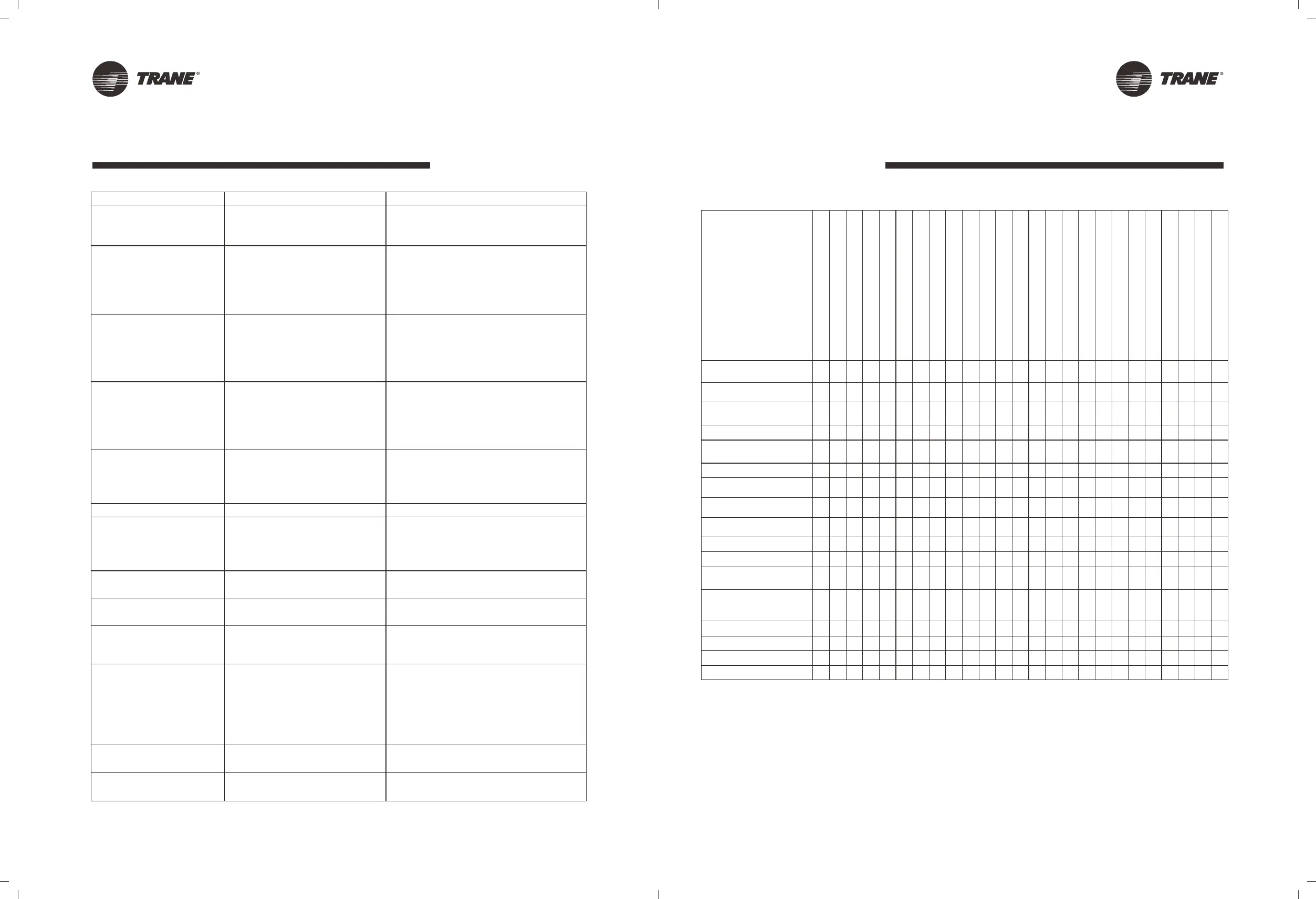
Symptom
Probable Cause
Recommended Action
√ Indicates Most Common Causes
@ Indicates Other Possible Causes
Pulley and Belt
Rapid side wall wear
@ @
√ √
@ @ @ @ @ @ @ @
Worn cove on back
√
@ @
Belt turns over or
jump off pulley
@ @ @
√
@
Belt soft,swollen
√
@
Belt slips,squeals
(Spin Burn)
√ √ √ √
@ @ @ @
Belt cover split
@ @
Underside cracked
@ @ @ @
√ √
@
Tie-band damakaged
@ @
√ √
@
√
Repeated breakage
@ @ @ @
√
Belts ride too high
@ @
Belts bottoming
√ √
@
√
Repeated take up
necessary
@ @ @ @
Belt vebrate
excessively or
appear mismatched
@ @ @ @ @ @
√
@ @
Bearing are hot
@ @ @ @ @
√
@ @
Shafts whip orbend
@ @ @ @ @
√
Cracked bushings
@ @
√
Pulley wobble
@ @ @
√
Couscs SYMPTOMS
Belt pries on or misplaced slack
Belts rubbing guard
Pulleys misalign
Won or damaged pulleys
Pulleys too far from pulleys
Poor bearing or shaft conditions
Insufficient tension
Excessive tension
Improper pulley installation
Belt worn(Normal service life)
Wrong belt cross section or type
Mismatched or mixed belts
Machince induced impulse or type
Improper or prolonged storage
Excessive heat
Excessive oil or grease
Abrasive environment
Foreign objects in grooves
Excessive moisture
Overloaded drive-undebelting
Drive seriously overbelted
Pulley too small
Insufficient wrap on small pulley
Backside ldler
Use of belt dressing



 To Next Page