TRANE
R
Assembly & Installation
Chilled Water
Piping - Coil Connection
General Coil Piping Recommendation
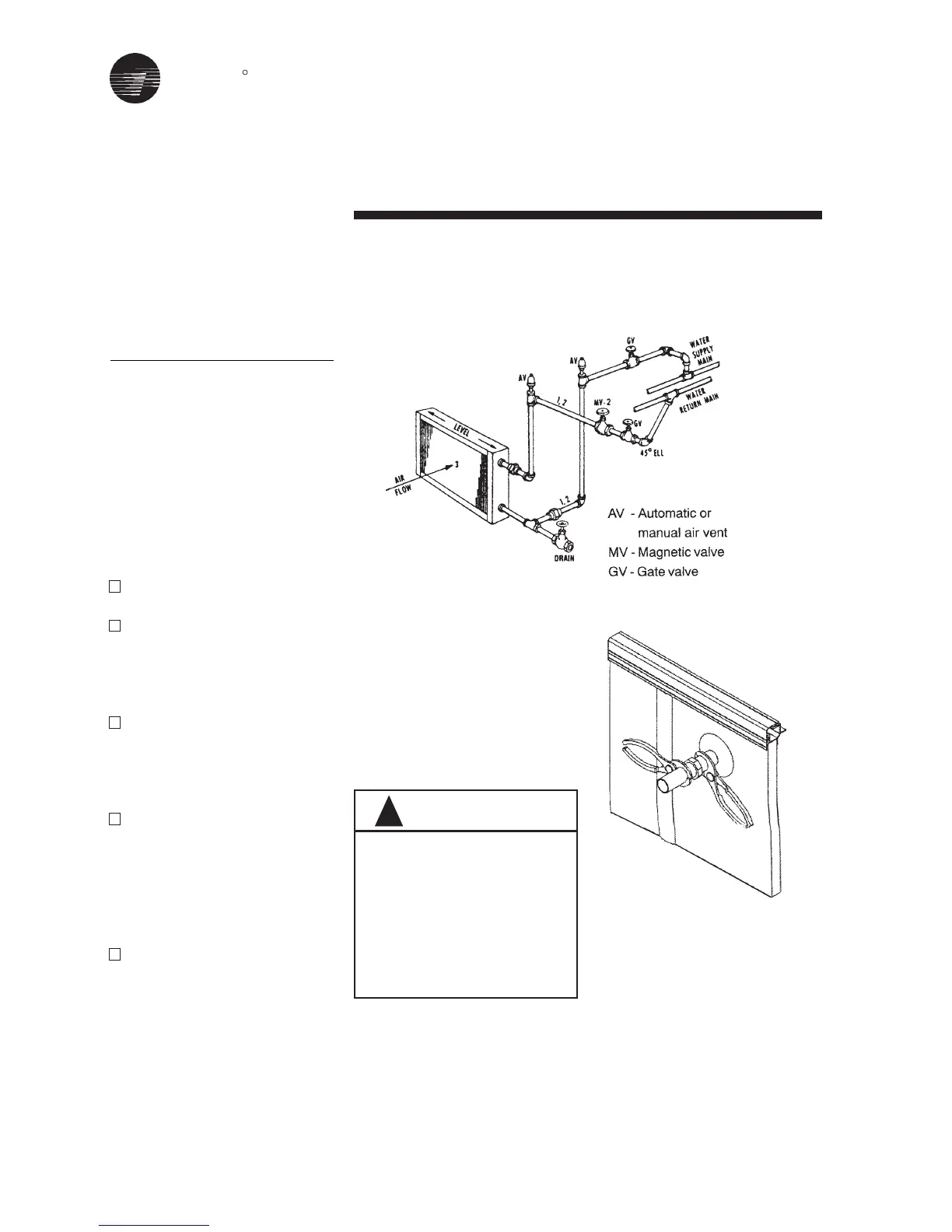
Refer to Figure 11 for typical cooling /
heating and steam coil piping.
Proper installation, piping and trapping
is necessary to assure satisfactory coil
operation and to prevent operational
damage. Water inlet and outlet
connections protrude through the coil
section side panel. Follow standard
piping practices when piping to the
coil. Note the following:
1. Support all piping independently of
the coils.
2. Provide swing joints or flexible
fittings in all connections that are
adjacent heating coils in order to
absorb thermal expansion and
contraction strains.
3. When attaching piping to the coil
header, make the connection only
tight enough to prevent leaks, the
maximum recommended torque is
200ft-lbs.
4. Teflon tape or teflon piping
compound should not be used
because of its high lubricity, teflon
makes it easier to tighten the pipe
to the header joint past the point
where an effective seal is created,
thus damage to the coil could result.
5. "White Zinc" compound / pipe
sealer on all threaded connection
is recommended, instead.
20
NOTE: DRAIN AND VENT CON-
NECTIONS ARE PROVIDED AS
STANDARD ON COIL HEADERS.
IF EXTENDED DRAINS AND VENTS
ARE REQUIRED, THEY MUST BE
FIELD PROVIDED.
Figure 12
Completely stress-free connections
are essential. The pipework of the coils
should be arranged to facilitate easy
removal of the coil for any required
maintenance purposes.
Figure 11
Typical Piping for Water Coil
IMPORTANT
!
To avoid damaging the coil
connections it is essential to grip
the pipe connection whilst
applying counter pressure to
tighten the joint (see Figure 12).
Use “Back-up wrench” when
attaching piping to coils, on
threaded connections.


 To Next Page