ARTC-SVX013A-EN
65
7. Verify chilled water flow to condenser and evaporator.
8. Monitor and record temperature and refrigerant
pressures registering on the touchscreen interface
panel.
Emergency Power Shutdown
The chiller includes a disconnect to turn off the high voltage
to the unit. Should an emergency condition arise, the
disconnect must be opened to shutdown all voltage to the
chiller.
There are several ways to interrupt power to all or part of
the chiller:
• Disconnect the primary power source from the building
that feeds electricity to the chiller. This occurs in
sudden emergencies (usually weather-related) or
planned maintenance shutdowns.
• Press the HOA button to access the OFF button. Press
the OFF button to disable the module. The HOA button
is located on the touchscreen of the unit.
• Each chiller has a toggle switch located on the exterior
of the power panel. This switch is used to isolate power
in the control panel.
Note: Pressing the HOA button on the touchscreen
interface panel does not de-energize the chiller or
the high voltage current into the chillers control
panel. This action sends a command to the
controller to discontinue electrical current to that
compressor.
Water Quality Guidelines
Water quality must be maintained periodically by the end
user to avoid scaling and corrosion inside the heat
exchangers.
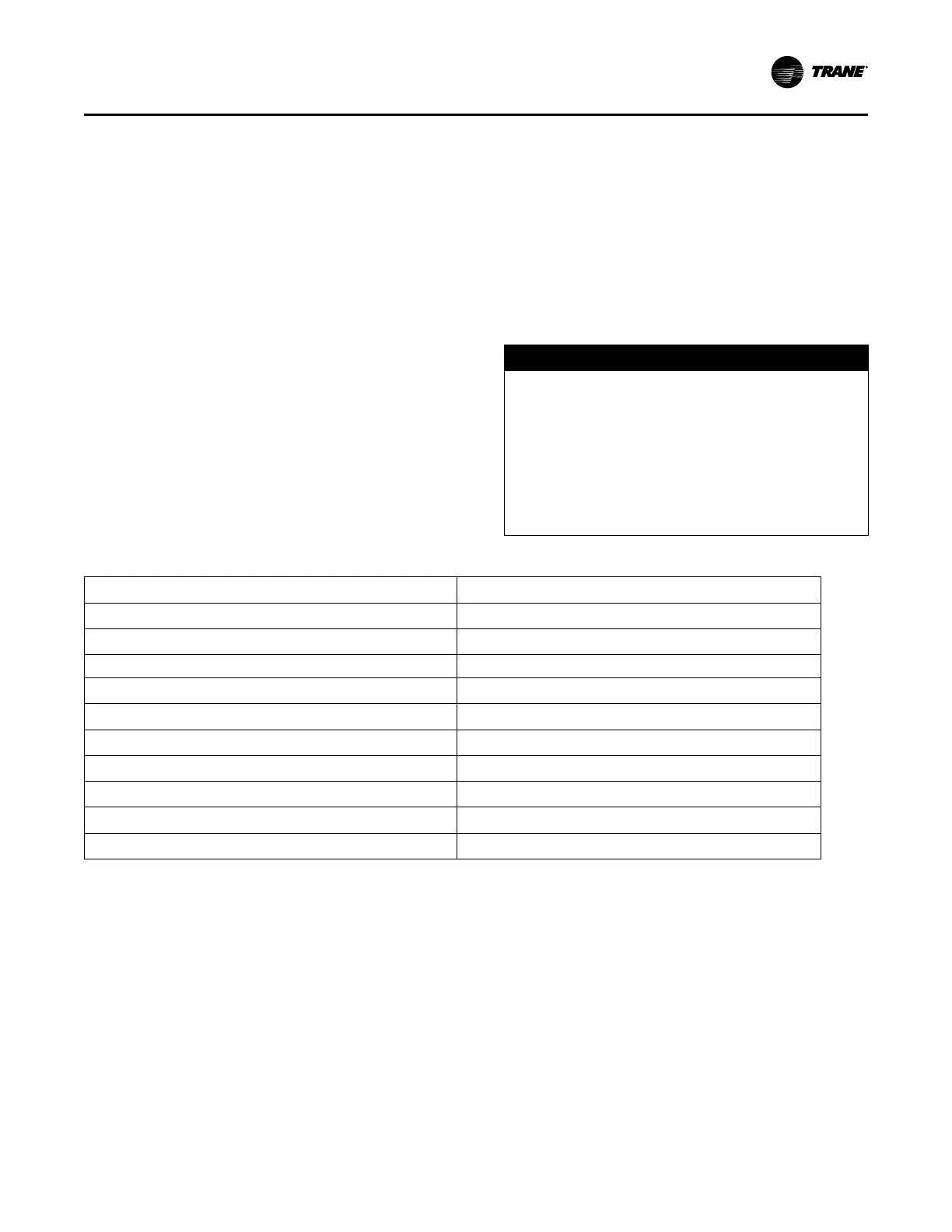
NOTICE
Proper Water Treatment Required!
The use of untreated or improperly treated water
could result in scaling, erosion, corrosion, algae or
slime.
Use the services of a qualified water treatment
specialist to determine what water treatment, if any, is
required. Trane assumes no responsibility for
equipment failures which result from untreated or
improperly treated water, or saline or brackish water.
Table 23. Water quality guidelines
Element/Compound/Property
Value/Unit
pH
7.5 - 9.0
Conductivity < 500 μS/cm
Total Hardness 4.5 - 8.5 dH°
Free Chlorine
< 1.0 ppm
Ammonia (NH3) < 0.5 ppm
Sulphate (SO42–) < 100 ppm
Hydrogen Carbonate (HCO3– 60 – 200 ppm
(HCO3–) / (SO42–)
> 1.5
(Ca + Mg) / (HCO3–)
> 0.5
Chloride (Cl-) < 200 ppm
Notes:
1. Total Hardness/corrosion: Water with high hardness can cause corrosion problems due to its high ion content (Ca+2, Mg+2, Fe+2) which
also means a high electrical conductivity and a high total dissolved solid (TDS). For this reason, too high hardness values should be
avoided, not only due to higher risk of scaling, but also for corrosion risk. On the other hand, soft water, but not necessarily cation
exchange softened water, may in contrast have a low buffering capacity and so be more corrosive. If the hardness values are outside the
recommended range, other parameters such as oxygen content, conductivity, and pH values should be considered to evaluate the
corrosion risk.
2. Fe3+ and Mn4+ are strong oxidants and may increase the risk for localized corrosion on stainless steels in combination with brazing
material copper.
Monitor Water Quality
Maintaining water/glycol mixture quality and cleanliness is
critical to chiller health and maintainability. Water/glycol
mixture samples should be taken and tested by a
professional lab. The results will enable the accurate
adjustment of quality thereby increasing the operational life
of the chiller.
Note: Trane will not validate the chiller warranty if the
proper water/glycol mixture composition and quality
is not maintained.
Operating Procedures


 To Next Page