Need help?
Do you have a question about the TRENDnet TEG-S80ES and is the answer not in the manual?
Describes the switch's capabilities, cost-effectiveness, and common managed features.
Lists the items included in the switch package.
Highlights the web interface, common features, and integration options for SMB networks.
Mentions SNMP, SNMP Trap, and Port Mirroring for administrator monitoring solutions.
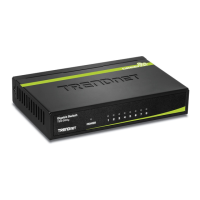
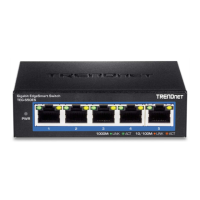
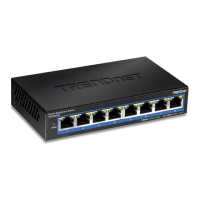
Illustrates the switch's physical layout, ports, and explains the meaning of LED status indicators.
Details site considerations for desktop placement and ventilation.
Outlines initial IP setup steps for accessing the switch via its default IP address.
Provides step-by-step instructions to log into the switch's web interface using a browser.
Explains how to connect devices using the switch's Gigabit Ethernet ports and check LED status.
Displays firmware version, uptime, and boot loader details.
Shows system name, location, and contact details for identification.
Details the switch's MAC address and current IP configuration.
How to assign system name, location, and contact for identification.
Steps to change IP address, subnet mask, and gateway for network access.
Procedure to update the login password for enhanced security.
Sets the duration before automatic user logout from the management page.
Enables or disables SNMP service globally on the switch.
Defines SNMP community strings for access control.
Configures trap destinations for SNMP messages.
Displays port traffic counts (TxOK, TxErr, RxOK, RxErr) for troubleshooting.
Configures the energy-saving feature for network links during low utilization.
Configures port speed, duplex, flow control, and status.
Manages flow control and jumbo frame support per port.
Configures the overall STP state and mode for loop prevention.
Configures Spanning Tree Protocol behavior on individual ports.
Sets up port trunking for increased bandwidth and redundancy.
Sets up traffic mirroring for network monitoring and analysis.
Configures the feature to detect and prevent network loops.
Adds specific MAC addresses to VLANs for static mapping.
Adds multicast MAC addresses to VLANs for static mapping.
Enables or disables IGMP snooping for multicast traffic management.
Sets thresholds to prevent broadcast/multicast storms.
Configures inbound traffic rate limits per port.
Configures outbound traffic rate limits per port.
Procedures for creating, changing, and deleting VLANs.
Assigns ports to VLANs and sets Port VLAN IDs (PVID).
Sets the forwarding mode (IVL or SVL) for VLAN traffic.
Displays learned MAC addresses per VLAN dynamically.
Steps to set up a secure, isolated private VLAN.
Defines source ports and forwarding for private VLANs.
Introduces the feature for uninterrupted voice traffic and quality.
Steps to create a voice VLAN, including CoS priority settings.
Maps OUIs for automatic IP phone identification in voice VLANs.
Configures Class of Service priority for traffic.
Assigns priority values to untagged frames at ingress.
Maps DSCP values to specific QoS egress queues.
Configures the queue scheduling method (e.g., Strict Priority).
Instructions for updating the switch's firmware.
Saves and loads the switch's configuration settings.
Verifies cable integrity and estimates fault distance.
Procedures for restarting or resetting the switch to defaults.
Lists supported operating systems for the management utility.
Steps to install and start the management utility software.
Lists functions for finding and monitoring network devices via the utility.
How to set device parameters, upgrade firmware, and access web interface using the utility.
Describes the menus (File, View, Option, Help) within the utility.
Lists supported IEEE standards, device ports, and management interfaces.
Details switch fabric, buffer, speeds, power, and special features.
Outlines FCC compliance rules and interference guidelines.
States RoHS compliance and lists relevant EU directives.
Explains warranty terms, RMA process, and repair/replacement.
Specifies conditions voiding the warranty and liability limits.
 General
| Switch type | Managed |
|---|---|
| Quality of Service (QoS) support | Yes |
| Stackable | - |
| Product color | Black, Blue |
| Rack mounting | No |
| Basic switching RJ-45 Ethernet ports type | Gigabit Ethernet (10/100/1000) |
| Basic switching RJ-45 Ethernet ports quantity | 8 |
| Number of VLANs | 32 |
| Networking standards | IEEE 802.1D, IEEE 802.1Q, IEEE 802.1p, IEEE 802.1w, IEEE 802.3, IEEE 802.3ab, IEEE 802.3ad, IEEE 802.3az, IEEE 802.3u, IEEE 802.3x |
| Virtual LAN features | Private VLAN, Port-based VLAN |
| Input current | 0.2 A |
| Output current | 1 A |
| Output voltage | 5 V |
| AC input voltage | 100 - 240 V |
| AC input frequency | 50 - 60 Hz |
| Power consumption (max) | 4.94 W |
| MAC address table | 4000 entries |
 Weight and Dimensions
| Depth | 82 mm |
|---|---|
| Width | 145 mm |
| Height | 28 mm |
| Weight | 317 g |

 To Next Page