TY96/97 VHF Radio Installation Manual 29 July 2016
01238-00 Issue AD
______________________
Page 2 Trig Avionics Limited
2. Introduction
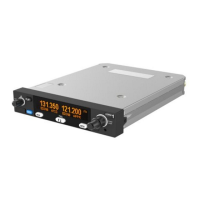
2.1 TY96 and TY97 Description
The TY96 and TY97 VHF radio systems are ED-23C compliant class C (25 kHz offset carrier) and
class H1 and H2 (8.33 kHz offset carrier) VHF radios. The TY96 has a nominal power output of 10
watts, and meets the power output requirements for Class 3 and Class 5. The TY97 has a nominal
power output of 16 watts, and meets the power output requirements for Class 3 and Class 5. The TY96
and TY97 are certified to ETSO 2C169a, 2C128a, TSO C169a and TSO C128a.
The TY96 can be powered from either a 14 volt nominal or 28 volt nominal DC power supply with no
configuration changes required. The TY97 requires a 28 volt nominal DC power supply.
2.2 Interfaces
At the rear, the VHF radio unit has a 25 way D-type connector and single antenna connector for blind
mating with the corresponding connectors in the mounting tray. The 25 way D-type interface provides
the following services:
The TY96 operates on 11 to 33 volts DC. The TY97 operates on 22 to 33
volts DC.
Connects to the aircraft lighting bus and is used to adjust the switch lighting
intensity.
An optional input to allow preloading of frequencies, generally from a GPS.
There are two push to talk inputs corresponding to the two microphones.
For backward compatibility with older installations both microphones can
optionally be gated by a single PTT input.
An optional keyswitch input to enable remote transfer of primary and
secondary frequencies
An optional input to allow the intercom to be switch controlled.
There are two microphone inputs, suitable for conventional aircraft
microphones.
A single connection to allow audio annunciators or ident tones to be routed
to the headphones and speaker.
A two channel music input to allow connection of a stereo audio signal of
1.5Vrms into a 600 ohms load. Audio is routed to the headphones only.
A speaker output suitable for a cabin speaker with impedance of 4 ohms or
greater.
Two stereo headphone outputs suitable for conventional aircraft headsets
with impedance in the region of 150 – 600 ohms.
A mono audio output designed to connect to an aircraft audio panel with an
impedance of 600 ohms.


 To Next Page