SECTION
7:
Special
Repairs
and
Procedures
PTO
HORSE
MODEL
TECHNICAL
MANUAL
Page
7-4
4/90
Note: If necessary. you can
remove the power unit housing
cover to move the gear and clutch
by hand.
8.
Complete the installation
of
the wheel shaft. See Section 5
of
this manual
for
more information.
Identifying a
Bubbled Wheel
Shaft
A wheel shaft
is
bubbled when the
metal around the keyway raises
or
swells slightly. This weakening
of
the metal
is
due to excessive pres-
sure being exerted by the clutch
on the hi-pro key to turn the
wheels. This
is
often caused by
improper shifting
or
by the wheels
striking
an
object that abruptly
cause them to stop turning.
A bubbled wheel shaft should be
discarded and replaced with a new
one.
Testing for a Bubbled
Wheel Shaft
Disconnect the linkage from the
eccentric lever and work the
eccentric lever by hand. If the
lever
is
difficult to move the wheel
shaft may be bubbled.
Tightening the
Castle
Nut
On
the
Wheel Speed Lever
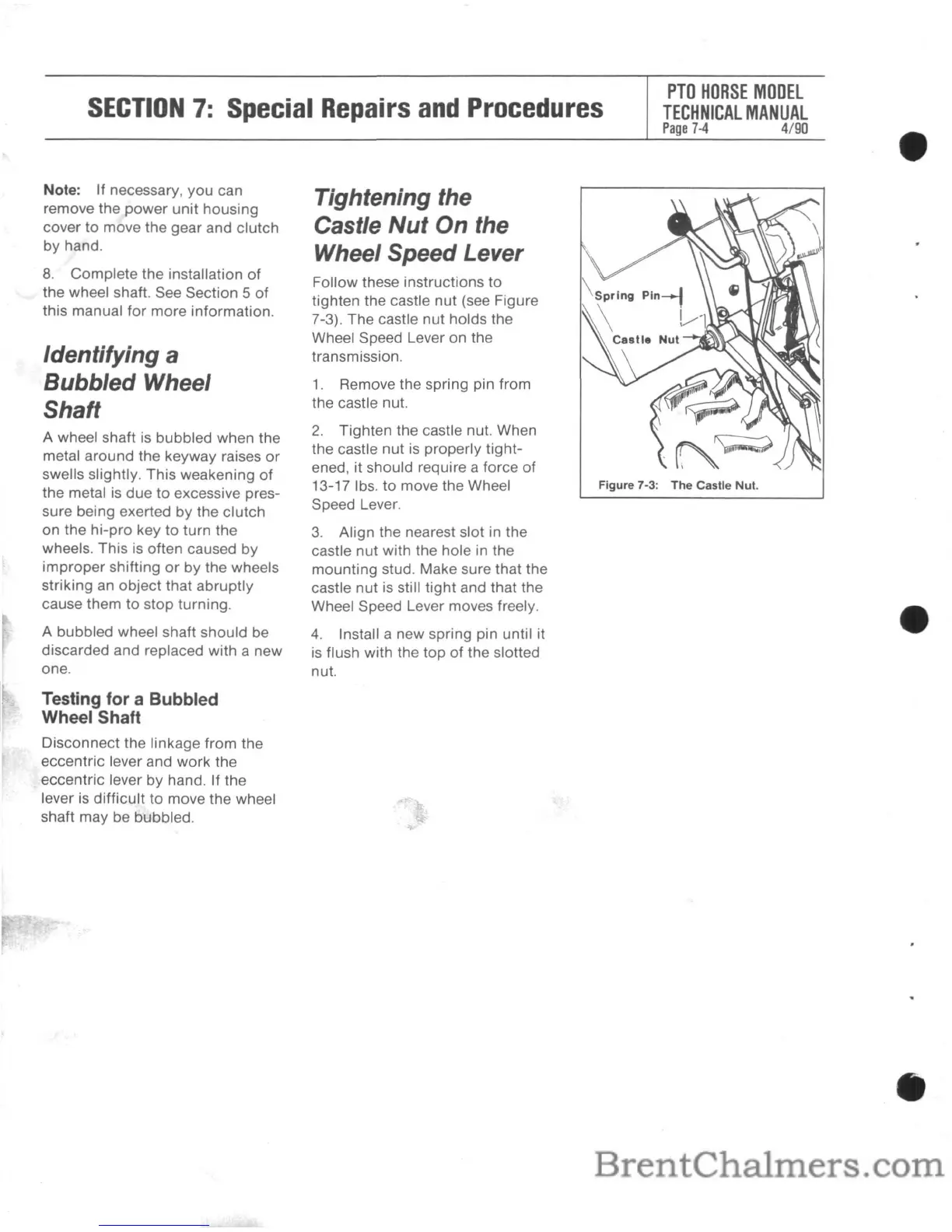
Follow these instructions to
tighten the castle nut (see Figure
7-3). The castle nut holds the
Wheel Speed Lever on the
transmission.
1.
Remove the spring pin from
the castle nut.
2.
Tighten the castle nut. When
the castle nut
is
properly tight-
ened, it should require a force
of
13-17 Ibs. to move the Wheel
Speed Lever.
3.
Align the nearest slot in the
castle nut with the hole in the
mounting stud. Make sure that the
castle nut
is
still tight and that the
Wheel Speed Lever moves freely.
4.
Install a new spring pin until it
is
flush with the top
of
the slotted
nut.
Figure 7-3:
The
Castle Nut.



 To Next Page